
At their core, concrete mixing plant containers deliver significant environmental benefits by fundamentally changing the logistics of concrete production. They reduce energy consumption, lower transportation-related emissions, and minimize on-site waste and pollution through their mobile, self-contained, and highly efficient design.
The primary environmental advantage of a containerized mixing plant is its ability to localize high-quality concrete production, drastically cutting the fuel, emissions, and material waste associated with transporting ready-mix concrete over long distances.
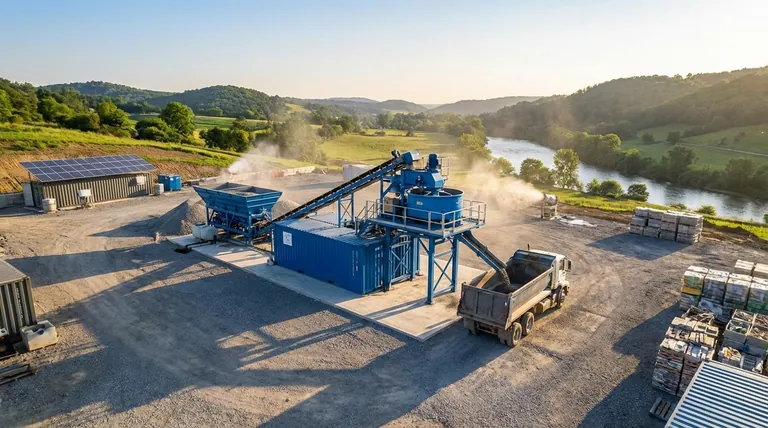
Reducing the Carbon Footprint of Transport
A major source of environmental impact in construction is the transportation of materials. Containerized plants directly address this challenge.
The Impact of Mobility
By bringing the entire mixing plant to the construction site, these containers virtually eliminate the need for a fleet of ready-mix trucks traveling from a distant centralized plant.
This significantly reduces the total vehicle miles required for a project, leading to a direct decrease in fuel consumption.
Lowering Vehicle Emissions
Fewer truck journeys mean a substantial reduction in CO2, NOx, and particulate matter emissions. This is especially beneficial for projects in urban areas where air quality is a primary concern.
Minimizing On-Site Waste and Pollution
The design of a containerized plant is inherently more controlled than traditional on-site mixing or reliance on distant batching plants.
Self-Contained by Design
Because the system is enclosed, it drastically reduces the release of cement dust and other particulates into the air. This improves local air quality and minimizes site contamination.
The contained nature also lowers noise pollution compared to open, on-site mixing operations, making it a better choice for noise-sensitive environments.
Reducing Material Waste
Precision and automation ensure that concrete is produced on-demand and to exact specifications. This eliminates the common problem of over-ordering from a central plant, which often results in wasted concrete.
Enhancing Resource Efficiency Through Precision
Modern containerized plants integrate technology that optimizes the use of raw materials, further boosting their environmental credentials.
Superior Quality Control
Automated and carefully monitored mixing processes ensure a consistent, high-quality product. This reduces the likelihood of bad batches that must be discarded, saving cement, sand, gravel, and water.
Innovations in Sustainability
Many modern units are designed to incorporate more sustainable practices. This includes the ability to effectively use recycled concrete aggregates in new mixes.
Furthermore, advanced systems can include water recycling capabilities, capturing and reusing water during the mixing and washout processes to conserve this critical resource.
Understanding the Trade-offs
While highly beneficial, containerized plants represent a specific solution that must be weighed against other methods, like large-scale centralized plants.
On-Site Efficiency vs. Production Scale
A containerized plant's primary advantage is its on-site efficiency, which minimizes transport and waste for a specific project.
A large, permanent centralized plant may achieve greater economies of scale in pure production and can service multiple projects simultaneously. However, these benefits are often offset by the significant environmental cost of transporting the final product to each site.
The Logistical Calculation
The choice often comes down to project location and scale. For remote infrastructure projects or sites far from a central plant, the environmental case for a containerized unit is overwhelmingly strong.
How to Apply This to Your Project
Choosing the right approach depends entirely on your project's primary constraints and goals.
- If your primary focus is minimizing a project's carbon footprint: A containerized plant is the superior choice due to the drastic reduction in transportation emissions.
- If your primary focus is reducing on-site disruption in an urban area: The low noise, minimal dust, and small footprint of a containerized unit offer clear advantages.
- If your primary focus is material conservation and cost control: The plant's precision mixing reduces waste from over-ordering and rejected batches, directly impacting your bottom line and resource use.
Ultimately, adopting containerized concrete mixing plants is a strategic move toward more efficient, controlled, and environmentally responsible construction.
Summary Table:
| Environmental Benefit | Key Impact |
|---|---|
| Reduced Transport Emissions | Drastically cuts CO2, NOx from fewer truck journeys |
| Minimized On-Site Waste | Precision mixing eliminates over-ordering and material waste |
| Lower Air & Noise Pollution | Enclosed design reduces cement dust and noise |
| Enhanced Resource Efficiency | Supports use of recycled aggregates and water recycling |
Ready to reduce your project's environmental footprint and costs?
GARLWAY specializes in high-efficiency, containerized concrete batching plants designed for construction companies and contractors who value sustainability and on-site control. Our solutions minimize transport emissions, reduce material waste, and deliver precise, high-quality concrete exactly where you need it.
Contact GARLWAY today to discuss how our concrete mixing plants can make your next project greener and more efficient.
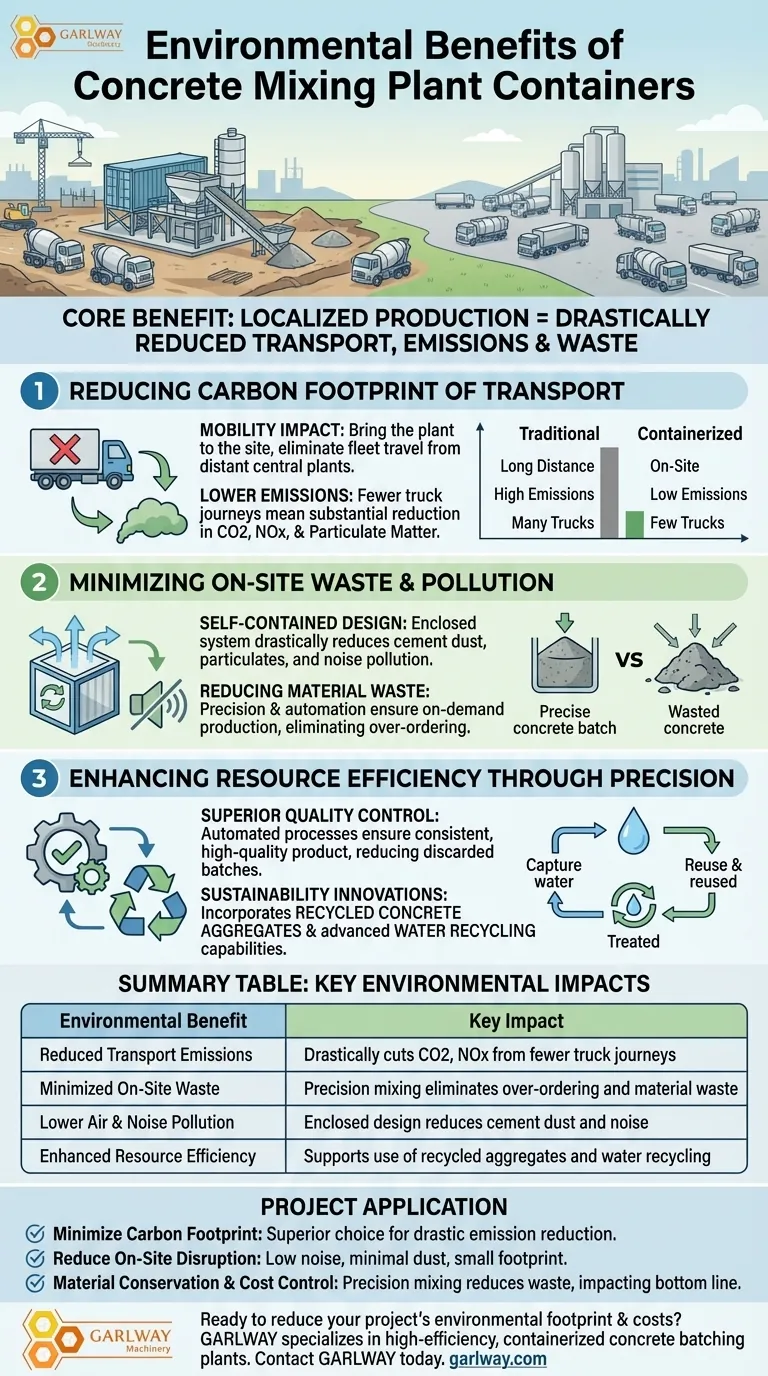
Visual Guide
Related Products
- HZS35 Small Cement Concrete Mixing Batch Plant
- HZS120 Ready Mix Concrete Batching Plant Commercial Mud Cement Mixer
- HZS180 Ready Mix Concrete Plant for Foundations with Sand and Cement
- HZS75 Concrete Batching Plant Cement Mixer Price Concrete Mixer Bunnings Mixing Plant
- Construction Products Concrete Plant Machine Mixing Concrete Mixer
People Also Ask
- Why buy concrete batch plant parts only from the manufacturer? Protect Your Investment and Maximize Uptime
- Why is proper maintenance important for a concrete batch mix plant? Maximize Uptime & Profitability
- What is the advantage of a mobile concrete batching plant? Achieve On-Site Production & Total Control
- What are the advantages and disadvantages of concrete batching plants? Maximize Quality & Efficiency
- What are the two methods of material charging in a concrete mixing station? Single vs. Multiple Charging Explained





