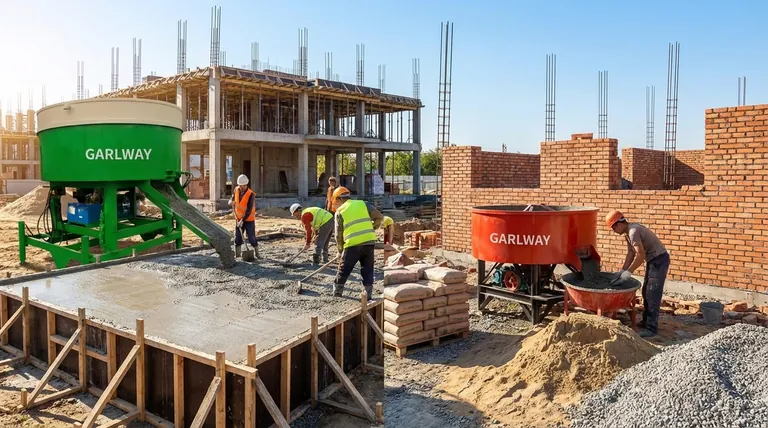
In construction, cement is rarely used alone. Its primary function is to act as a binding agent that, when mixed with water and other materials, creates two of the most essential building composites: concrete and mortar. These materials are then used for virtually all major structural applications, including foundations, beams, walls, and slabs.
The critical takeaway is that cement is not the final product, but the indispensable active ingredient. Its true purpose is to chemically react with water to bind aggregates (like sand and stone) together into the strong, durable materials that form the backbone of modern construction.
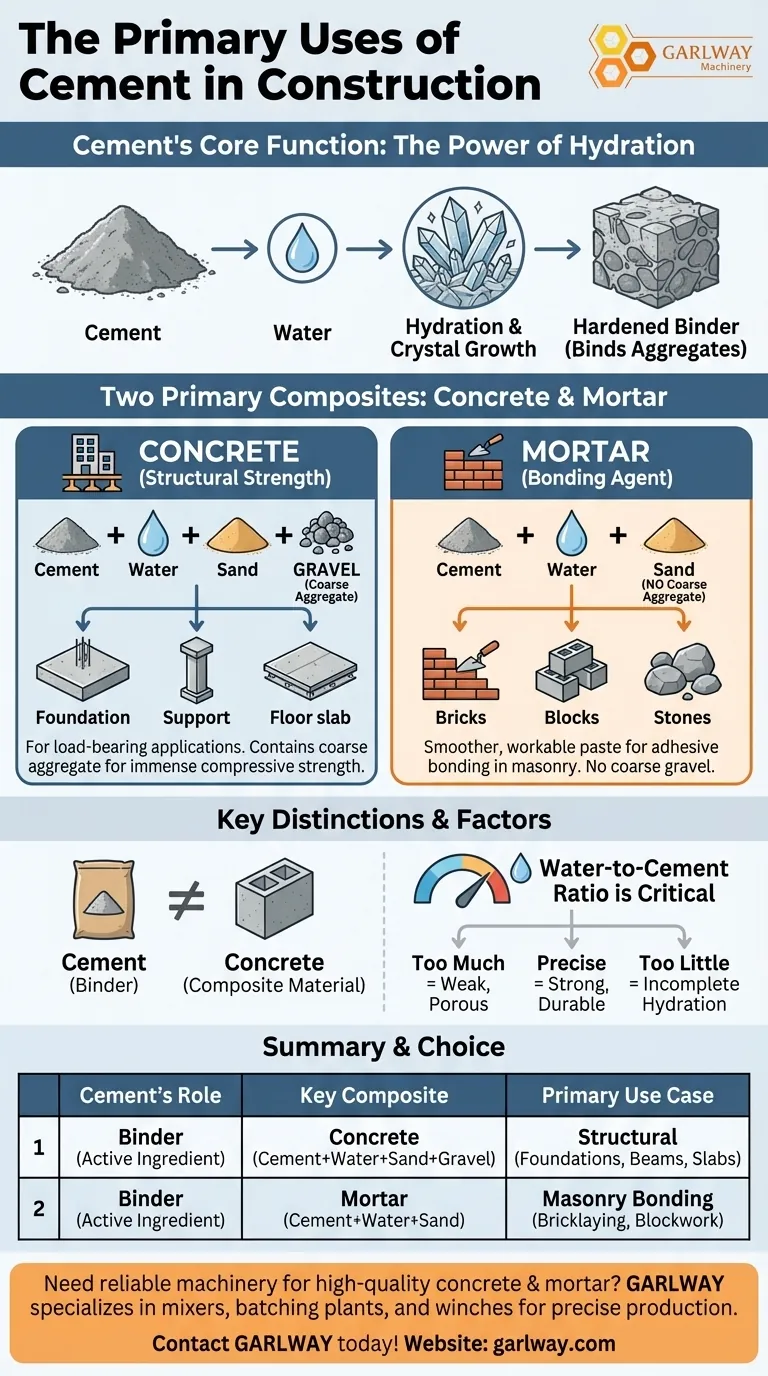
Cement's Core Function: The Power of Hydration
From Powder to Rock-Solid Binder
Cement starts as a very fine powder. Its magic lies in a chemical process that activates when it comes into contact with water.
The Chemical Reaction
This reaction, known as hydration, causes the cement particles to form crystals. These crystals grow and interlock, creating a dense, hardened paste.
The End Result
This hardened paste is what binds inert materials like sand and gravel together, creating a single, solid, and incredibly strong mass. The final strength depends on the proportions of cement, water, and aggregates.
The Two Primary Composites Made from Cement
Cement is the key ingredient in both concrete and mortar, but the final materials serve very different purposes.
Creating Concrete for Structural Strength
Concrete is made by mixing cement, water, sand (fine aggregate), and gravel (coarse aggregate).
The presence of coarse aggregate gives concrete its immense compressive strength, making it ideal for large, load-bearing applications. These include pouring foundations, constructing support columns and beams, and creating durable slabs for floors, sidewalks, and driveways.
Formulating Mortar for Bonding
Mortar is made by mixing cement, water, and sand. Notice the key difference: it does not contain coarse aggregates like gravel.
This makes mortar a much smoother, more workable paste. Its primary use is as an adhesive or "glue" to bond bricks, stones, and concrete blocks together in masonry work. It also fills the gaps between these units, ensuring structural stability.
Understanding the Key Distinction
The Misconception: Cement vs. Concrete
The terms "cement" and "concrete" are often used interchangeably in casual conversation, but in the construction industry, they are fundamentally different.
Cement is the fine, powdered binding agent.
Concrete is the final composite structural material made from cement, water, sand, and gravel. You pour a concrete slab, not a cement slab.
Water is a Critical Factor
The water-to-cement ratio is one of the most critical factors in determining the final strength of the concrete or mortar.
Too much water creates a weaker, more porous final product, while too little prevents the hydration process from completing, also compromising strength. Precision is key for reliable results.
Making the Right Choice for Your Goal
Understanding cement's role as a binder allows you to select the correct composite material for your construction needs.
- If your primary focus is structural integrity (foundations, beams, slabs): You need concrete, where cement binds coarse aggregates to create a high-strength, load-bearing material.
- If your primary focus is masonry bonding (bricklaying, blockwork): You need mortar, where cement binds sand to create a workable paste that acts as an adhesive.
Ultimately, cement's value lies not in what it is, but in what it empowers builders to create.
Summary Table:
| Cement's Role | Key Composite | Primary Use Case |
|---|---|---|
| Binder (Active Ingredient) | Concrete (Cement + Water + Sand + Gravel) | Structural Applications (Foundations, Beams, Slabs) |
| Binder (Active Ingredient) | Mortar (Cement + Water + Sand) | Masonry Bonding (Bricklaying, Blockwork) |
Need reliable machinery to produce high-quality concrete and mortar for your projects? GARLWAY specializes in construction machinery, offering concrete mixers, concrete batching plants, and winches for construction companies and contractors globally. We help you achieve precise mixing and efficient production, ensuring the structural integrity and durability of your builds. Contact GARLWAY today to discuss your equipment needs and enhance your construction capabilities!
Visual Guide
Related Products
- Portable Cement Mixer with Lift Concrete Machine
- Portable Concrete Mixer Machine Equipment for Mixing Concrete
- Portable Ready Mix Concrete Mixer Equipment
- HZS25 Best Cement Mixer for Quick Mix Concrete at Bunnings
- Shaft Mixer Machine for Cement and Regular Concrete Mixing
People Also Ask
- What are the size and portability options for portable cement mixers? Find Your Perfect Match for Any Job
- Why is it necessary to use a portable concrete mixer? Gain Total Control & Efficiency
- How much concrete can you pour with a portable mixer? Find the Perfect Fit for Your Project
- What is a portable cement mixer? Achieve Consistent, On-Demand Concrete Mixing
- What are the power sources for portable cement mixers? Choose the Right Power for Your Job Site