
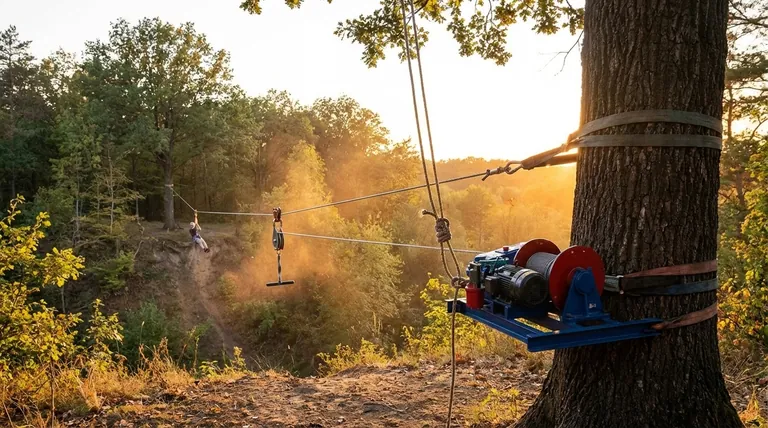
Beyond vehicle recovery, a winch’s power can be repurposed for several creative recreational uses. People have engineered temporary zip lines using snatch blocks, constructed unique swings (or "fling foxes") for children by hoisting ropes over high branches, and set up expansive dog runs by tensioning a cable between two points. These applications leverage the winch's core function—controlled pulling—for temporary, imaginative play structures.
The central idea is to redirect a winch's industrial-grade pulling power from work to play. However, this creative freedom comes with a critical responsibility: understanding the immense forces involved and prioritizing safety above all else, as these tools are not inherently designed for human-rated recreational activities.
The Principle: Repurposing Power for Play
A winch is fundamentally a tool for material lifting and horizontal pulling, widely used in demanding industries like construction, forestry, and mining. Its creative recreational use stems from applying this raw power to new contexts.
From Utility to Recreation
The core function of any winch is to apply controlled, immense force through a cable. While its intended use is for tasks like pulling a vehicle or hoisting materials, the principle remains the same for recreation. The goal is simply to tension a line or lift an object for fun rather than for work.
The Importance of Rigging
These creative uses are rarely possible with the winch alone. Success and safety depend on proper rigging components like snatch blocks (pulleys), tree-saver straps, strong D-ring shackles, and, most importantly, secure and reliable anchor points.
Creative Applications in Practice
With the right setup and a deep respect for safety, a winch can become the centerpiece of temporary outdoor fun.
Constructing a Temporary Zip Line
A winch is ideal for tensioning the main line of a zip line between two solid anchors, such as large, healthy trees. Snatch blocks are then used to create the pulley system that allows a person to ride down the cable. This requires careful calculation of line sag and anchor strength.
Building a "Fling Fox" or Unique Swing
For creating a swing, a winch can be used to precisely place a rope over a high, sturdy tree limb that would otherwise be inaccessible. Once the rope is in place, the winch is removed from the system, and a swing is attached for use.
Setting Up an Expansive Dog Run
A simpler and lower-risk application is creating a long dog run. The winch can tension a steel cable between two posts or trees, and the dog's leash can be attached to a pulley that runs along this cable. This gives the dog freedom to roam over a large area without the risk of wandering off.
Understanding the Critical Trade-offs
Using a tool outside its primary design parameters introduces significant risks that must be understood and respected.
Designed for Material, Not People
Most vehicle-mounted and utility winches are not rated for lifting or suspending humans. Their safety factors, brake mechanisms, and cable types are designed for pulling static, non-human loads. Using them for applications like a zip line places a person's safety on a tool not certified for that task.
The High Consequence of Failure
The forces involved in tensioning a line for a zip line are enormous. A failure in the winch, the cable, an anchor point, or any piece of rigging can be catastrophic. Unlike vehicle recovery, where failure might mean property damage, failure in a recreational setup can lead to severe injury or death.
The Necessity of Expert Knowledge
These projects are not for beginners. Safely executing them requires a deep and practical understanding of physics, load calculations, anchor system integrity, and advanced rigging principles. Misjudging the force on an anchor point could cause it to fail with explosive force.
Making the Right Choice for Your Goal
Before attempting any recreational winch project, evaluate your goal and your expertise with radical honesty.
- If your primary focus is simple, low-risk fun: Consider applications that do not involve suspending people, such as creating a tensioned line for a dog run or a slackline.
- If your goal is a zip line or human swing: Recognize that this is an advanced, high-risk application where purpose-built, professionally rated recreational equipment is always the safer and recommended choice.
By understanding both the winch's immense power and its inherent limitations, you can explore its creative potential responsibly.
Summary Table:
| Application | Key Function | Primary Risk Level |
|---|---|---|
| Temporary Zip Line | Tensioning the main cable | High (Human Suspension) |
| 'Fling Fox' Swing | Hoisting rope over high branches | High (Human Suspension) |
| Expansive Dog Run | Tensioning a cable between anchors | Low (No Human Load) |
Unlock the Full Potential of Your Equipment with GARLWAY
Whether you're a construction professional relying on winches for heavy lifting or a contractor needing durable concrete mixers and batching plants, GARLWAY provides the industrial-grade power and reliability you require. Our machinery is engineered for demanding applications, ensuring safety and performance where it matters most.
Let us help you build with confidence. Contact our experts today to find the perfect solution for your project's needs.
Visual Guide
Related Products
- Warn Winch Windlass Boat Trailer Winch
- Electric and Hydraulic Winch for Heavy Duty Applications
- Small Electric Winch 120V and 240V for Compact Applications
- Quick Windlass Portable Winch for Truck and Boat Best Boat Winch
- Hydraulic Winding Engine Harbor Freight Winch
People Also Ask
- What are the main components of a boat trailer winch? A Guide to Safe & Efficient Boat Loading
- What factors should be considered when choosing a boat trailer winch? Ensure Safe and Effortless Boat Loading
- What is the purpose of boat trailer winches? Safely and Efficiently Load Your Boat
- What are the two main types of boat trailer winches? Manual vs. Electric Explained
- How often should a boat trailer winch be replaced? Your Guide to Safety and Longevity





