
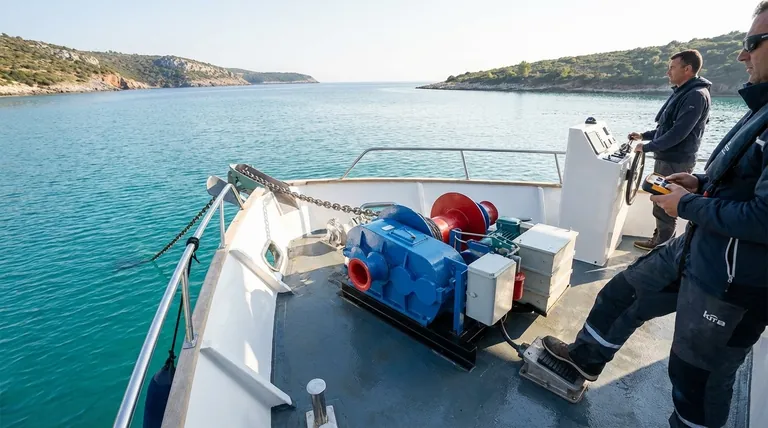
At its core, Quick windlasses are operated through two primary methods: deck-mounted footswitches for hands-free control at the bow, and wireless remote controls that provide the flexibility to manage the anchor from anywhere on the vessel. These options allow for secure and convenient anchoring tailored to your specific needs and boating style.
The choice between windlass controls is not just about convenience; it's about determining where you need command of your anchor. The decision hinges on whether you prioritize robust, fixed-point operation at the bow or the flexibility to anchor from the helm.
The Primary Control Methods Explained
Understanding how each control method functions is key to outfitting your vessel for safe and efficient anchoring. Both footswitches and wireless remotes are designed for the harsh marine environment but serve distinct operational purposes.
Footswitches: Hands-Free Control at the Bow
Footswitches are heavy-duty, weather-resistant buttons mounted directly onto the deck, typically near the windlass itself. They are a hardwired solution, connected directly to the windlass control circuit.
Operation is simple and intuitive, with separate buttons for deploying (down) and retrieving (up) the anchor. Their primary advantage is enabling hands-free operation, allowing you to guide the anchor line or chain while controlling the windlass with your foot.
Wireless Remote Controls: Ultimate Flexibility
A wireless remote control system untethers you from a fixed position. It consists of a handheld transmitter and a receiver wired to the windlass.
This allows the operator to raise or lower the anchor from any location within range, most commonly the helm. This flexibility is invaluable for single-handed boaters or for situations where visibility from the bow is limited, as it allows you to control the anchor while also managing the boat's position and throttle.
Understanding the Trade-offs
Neither solution is universally superior; they represent a trade-off between simplicity and flexibility. The best choice depends entirely on your boat and how you use it.
The Simplicity and Reliability of Footswitches
Because footswitches are a hardwired component, they are exceptionally reliable. There are no batteries to replace and no risk of signal loss.
However, their fixed location is their primary limitation. You must be physically present at the bow to operate the windlass, which can be challenging in rough seas or when maneuvering in a crowded anchorage.
The Convenience vs. Complexity of Wireless Remotes
The convenience of a wireless remote is unmatched, providing full control from the safety of the cockpit or flybridge. This enhances situational awareness and safety.
The trade-offs are the introduction of potential failure points: the remote requires batteries, it can be dropped overboard, and in very rare cases, it could experience signal interference.
Making the Right Choice for Your Vessel
Selecting the appropriate control system enhances the safety and ease of one of your most critical boating operations. Your choice should be a direct reflection of your anchoring needs.
- If your primary focus is maximum reliability at the bow: Hardwired footswitches offer a robust, simple, and failsafe solution for direct anchor management.
- If your primary focus is single-handed operation or control from the helm: A wireless remote is essential, providing the flexibility to manage anchoring while maneuvering the vessel.
- If your primary focus is comprehensive safety and redundancy: The ideal configuration for many boaters is to install both systems, ensuring you have backup control and the right tool for any situation.
Equipping your vessel with the right control method transforms anchoring from a chore into a seamless and confident process.
Summary Table:
| Control Method | Primary Function | Best For | Key Consideration |
|---|---|---|---|
| Footswitches | Hands-free, hardwired control at the bow | Maximum reliability, direct anchor management | Requires operator to be at the bow |
| Wireless Remote | Untethered control from anywhere on deck | Single-handed operation, control from the helm | Requires batteries, potential for signal loss |
| Both Systems | Provides full redundancy and flexibility | Comprehensive safety for any anchoring situation | Higher initial installation cost |
Anchor with Confidence Using GARLWAY Marine Equipment
Choosing the right control system is crucial for safe and efficient anchoring. As a leading supplier of robust marine and construction machinery, GARLWAY understands the importance of reliable performance in demanding environments. Whether you operate a commercial vessel or a private yacht, we provide durable solutions built to last.
Let us help you equip your vessel for success. Contact our experts today to discuss your specific needs and find the perfect windlass control system for seamless operation.
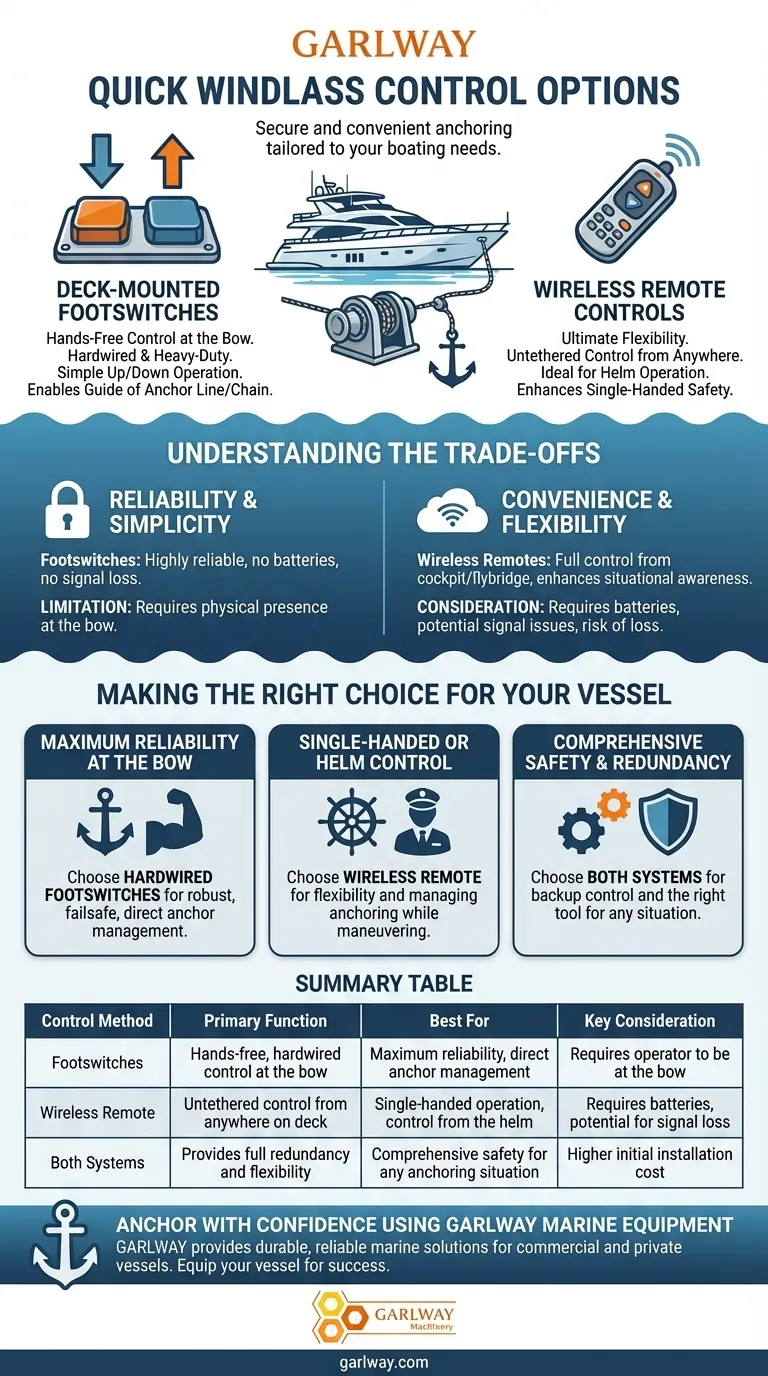
Visual Guide
Related Products
- Quick Windlass Portable Winch for Truck and Boat Best Boat Winch
- Electric Hoist Winch Boat Anchor Windlass for Marine Applications
- Warn Winch Windlass Boat Trailer Winch
- Heavy Duty Electric Boat Winch Windlass Anchor
- 12000 lb Electric Boat Trailer Winch with Windlass Anchor Warn
People Also Ask
- What features were incorporated into the upgraded portable winch system? Boost Your Recovery Power & Safety
- What are some uses mentioned for portable winches beyond vehicle recovery? Essential Versatility for Property & Work
- How could the twisting issue with a portable winch be mitigated? Achieve Safe, Centered Pulls with Proper Rigging
- What are the primary uses of a portable winch for a truck? Boost Your Truck's Capability and Self-Reliance
- What is the single rope traction force of the quick winch without a pulley block? 0.5 to 40 Tons Explained


