
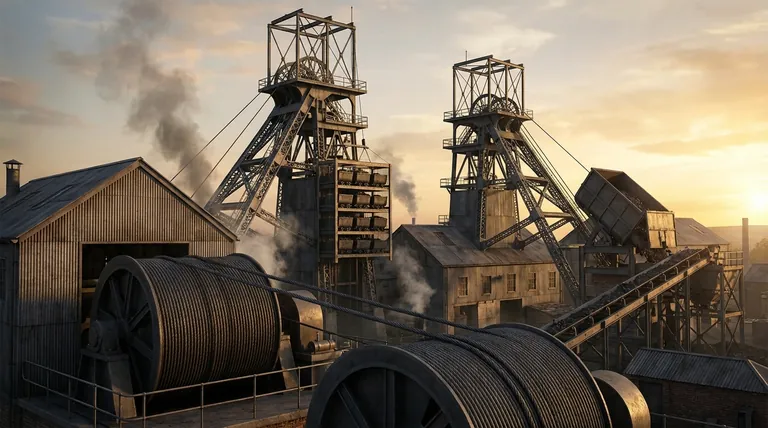
In British coal mining, the predominant method for hoisting materials to the surface is cage winding. This system functions like a heavy-duty elevator, using a "cage" to lift entire mine cars, or tubs, filled with coal through the mine shaft.
The choice of a winding system is a fundamental engineering decision, balancing the need for operational versatility against the demand for maximum mineral output. Cage winding prioritizes flexibility, which is why it has remained the standard in many British mines.
The Fundamental Role of Winding in Mining
Defining the Hoisting Operation
Winding is the critical process of transporting minerals, materials, and personnel between the underground workings and the surface. It is the vertical logistics backbone of any deep mining operation.
The winding system, consisting of a winder engine, ropes, and conveyances, dictates the ultimate production capacity of the mine shaft.
The Two Primary Systems
Virtually all modern mine winding operations rely on one of two methods: cage winding or skip winding.
While both lift material, their core mechanics and operational philosophies are fundamentally different, leading to distinct advantages and disadvantages.
A Closer Look at Cage Winding
The Mechanics of the System
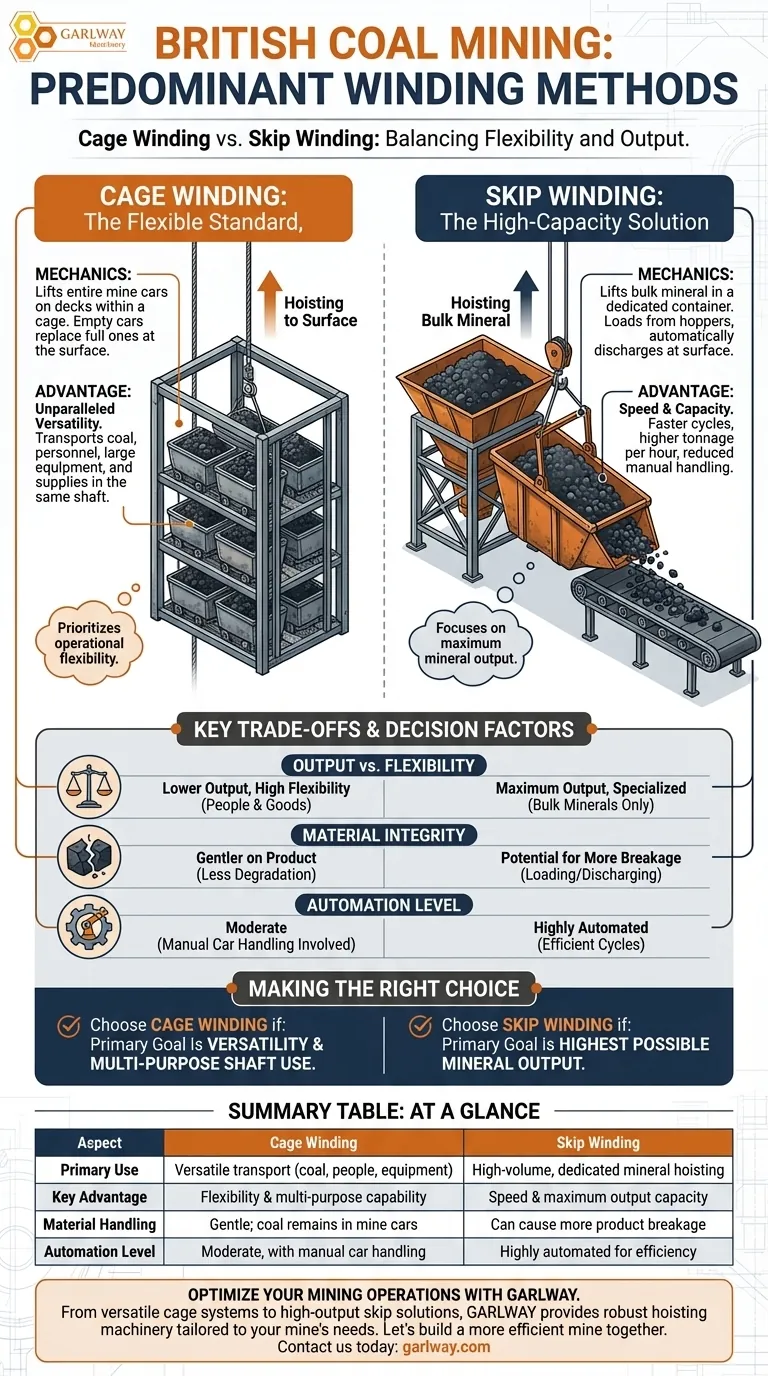
In cage winding, one or more decks are built into a steel frame, or cage. Mine cars are pushed onto these decks at the bottom of the shaft.
The cage is then hoisted to the surface, where the full cars are removed and replaced with empty ones to be sent back down.
The Primary Advantage: Versatility
The key strength of cage winding is its unparalleled flexibility. The same system can be used to transport coal-filled tubs, miners, large pieces of equipment, and supplies without modification.
This multi-purpose capability is invaluable in mines with complex logistical needs or where a single shaft must serve all functions.
Understanding the Alternative: Skip Winding
A Focus on Bulk Material Handling
Skip winding is a more specialized, high-capacity system. Instead of lifting mine cars, a large container called a "skip" is loaded directly with the mined mineral from a measuring flask or hopper at the shaft bottom.
At the surface, the skip automatically tips to discharge its contents onto a conveyor system.
The Primary Advantage: Speed and Capacity
By eliminating the manual handling of individual mine cars, skip winding achieves significantly faster loading and unloading cycles.
This allows for much higher tonnage to be moved per hour, making it the preferred method for modern, high-production mines focused exclusively on output.
Key Trade-offs: Cage vs. Skip
Output vs. Flexibility
This is the central dilemma. Skip winding offers maximum speed and tonnage but is highly specialized for moving bulk minerals.
Cage winding has a lower output capacity but offers the critical flexibility to move people and equipment in the same shaft. Many older British mines were designed around this need for versatility.
Material Integrity
Cage winding is gentler on the product. Coal remains in the mine car throughout its journey, minimizing degradation.
The process of loading and discharging a skip can cause more breakage, which can be a significant issue for friable, high-value coal.
Infrastructure and Automation
Skip winding systems are more easily automated, reducing labor requirements at the top and bottom of the shaft.
Cage winding typically involves more manual maneuvering of mine cars, though modern systems have incorporated a high degree of automation as well.
Making the Right Choice for Your Goal
The selection of a winding system is dictated by the mine's primary operational goal.
- If your primary focus is versatility and multi-purpose shaft use: Cage winding is the superior choice, allowing for the movement of personnel, materials, and minerals.
- If your primary focus is achieving the highest possible mineral output: Skip winding is the more efficient and productive system for dedicated, high-volume operations.
Ultimately, understanding these core trade-offs allows engineers to select the system that best aligns with the mine's specific economic and logistical objectives.
Summary Table:
| Aspect | Cage Winding | Skip Winding |
|---|---|---|
| Primary Use | Versatile transport of coal, people, and equipment | High-volume, dedicated mineral hoisting |
| Key Advantage | Flexibility and multi-purpose capability | Speed and maximum output capacity |
| Material Handling | Gentle; coal remains in mine cars | Can cause more product breakage |
| Automation Level | Moderate, with manual car handling | Highly automated for efficiency |
Optimize Your Mining Operations with GARLWAY
Choosing the right winding system is critical for your mine's efficiency and profitability. At GARLWAY, we specialize in providing robust construction machinery, including advanced winches and hoisting solutions tailored for the demanding environments of coal mining.
Whether you require the versatility of a cage winding system or the high-output capacity of a skip system, our engineering expertise ensures you get a solution that maximizes your operational goals.
Let's build a more efficient mine together. Contact our experts today to discuss your specific winding needs and discover how GARLWAY can enhance your productivity.
Visual Guide
Related Products
People Also Ask
- What role does hydraulic fluid play in hydraulic winches? It's the Lifeblood of Your Heavy-Duty Pulling Power
- What vehicles commonly use hydraulic winches? For Industrial Trucks Needing Unmatched Power
- What are the features of hydraulic winches? Unmatched Power and Continuous Duty for Heavy Loads
- What preventive measures can be taken to avoid oil leakage in hydraulic winches? Ensure Long-Term Reliability
- What does 'power out' mean in a hydraulic winch? Achieve Absolute Control When Lowering Heavy Loads
