
At their core, paddle industrial mixers are used for the gentle, low-shear blending of solids, slurries, and sludges. They excel in applications where materials are heavy, abrasive, or fragile, making them essential in industries like construction materials manufacturing, mineral processing, and specialty chemical production.
The key to understanding a paddle mixer's purpose is not just what it mixes, but how it mixes. Its design is for gentle, convective blending, making it the ideal choice when you need to thoroughly combine materials without degrading their physical structure.
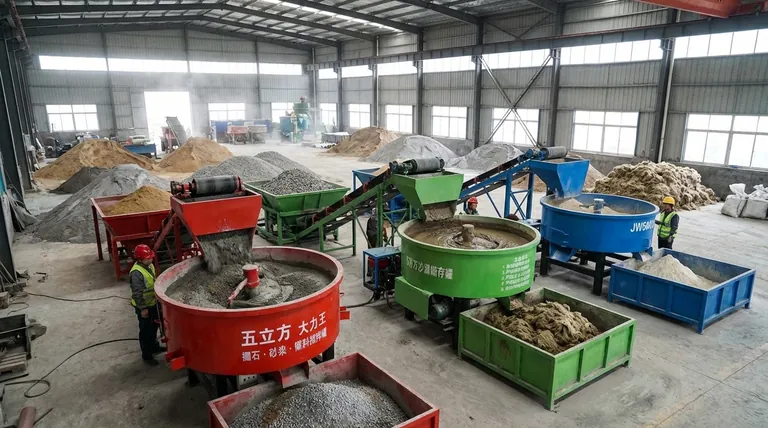
How Paddle Mixers Achieve a Gentle Blend
Paddle mixers fall into a category known as convection mixers. Unlike mixers that use high-speed force, their effectiveness comes from the physical movement and folding of the material.
The Convective Mixing Mechanism
The mixer uses large, angled paddles that rotate at a relatively low speed. These paddles scoop, lift, and tumble the material from the bottom of the trough to the top.
This action creates a gentle but thorough mixing pattern, ensuring different components are consistently folded into one another.
Preserving Particle Integrity
The primary advantage of this low-speed, low-shear action is that it preserves the size and shape of the particles being mixed.
This is critical when working with fragile crystals, abrasive minerals, or fibrous materials that would be damaged or pulverized by more aggressive mixing methods.
Ideal for Heavy or Viscous Materials
The large surface area and powerful scooping motion of the paddles are highly effective for moving heavy, dense, or viscous substances.
They can efficiently blend thick slurries, dense powders, and sludges that would stall or be ineffectively mixed by other types of equipment.
Key Industries and Use Cases
The unique mixing action of paddle mixers makes them indispensable in several specific industrial applications where material integrity is paramount.
Construction and Building Materials
Paddle mixers are frequently used to produce concrete, mortar, stucco, and other cementitious products. They ensure aggregates are evenly distributed throughout the binder without crushing or breaking them down.
Mineral Processing
In the mining and minerals industry, these mixers are used to blend different grades of mineral powders or to create slurries for further processing. The gentle action prevents unwanted changes in particle size distribution.
Specialty Chemical Production
For sensitive applications like blending explosive powders or certain fertilizers, the low-friction, gentle action of a paddle mixer is a critical safety and quality feature. It minimizes heat generation and the risk of ignition.
Sludge and Slurry Management
Industries from wastewater treatment to chemical manufacturing use paddle mixers to keep solids suspended within a liquid, preventing settling and ensuring a consistent mixture over time.
Understanding the Trade-offs
While highly effective for their intended purpose, paddle mixers are not a universal solution. Choosing the wrong mixer can lead to poor product quality and process inefficiency.
Low Shear vs. High Shear
A paddle mixer is fundamentally a low-shear device. It is entirely unsuitable for processes that require creating fine emulsions or deagglomerating and dispersing powders into a liquid.
For those applications, a high-shear mixer, which uses high-speed impellers to break down particles, is the correct tool.
Limitations with Trace Ingredients
While effective for bulk blending, achieving a perfectly homogenous mixture of a very small amount of a key ingredient (a trace ingredient) can be challenging. The convective folding action may not be sufficient for perfect micro-level distribution.
Making the Right Choice for Your Process
Your decision should be based on the physical properties of your materials and your desired end state.
- If your primary focus is blending heavy sludges, slurries, or dense powders without breaking them down: The powerful, scooping action of a paddle mixer is the correct choice.
- If your primary focus is mixing fragile or abrasive solids where particle integrity is non-negotiable: The gentle, low-shear nature of a paddle mixer is ideal.
- If your primary focus is creating an emulsion or dispersing fine powders that require particle size reduction: You must select a high-shear mixer instead of a paddle mixer.
Ultimately, matching the mixer's mechanical action to your material's specific needs is the key to an efficient and successful process.
Summary Table:
| Key Attribute | Benefit | Ideal For |
|---|---|---|
| Gentle, Low-Shear Action | Preserves particle integrity; prevents material degradation. | Fragile crystals, abrasive minerals, fibrous materials. |
| Convective Blending | Thoroughly folds and mixes materials without high-speed force. | Heavy powders, dense slurries, viscous sludges. |
| Powerful Scooping Motion | Efficiently moves heavy, dense substances that stall other mixers. | Concrete, mortar, mineral powders, wastewater sludge. |
Need a Reliable Mixer for Your Demanding Materials?
If you're blending heavy sludges, abrasive minerals, or fragile materials where preserving particle integrity is critical, you need the right equipment. GARLWAY specializes in robust construction machinery, including industrial mixers designed for tough applications.
We help construction companies and contractors globally achieve consistent, high-quality blends by providing:
- Durable Paddle Mixers built to handle abrasive and viscous materials.
- Expert Guidance to select the perfect mixer for your specific process needs.
- Full Range of Support including concrete batching plants and mixers for a complete solution.
Let's discuss your project requirements. Contact GARLWAY today for a consultation and discover how our machinery can enhance your operational efficiency and product quality.
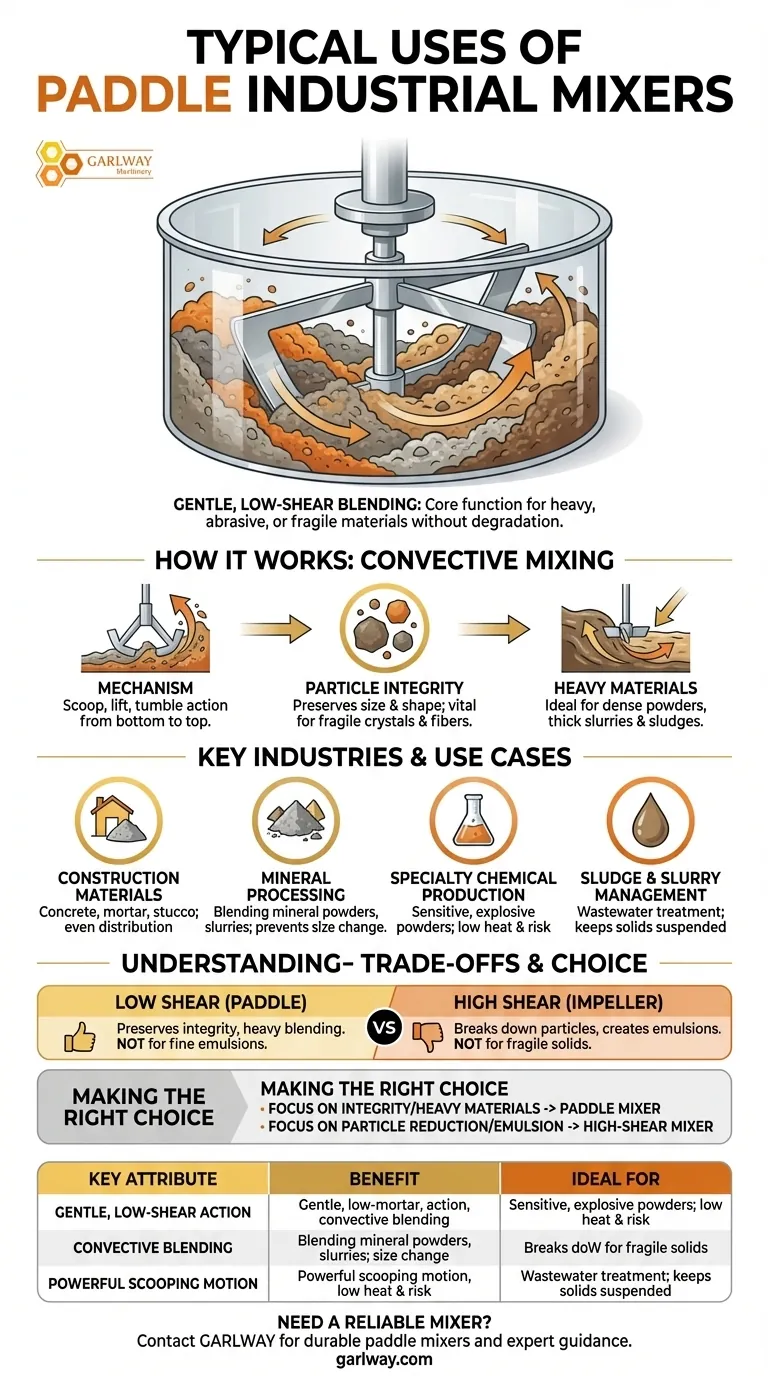
Visual Guide
Related Products
- JZC1000 Industrial Concrete Mixer Machine Cement Mixer Price
- Portable Concrete Mixer Machine Equipment for Mixing Concrete
- Portable Cement Mixer with Lift Concrete Machine
- Skid Steer Self Loading Concrete Mixers for Construction
- Portable Ready Mix Concrete Mixer Equipment
People Also Ask
- How are industrial mixers used in the construction industry? The Foundation of Strong, Durable Structures
- What are the three main categories of industrial concrete mixers? Choose the Right Mixer for Your Plant
- What types of materials can be processed in these mixers? Match Your Material to the Perfect Mixer
- Why are industrial mixers important in mining and mineral processing? Maximize Recovery & Ensure Safety
- How are industrial mixers used in the pulp and paper industry? Ensure Consistent, High-Quality Pulp


