In short, manual winches typically offer three gear ratios for distinct tasks. A 1:1 ratio is used for rapidly winding up slack line, a 3:1 ratio provides a balance of speed and power for lighter boats, and a 5:1 ratio (or higher) delivers the necessary mechanical advantage to pull heavy boats completely onto a trailer.
The gear ratio of a manual winch is the fundamental trade-off between power and speed. A higher ratio number (like 5:1) makes cranking easier but slower, while a lower ratio (like 1:1) is faster but requires significantly more physical effort.
The Principle of Mechanical Advantage
A manual winch is a simple machine designed to multiply force. The gear ratio is the core of how it achieves this, allowing a person to move a load that would otherwise be impossible to handle by hand.
What the Ratio Number Means
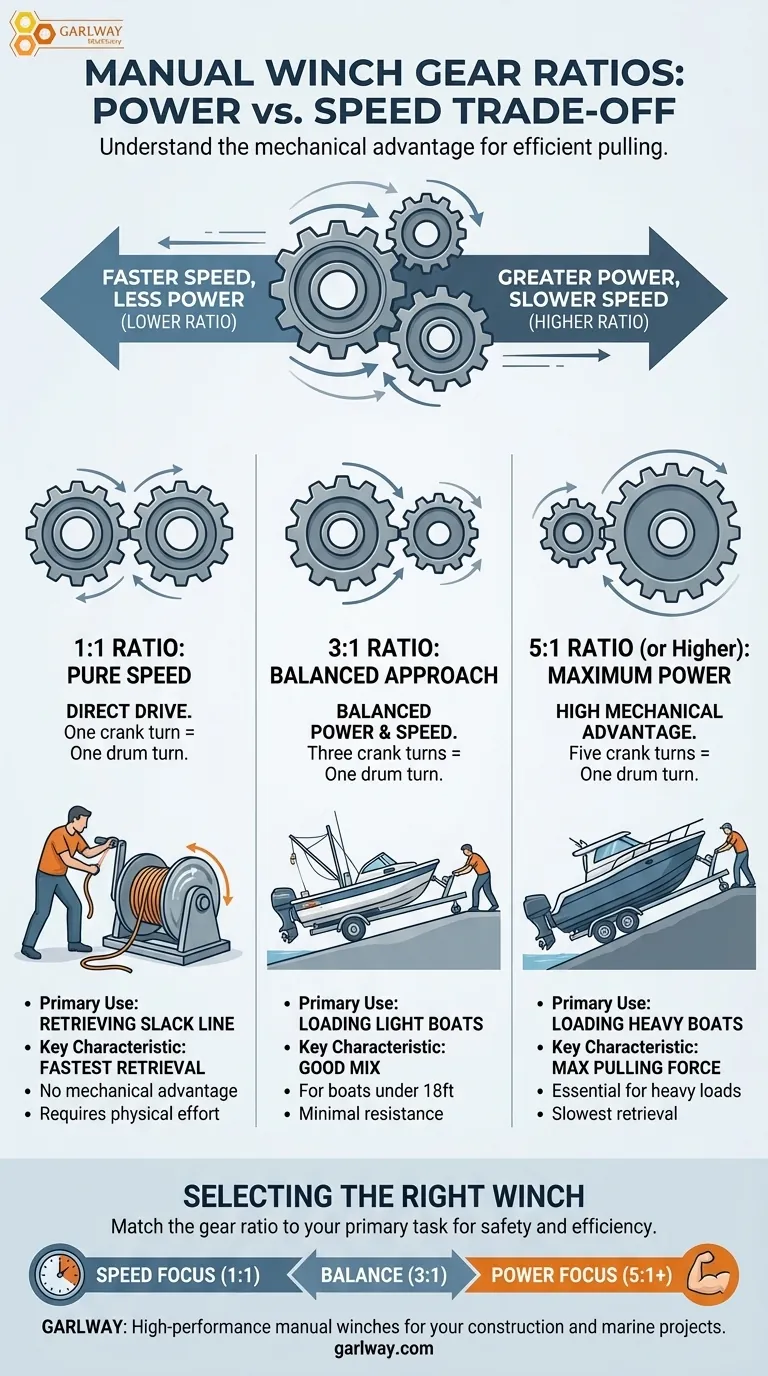
The gear ratio, expressed as X:1, tells you how many times you must turn the crank handle for the winch drum to make one full revolution.
For a 5:1 ratio, you turn the crank five times to make the drum rotate once. This translates your faster, lower-force cranking into a slower, higher-force pull.
The Inverse Relationship: Power vs. Speed
The two key outcomes of a gear ratio—power and speed—are inversely related. You cannot have more of one without sacrificing the other.
A high gear ratio (e.g., 5:1) gives you high mechanical advantage. This makes it easier to pull heavy loads but results in a slow retrieval speed.
A low gear ratio (e.g., 1:1) provides no mechanical advantage. This allows for very fast retrieval but requires you to apply all the force yourself.
Key Components That Make It Work
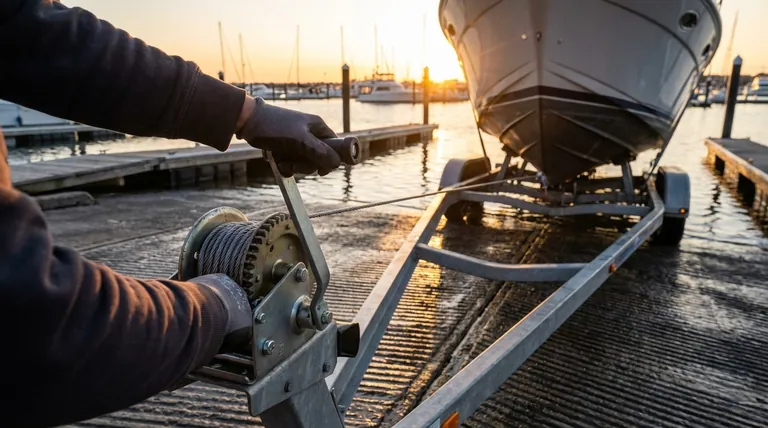
This mechanical advantage is created by the interaction of a few core components. The crank handle provides the input force, which is then multiplied by the gear train before being transferred to the cylindrical drum that winds the cable or rope.
Matching the Gear Ratio to the Task
Choosing the right winch means matching its gear ratio to the primary job it will perform. The most common application for these ratios is loading a boat onto a trailer.
The 1:1 Ratio: Pure Speed
This is a direct-drive ratio. One turn of the handle equals one turn of the drum.
It offers no mechanical advantage and is used almost exclusively for retrieving slack line quickly after the boat has been launched and the cable is loose.
The 3:1 Ratio: A Balanced Approach
This ratio provides a moderate amount of mechanical advantage, making it a good all-around choice.
It's typically suited for pulling smaller, lighter boats (often under 18 feet) onto a trailer where minimal resistance is expected.
The 5:1 Ratio (and Higher): Maximum Power
When you need significant pulling power, a ratio of 5:1 or higher is essential. This is the workhorse for heavier boats or for pulling any boat up a steep launch ramp.
The increased mechanical advantage means you exert far less effort, but you must crank many more times to get the boat fully loaded.
Understanding the Trade-offs
While the concept is simple, the practical implications of your choice are significant. Misunderstanding the trade-offs is the most common pitfall.
The Cost of Power is Time
A winch with a high gear ratio makes pulling a heavy load feel easy, but the process will be slow. If speed is a priority and your load is light, a high-ratio winch can be frustrating.
The Cost of Speed is Effort
Conversely, trying to use a low-ratio winch (like 3:1) for a load that is too heavy will be physically exhausting and potentially unsafe. You may find you lack the strength to even turn the crank.
Considering Dual-Speed Winches
Some higher-capacity manual winches solve this problem by offering two speeds. They typically have a high-speed, low-power ratio (like 3:1) and a low-speed, high-power ratio (like 10:1 or more) that you can switch between, giving you flexibility for different stages of the task.
Making the Right Choice for Your Goal
To select the correct winch, clearly define its primary purpose.
- If your primary focus is retrieving slack line quickly: A simple 1:1 ratio winch is the most efficient tool.
- If your primary focus is loading a lightweight boat on a level ramp: A 3:1 ratio provides a good balance of speed and manageable effort.
- If your primary focus is loading a heavy boat or pulling up a steep incline: A 5:1 ratio or higher is non-negotiable for safety and ease of use.
Ultimately, understanding the gear ratio empowers you to choose a tool that works with you, not against you.
Summary Table:
| Gear Ratio | Primary Use | Best For | Key Characteristic |
|---|---|---|---|
| 1:1 | Retrieving Slack Line | Speed | Fastest retrieval, no mechanical advantage |
| 3:1 | Loading Light Boats | Balance | Good mix of speed and power for smaller boats |
| 5:1 (or higher) | Loading Heavy Boats | Power | Maximum pulling force, slowest retrieval |
Need a reliable winch for your construction or marine project? GARLWAY specializes in high-performance construction machinery, including durable manual and electric winches designed for contractors and construction companies worldwide. Our winches deliver the precise power and control you need to handle heavy loads safely and efficiently. Contact GARLWAY today to find the perfect winch solution for your business!
Visual Guide
Related Products
- Quick Windlass Portable Winch for Truck and Boat Best Boat Winch
- Portable Small Trailer Winch
- Electric and Hydraulic Winch for Heavy Duty Applications
- Small Electric Winch 120V and 240V for Compact Applications
- Hydraulic Winding Engine Harbor Freight Winch
People Also Ask
- What features were incorporated into the upgraded portable winch system? Boost Your Recovery Power & Safety
- What are some uses mentioned for portable winches beyond vehicle recovery? Essential Versatility for Property & Work
- How could the twisting issue with a portable winch be mitigated? Achieve Safe, Centered Pulls with Proper Rigging
- What are the primary uses of a portable winch for a truck? Boost Your Truck's Capability and Self-Reliance
- What is the single rope traction force of the quick winch without a pulley block? 0.5 to 40 Tons Explained