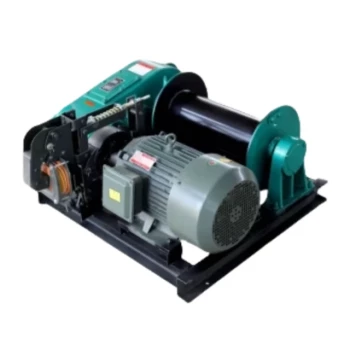
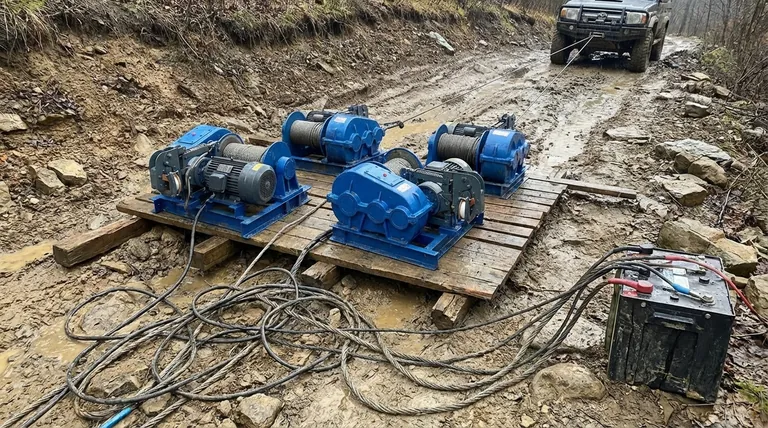
The primary issues with a portable winch setup are mechanical instability, power supply limitations, and complex cable management. Unlike permanently mounted winches, portable units can twist or rotate under an off-center load, and they require a robust, independent power source without the benefit of a vehicle's running alternator.
The core challenge is that the flexibility of a portable winch comes at the cost of stability and reliable power. Successfully using one requires a deliberate approach to mitigate these inherent risks before every use.
The Three Core Challenges of Portable Winches
Understanding the specific failure points of a portable winch system is the first step toward using one safely and effectively. These challenges are fundamentally different from those of a traditional, vehicle-mounted setup.
Mechanical Instability and Twisting
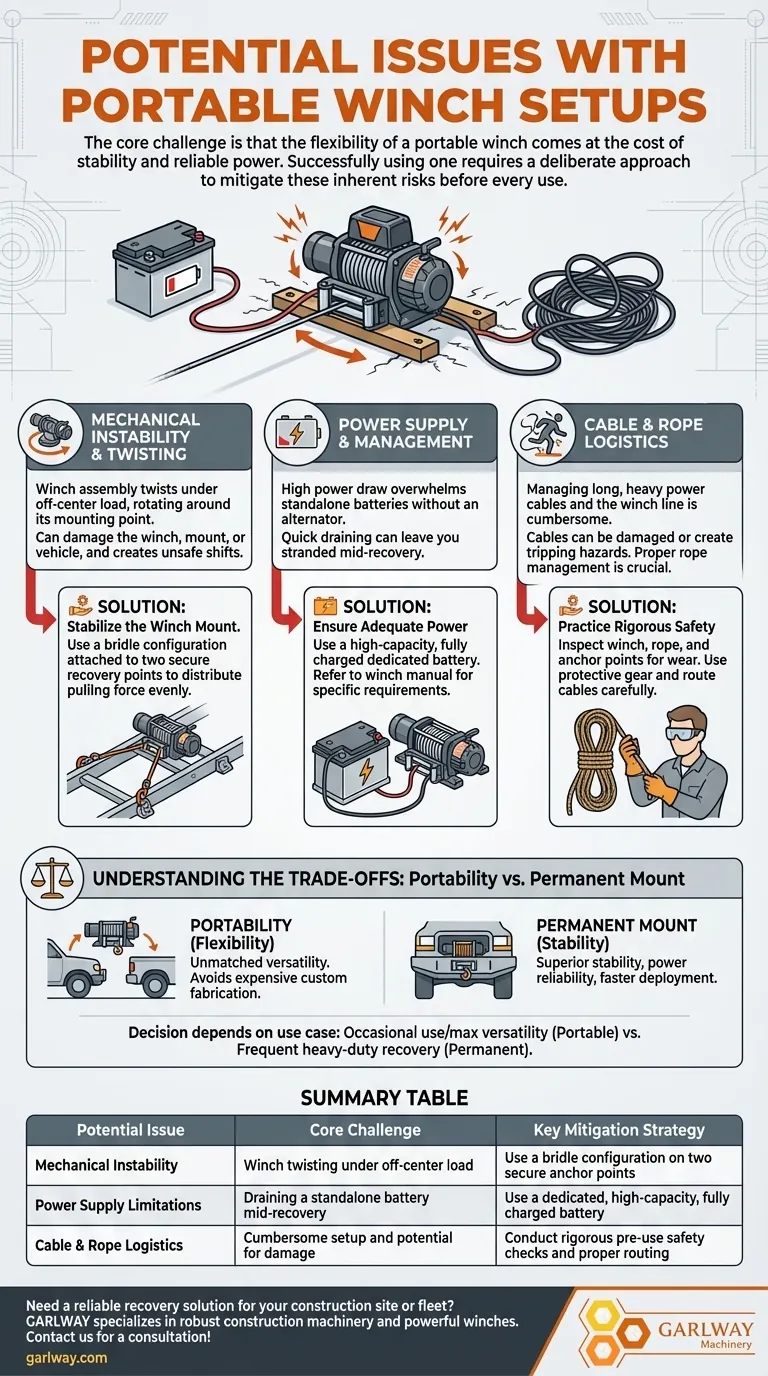
The most significant risk is the winch assembly twisting during a pull. This happens when the pulling force isn't perfectly centered, causing the entire unit to rotate around its mounting point.
This rotation can damage the winch, the mounting plate, or the vehicle itself. More critically, it can create an unsafe situation if the winch line suddenly shifts or the anchor point fails.
Power Supply and Management
A powerful winch has a very high power draw, which can easily overwhelm a standalone battery. Without a vehicle's alternator constantly replenishing the charge, the battery can be drained quickly, potentially leaving you stranded mid-recovery.
This requires careful planning to ensure your power source is fully charged and capable of handling the significant amperage required by the winch under load.
Cable and Rope Logistics
A portable system involves managing long, heavy power cables and the winch line itself. These cables can be cumbersome to route, can be damaged if not protected, and present a potential tripping hazard during a recovery operation.
Proper rope management is also crucial to prevent knots, tangles, or damage that could compromise its strength.
Mitigating the Risks: A Practical Guide
While the challenges are significant, they can be managed with the right techniques and a disciplined approach to safety.
Stabilizing the Winch Mount
To counteract the twisting forces, you must distribute the pulling force more evenly. Using a bridle configuration attached to two separate, secure recovery points on the vehicle is an effective method.
This spreads the load and creates a more stable pulling platform, significantly reducing the winch's tendency to rotate.
Ensuring Adequate Power
The solution is to use a high-capacity, fully charged battery dedicated to the task. Before any operation, you must be confident that your power source can sustain the high draw required for the duration of the pull.
Always refer to the winch manual to understand its specific power requirements and limitations. In some cases, an additional battery may be necessary.
Practicing Rigorous Safety Checks
Before every use, conduct a thorough inspection. Check the winch, the synthetic rope or steel cable, and all anchor points for any signs of wear or damage.
Always ensure your anchor points—both on the vehicle and the object you are pulling from—are stable and rated for the load. Wear protective gear, such as heavy-duty gloves and safety glasses, to prevent injury.
Understanding the Trade-offs: Portability vs. Permanent Mount
The decision to use a portable winch is a classic trade-off between flexibility and convenience.
The Benefit: Unmatched Flexibility
A portable winch offers incredible versatility. It can be moved from the front to the rear of a vehicle, attached to a trailer, or used in any situation where a temporary pulling solution is needed.
This is especially valuable for vehicles that lack standard mounting points, as it can avoid the need for expensive custom fabrication.
The Drawback: Weight and Complexity
Portability does not mean lightweight. A winch powerful enough for vehicle recovery is a heavy and bulky piece of equipment, often weighing up to 100 pounds or more.
The setup process is inherently more complex than using a permanently mounted winch. It requires connecting power, securing the winch to the vehicle, and carefully managing all rigging before every use.
Is a Portable Winch Right for You?
Choosing the correct setup depends entirely on your anticipated use case and tolerance for complexity.
- If your primary focus is occasional use and maximum versatility: A portable setup is an excellent choice, as long as you are disciplined in managing its stability and power needs.
- If your primary focus is frequent, heavy-duty recovery: A permanently mounted winch offers superior stability, power reliability, and a much faster deployment time.
- If you lack standard mounting points on your vehicle: A portable winch can be a highly practical and cost-effective solution compared to custom bumper installations.
Ultimately, making an informed decision means balancing the convenience of a fixed system against the versatile capability of a portable one.
Summary Table:
| Potential Issue | Core Challenge | Key Mitigation Strategy |
|---|---|---|
| Mechanical Instability | Winch twisting under off-center load | Use a bridle configuration on two secure anchor points |
| Power Supply Limitations | Draining a standalone battery mid-recovery | Use a dedicated, high-capacity, fully charged battery |
| Cable & Rope Logistics | Cumbersome setup and potential for damage | Conduct rigorous pre-use safety checks and proper routing |
Need a reliable recovery solution for your construction site or fleet? GARLWAY specializes in robust construction machinery, including powerful winches designed for demanding applications. Our experts can help you choose the right equipment—whether a portable or permanent mount—to ensure safety and efficiency for your construction company or contracting business. Contact GARLWAY today for a consultation and discover the right winch for your needs!
Visual Guide
Related Products
- Quick Windlass Portable Winch for Truck and Boat Best Boat Winch
- Portable Small Trailer Winch
- Small Electric Winch 120V and 240V for Compact Applications
- Electric Hoist Winch Boat Anchor Windlass for Marine Applications
- Warn Winch Windlass Boat Trailer Winch
People Also Ask
- What features were incorporated into the upgraded portable winch system? Boost Your Recovery Power & Safety
- What are some uses mentioned for portable winches beyond vehicle recovery? Essential Versatility for Property & Work
- How could the twisting issue with a portable winch be mitigated? Achieve Safe, Centered Pulls with Proper Rigging
- What are the primary uses of a portable winch for a truck? Boost Your Truck's Capability and Self-Reliance
- What is the single rope traction force of the quick winch without a pulley block? 0.5 to 40 Tons Explained