
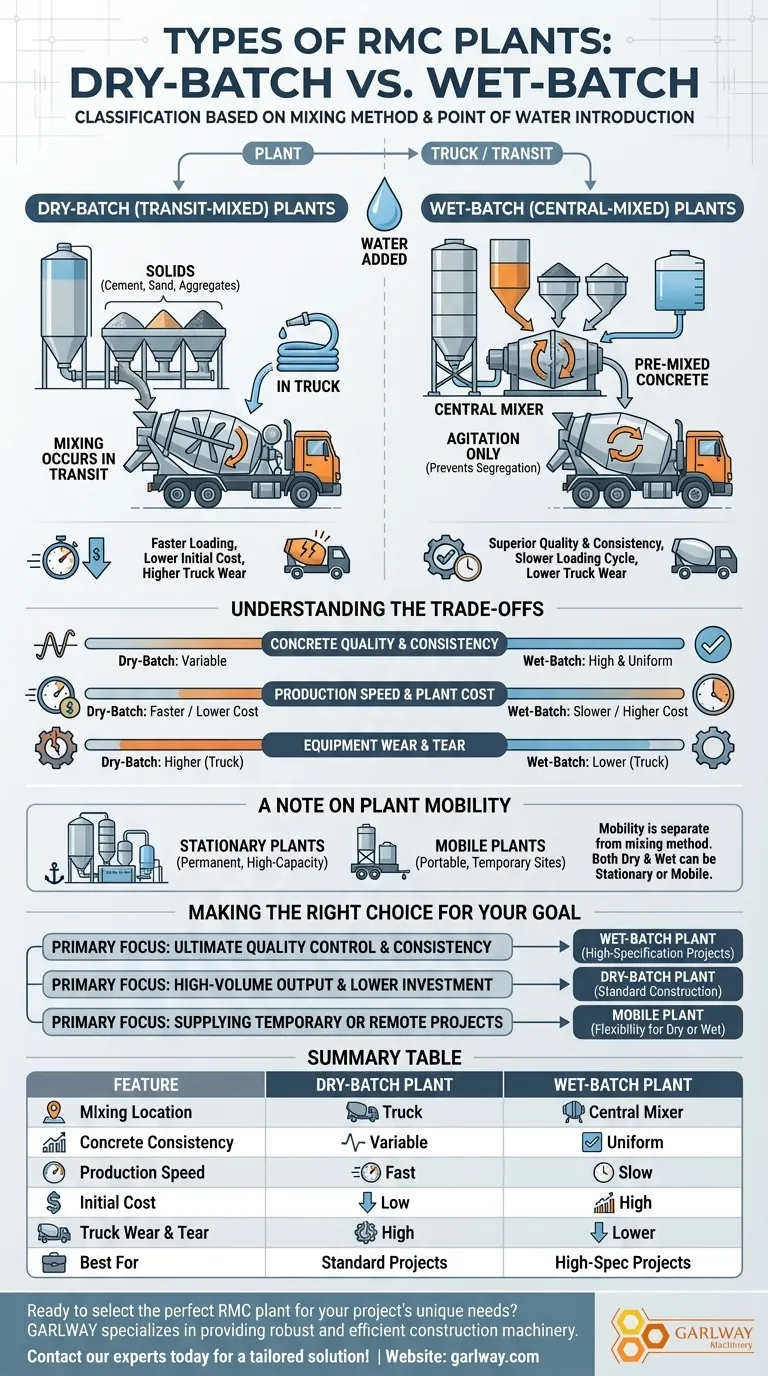
When it comes to Ready-Mix Concrete (RMC) plants, the primary classification is based on one critical factor: the point at which water is introduced into the mix. This defines the two fundamental types: dry-batch plants, where mixing occurs in the truck during transit, and wet-batch plants, where all ingredients are mixed at the plant before being loaded. The location of mixing directly impacts the final quality, consistency, and production speed of the concrete.
The choice between a dry-batch and wet-batch plant is a core trade-off. It balances the high consistency and quality control of central mixing (wet-batch) against the faster throughput and lower initial cost of in-transit mixing (dry-batch).
The Two Core Mixing Methods Explained
Understanding how each plant type operates is key to appreciating its specific advantages and applications in the construction industry.
Dry-Batch (Transit-Mixed) Plants
In a dry-batch system, the plant's main function is to accurately weigh and dispense the solid components of the concrete.
All dry ingredients—cement, sand, and various aggregates—are loaded into the truck mixer. The water is then added separately, either at the plant or upon arrival at the job site. The final, thorough mixing of the concrete happens inside the truck's rotating drum during its journey.
Wet-Batch (Central-Mixed) Plants
A wet-batch plant operates more like a centralized factory for concrete.
Here, all ingredients, including water, are introduced into a large, stationary mixer at the plant itself. Once the concrete reaches the specified consistency, this pre-mixed material is then discharged into a truck mixer. The truck's drum simply agitates the mix during transport to prevent segregation, rather than performing the primary mixing.
Understanding the Trade-offs
Neither method is universally superior; they are suited for different operational priorities and project requirements.
Concrete Quality and Consistency
Wet-batch plants typically offer superior quality control. The large, powerful central mixer ensures a highly consistent and homogenous mix from batch to batch, which is critical for high-performance or architectural concrete.
The quality of a dry-batch mix can be more variable. It depends heavily on factors like the condition of the truck's mixer blades, the transit time, and the number of drum revolutions, which can be less consistent than a controlled plant environment.
Production Speed and Plant Cost
Dry-batch plants can generally load trucks and dispatch them faster. This is because they skip the central mixing cycle, which can take 60-90 seconds per batch.
These plants are also typically less complex and therefore have a lower initial purchase price and reduced maintenance costs compared to their wet-batch counterparts.
Equipment Wear and Tear
The dry-batch process is significantly more demanding on the truck mixer. The drum and blades perform the hard work of blending the raw, abrasive materials, leading to faster wear.
In a wet-batch system, the truck is only agitating a fluid slurry, which causes much less stress on its components and can extend the life of the fleet.
A Note on Plant Mobility
It's important to recognize that mixing method (dry vs. wet) is a separate classification from plant portability.
Stationary vs. Mobile Plants
Both dry-batch and wet-batch systems can be engineered into different physical footprints. These include large, high-capacity stationary plants for permanent urban suppliers, easier-to-move ground-free base plants, and fully mobile plants designed for transport between temporary, large-scale project sites.
The choice of mobility is driven by business strategy and project logistics, while the choice of mixing method is driven by the desired concrete properties and operational efficiency.
Making the Right Choice for Your Goal
Selecting the appropriate RMC plant type requires aligning its core strengths with your project's primary objective.
- If your primary focus is ultimate quality control and mix consistency: A wet-batch (central-mixed) plant is the superior choice, especially for high-specification projects.
- If your primary focus is high-volume output and lower initial investment: A dry-batch (transit-mixed) plant is often the more economical and faster option for standard construction.
- If your primary focus is supplying temporary or remote projects: A mobile plant provides necessary flexibility, with the choice of dry or wet batching depending on the project's quality demands.
Ultimately, understanding where the concrete is mixed is the key to selecting the right RMC process for your project's unique balance of quality, speed, and cost.
Summary Table:
| Feature | Dry-Batch Plant | Wet-Batch Plant |
|---|---|---|
| Mixing Location | In the truck during transit | At the plant in a central mixer |
| Concrete Consistency | Can be variable | High and uniform |
| Production Speed | Faster truck loading | Slower due to mixing cycle |
| Initial Cost | Lower | Higher |
| Truck Wear & Tear | Higher | Lower |
| Best For | High-volume, standard projects | High-quality, high-specification projects |
Ready to select the perfect RMC plant for your project's unique needs?
GARLWAY specializes in providing robust and efficient construction machinery, including concrete batching plants, for construction companies and contractors worldwide. We can help you navigate the choice between dry-batch and wet-batch systems to optimize your operations for quality, speed, and cost.
Contact our experts today to discuss your requirements and get a tailored solution!
Visual Guide
Related Products
- HZS120 Ready Mix Concrete Batching Plant Commercial Mud Cement Mixer
- Ready Mixer Machine for Construction Ready Mix Machinery
- Belle Cement Mixer JS2000 Volumetric Concrete Mixer for Harbor Freight
- HZS90 Large Multiquip Concrete Mixers for Construction
- JW1000 Mobile Cement Mixer Concrete Mixer Truck and Batching Plant
People Also Ask
- What is a ready mix concrete batching plant? The Engine of Modern Construction
- What is the name of the machine used in ready mix? Unpacking the Complete Concrete System
- What is the core component of a concrete batching plant? The Mixer Unit Defines Your Concrete Quality
- What are the types of concrete mixers used in batching plants? Choose the Right Mixer for Your Project
- What are the advantages and disadvantages of concrete batching plants? Maximize Quality & Efficiency


