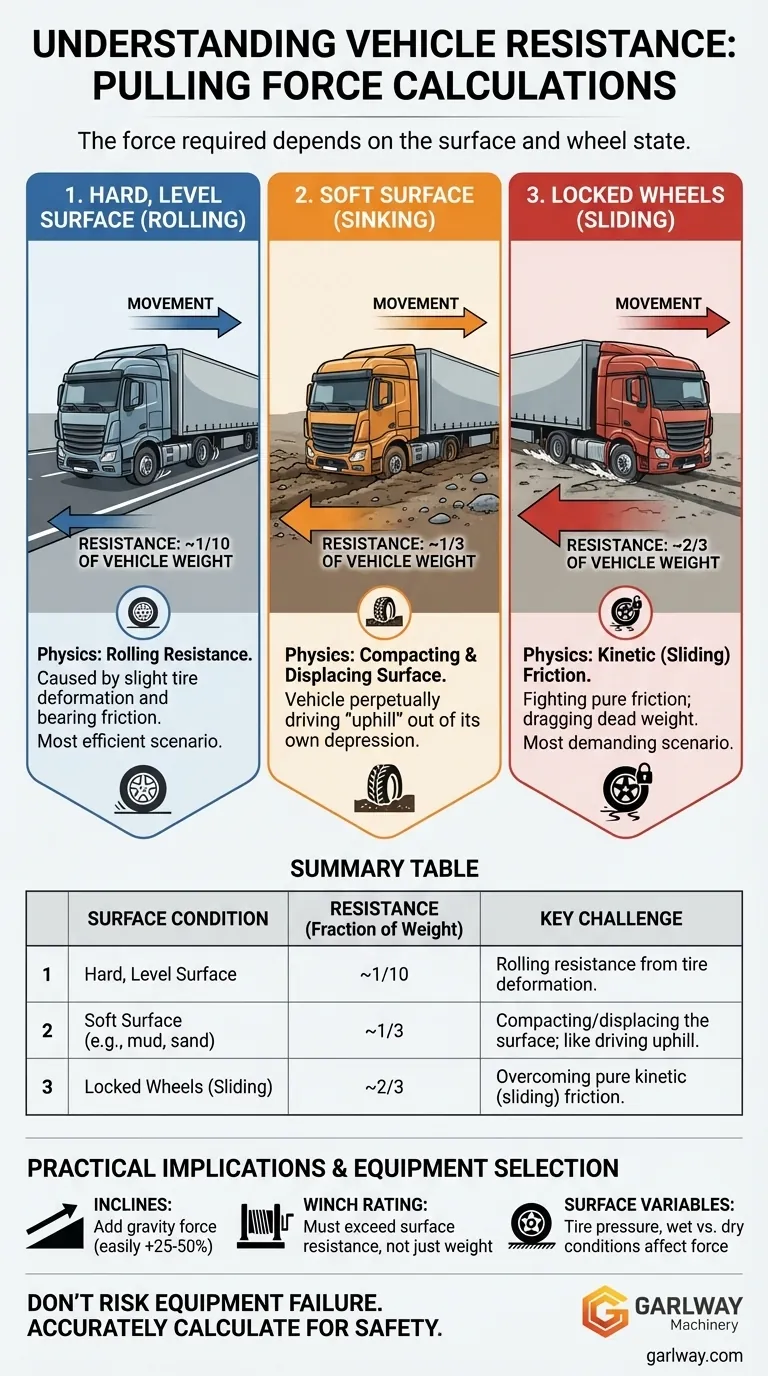
To move a vehicle, the force you must overcome depends heavily on the ground beneath it and whether its wheels can turn. On a hard, level surface, the resistance is about 1/10 of the vehicle's weight. This increases significantly to 1/3 of the vehicle's weight on soft surfaces like grass or gravel, and skyrockets to 2/3 of the weight if the wheels are locked and cannot rotate.
The crucial insight is that a vehicle's weight is only the starting point for calculating pulling force. The interaction between the tires and the surface—whether they roll easily, sink in, or are dragged—is the dominant factor that can triple or even sextuple the required effort.
Deconstructing Vehicle Resistance
Understanding why these resistance values change so drastically comes down to the difference between rolling and sliding. Each scenario presents a fundamentally different physics problem for the vehicle.
The Baseline: Rolling on Hard Surfaces
On a hard, level surface, the primary opposing force is rolling resistance. This force, estimated at 1/10 of the vehicle's weight, is caused by the slight deformation of the tires and friction in the wheel bearings.
This is the most efficient scenario, as the wheel's ability to roll converts the difficult task of sliding into a much easier rotational motion.
The Challenge of Soft Surfaces
When a vehicle moves onto a soft surface like grass, sand, or gravel, the resistance jumps to approximately 1/3 of its weight.
Here, the tires sink into the surface, which must be compacted or displaced. The vehicle is essentially forced to perpetually drive itself "uphill" out of the small depression its own weight creates in the ground. This requires far more energy than simply deforming a tire on pavement.
The Worst-Case: Sliding Friction
If a vehicle's wheels cannot rotate—due to brake lock-up, transmission failure, or axle damage—the situation changes completely. You are no longer overcoming rolling resistance.
You are now fighting against pure kinetic (sliding) friction. This force is immense, calculated at roughly 2/3 of the vehicle's total weight. You are dragging a dead weight, which is mechanically inefficient and demands the maximum pulling force.
Understanding the Practical Implications
These values are powerful rules of thumb, but applying them requires acknowledging real-world variables. They are the foundation for safe and effective planning, especially in vehicle recovery.
Why These Are "Rules of Thumb"
The 1/10, 1/3, and 2/3 figures are excellent estimations. However, factors like tire pressure, tread design, and the specific composition of the "soft surface" (e.g., wet sand vs. dry gravel) can alter the precise force required.
The Impact on Equipment Selection
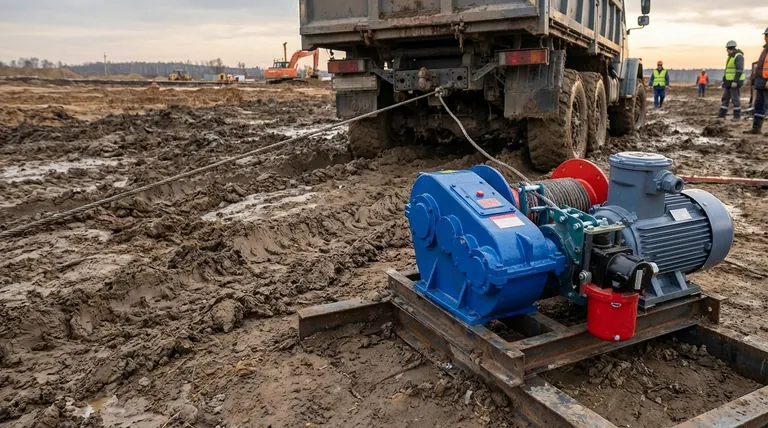
These multipliers are critical when choosing equipment like a winch. A winch rated only for the vehicle's curb weight may be sufficient on asphalt but will likely fail if that same vehicle is stuck in deep mud.
You must account for the surface resistance in addition to the vehicle's weight to determine the actual load your equipment will face.
The Critical Factor of Inclines
It is essential to remember that these calculations are for level surfaces. If the vehicle is on a slope, you must also add the force of gravity to your calculation.
An incline can easily add another 25-50% of the vehicle's weight to the total force required, on top of the surface resistance.
How to Apply This to Your Situation
Use these principles to estimate the force needed for your specific task. Always err on the side of caution and use equipment rated well above your minimum calculation.
- If you are moving a rolling vehicle on a hard, level surface: Plan for a required force of at least 1/10 of the vehicle's weight.
- If you are recovering a vehicle from a soft surface like mud, sand, or grass: Your equipment must handle a force of at least 1/3 of the vehicle's weight.
- If you must move a vehicle with locked wheels: You are facing the most demanding scenario and need equipment capable of pulling at least 2/3 of the vehicle's weight.
By understanding these fundamental forces, you can move from guesswork to calculated decisions for any vehicle recovery or towing operation.
Summary Table:
| Surface Condition | Resistance (as a fraction of vehicle weight) | Key Challenge |
|---|---|---|
| Hard, Level Surface | ~1/10 | Rolling resistance from tire deformation. |
| Soft Surface (e.g., mud, sand) | ~1/3 | Compacting/displacing the surface; like driving uphill. |
| Locked Wheels (Sliding) | ~2/3 | Overcoming pure kinetic (sliding) friction. |
Don't risk equipment failure during a critical recovery. Accurately calculating the required pulling force is essential for safety and success. GARLWAY specializes in construction machinery, offering robust winches, concrete mixers, and batching plants designed for the demanding conditions faced by construction companies and contractors globally. Our equipment is engineered to handle the high forces involved in vehicle recovery and heavy-duty tasks.
Let our experts help you select the right winch for your specific needs. Contact GARLWAY today to ensure your next operation is powered by reliable, high-performance machinery.
Visual Guide