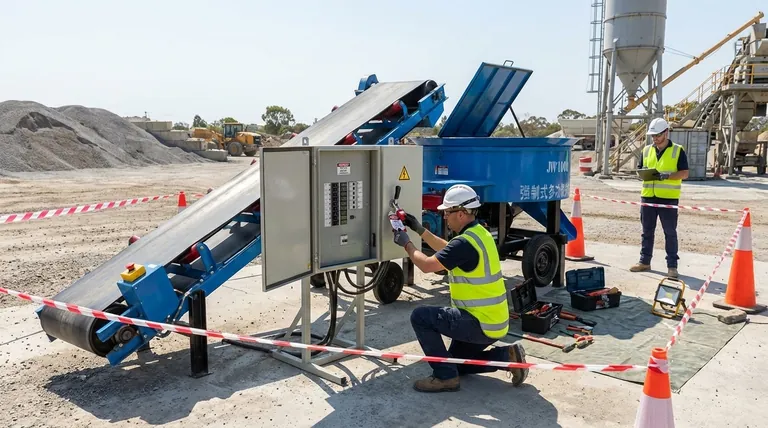
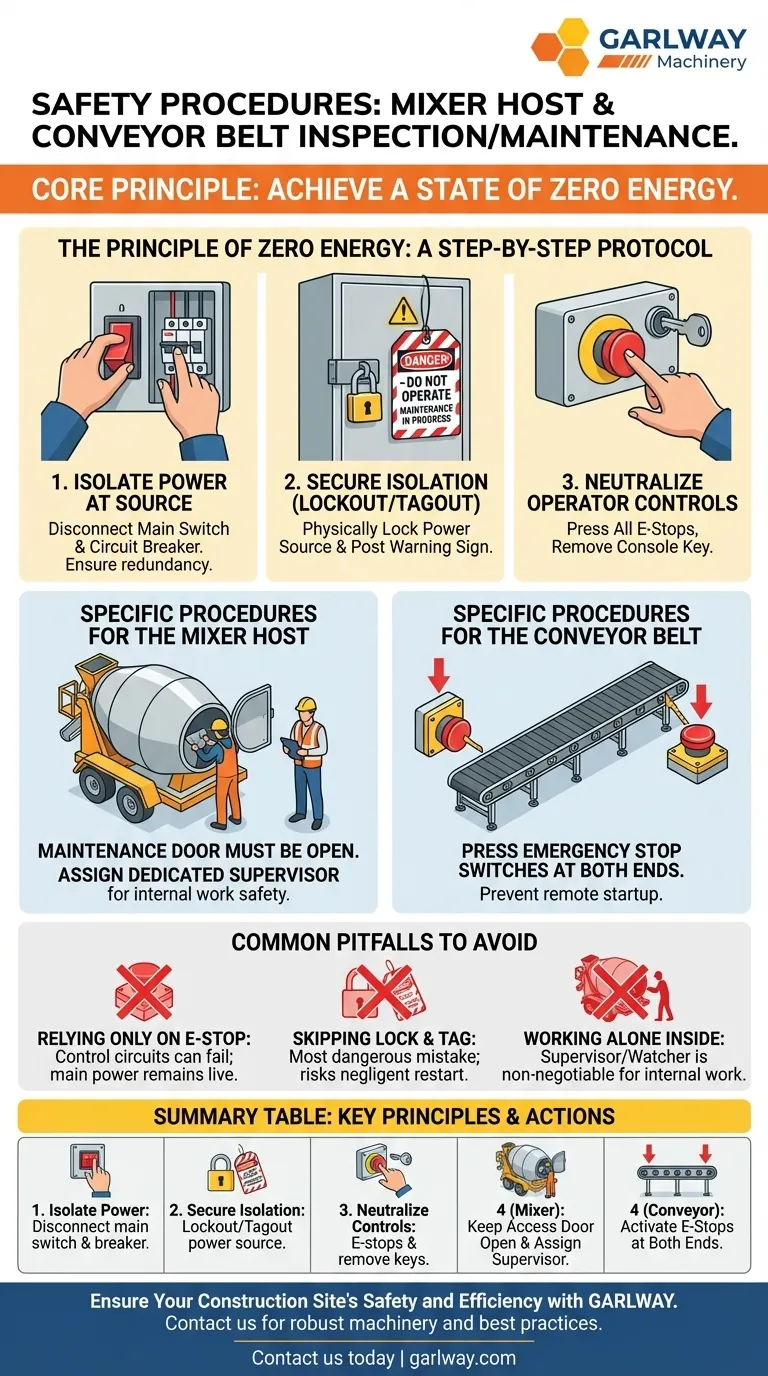
The foundational safety procedure for maintaining a mixer and conveyor is a systematic, multi-step energy isolation process. Before any work begins, you must de-energize the equipment at both the main switch and the local circuit breaker, physically lock the power source to prevent reactivation, post a clear warning sign, and engage all relevant emergency stop buttons.
The core objective is not simply to turn the machine off, but to achieve a state of zero energy. This ensures the equipment cannot be accidentally or negligently restarted by anyone while maintenance is being performed, which is the bedrock of industrial machinery safety.
The Principle of Zero Energy: A Step-by-Step Protocol
A safe maintenance operation relies on a clear, non-negotiable sequence of actions. Each step builds upon the last to create a secure environment where unexpected machine activation is impossible.
Step 1: Isolate Power at the Source
The first action is always to completely disconnect the machinery from its power source. This involves two critical actions: turning off the main power switch and then opening the circuit breaker for the specific motor being serviced. This provides a crucial layer of electrical redundancy.
Step 2: Secure the Isolation Point (Lockout/Tagout)
Simply flipping a switch is not enough. You must lock the electrical cabinet door to physically prevent anyone from re-engaging the circuit breaker. A warning sign must also be hung on the lock, clearly indicating that maintenance is in progress and the equipment should not be operated.
Step 3: Neutralize All Operator Controls
After isolating the main power, move to the primary operator console. Press the main emergency stop button and, if the console has one, remove the key. This deactivates the machine's control circuits and removes the most common means of restarting it.
Specific Procedures for Each Machine
While the core energy isolation protocol applies to all equipment, mixers and conveyors have unique characteristics that require additional safety measures.
For the Mixer Host
When performing internal cleaning or maintenance on the mixer, the maintenance access door must be kept open. This serves as a clear visual indicator that work is in progress. Crucially, a dedicated person must be assigned to supervise the process, ensuring the safety of the individual working inside the machine.
For the Conveyor Belt
Conveyor belts often span long distances with multiple points of operation. Because of this, you must press the emergency stop switches located at both ends of the belt. This prevents someone from attempting to start the conveyor from a location that is out of sight of the maintenance area.
Common Pitfalls to Avoid
Understanding why each step is critical helps prevent dangerous shortcuts. Deviating from the protocol introduces unacceptable risk.
Relying Only on the Emergency Stop
An emergency stop button is part of the control circuit; it is not a true energy isolation device. The main power lines to the motor are still live. A control circuit can fail, or the button can be reset, allowing the machine to start unexpectedly.
Skipping the Lock and Tag
Failing to physically lock out the power source is the most common and dangerous mistake. Without a lock, anyone unaware of the maintenance work can walk by, see a tripped breaker, and reset it, starting the machine while someone is working on it.
Working Alone Without Supervision
For any work inside a machine like a mixer, a dedicated supervisor or "watcher" is non-negotiable. This person's sole responsibility is to monitor the worker, prevent unauthorized access, and serve as the first responder in an emergency.
Applying This to Your Task
Your specific maintenance task dictates which safety layers are most critical, though the full procedure should always be your default.
- If your primary focus is a brief visual inspection: Always complete the full energy isolation procedure. A "quick look" is never worth the risk of accidental startup from a remote location.
- If your primary focus is internal cleaning or maintenance (mixer): You must add two steps to the full lockout: keep the access door open and post a dedicated supervisor for the entire duration of the work.
- If your primary focus is work anywhere on a conveyor system: In addition to the full lockout, pay special attention to engaging the emergency stops at both ends to mitigate the high risk of remote startup.
Ultimately, a disciplined and methodical approach to these safety protocols is the only way to ensure a safe work environment.
Summary Table:
| Step | Action | Key Principle |
|---|---|---|
| 1 | Isolate Power at Source | Disconnect main switch and circuit breaker for redundancy. |
| 2 | Secure Isolation (Lockout/Tagout) | Physically lock the power source and post a warning sign. |
| 3 | Neutralize Operator Controls | Press all emergency stops and remove keys if applicable. |
| 4 (Mixer) | Keep Access Door Open & Assign Supervisor | Ensure visual safety and dedicated oversight for internal work. |
| 4 (Conveyor) | Activate Emergency Stops at Both Ends | Prevent remote startup across long distances. |
Ensure Your Construction Site's Safety and Efficiency with GARLWAY
Proper maintenance is critical for the safety of your crew and the longevity of your equipment. GARLWAY specializes in providing robust and reliable construction machinery, including concrete mixers and batching plants, designed with safety and ease of maintenance in mind.
Let our experts help you implement best practices and equip your team with machinery built for performance and safety. Contact us today to discuss your project needs and discover how GARLWAY can support your operations.
Visual Guide
Related Products
- Portable Concrete Mixer Machine Equipment for Mixing Concrete
- Construction Products Concrete Plant Machine Mixing Concrete Mixer
- Portable Ready Mix Concrete Mixer Equipment
- Hydraulic Concrete Mixer Machine Cement Mixing Equipment for Mixture Concrete
- Portable Cement Mixer with Lift Concrete Machine
People Also Ask
- Why is it necessary to use a portable concrete mixer? Gain Total Control & Efficiency
- How much concrete can you pour with a portable mixer? Find the Perfect Fit for Your Project
- What types of projects are portable concrete mixers suitable for? Ideal for DIY & Small-Scale Construction
- How much does a portable concrete mixer hold? A Guide to Choosing the Right Capacity
- What types of portable concrete mixers exist? Find the Perfect Mixer for Your Project