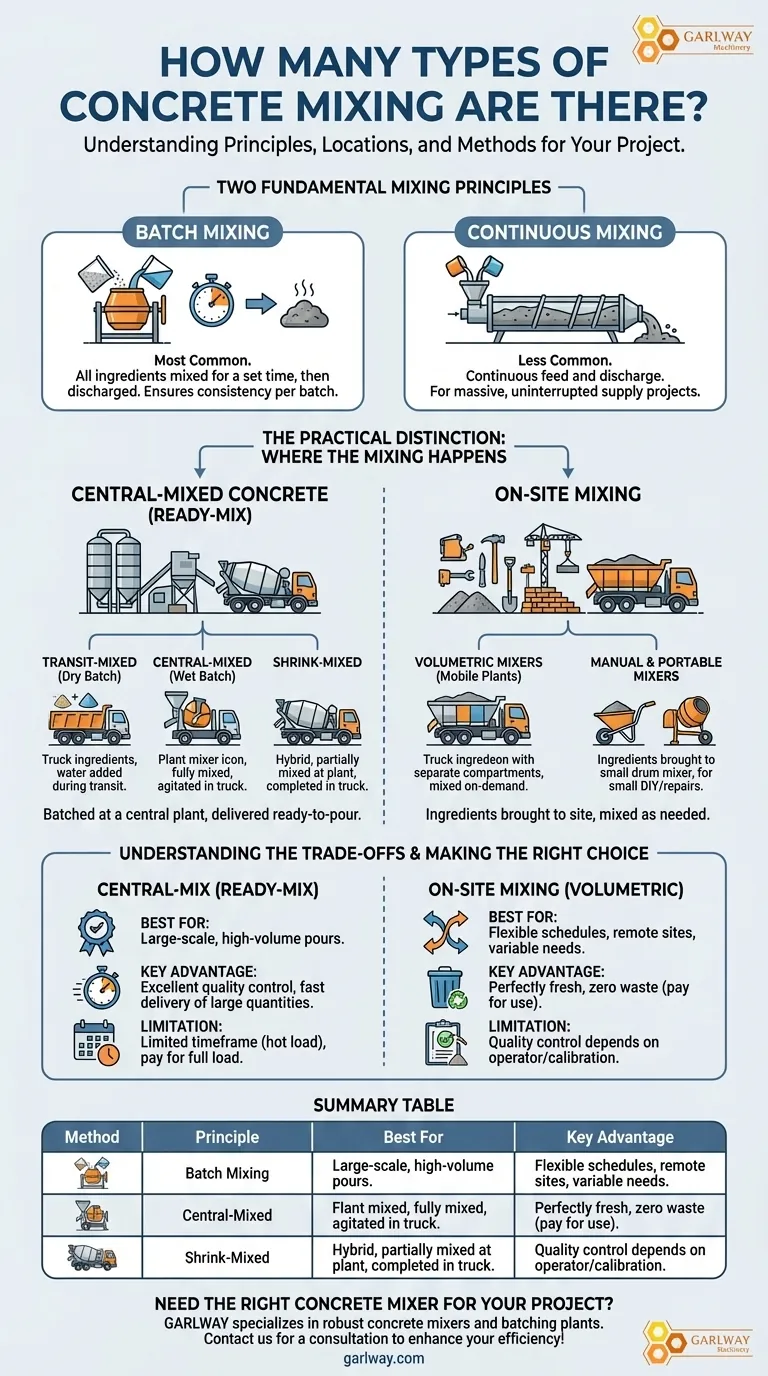
At its core, there are two fundamental principles of concrete mixing: Batch Mixing and Continuous Mixing. However, the more practical way to categorize mixing is by where the process takes place: at a central plant before delivery or directly at the job site.
The most critical distinction is not the type of machine used, but the methodology behind it. Your choice comes down to weighing the consistency and volume of plant-mixed concrete against the flexibility and freshness of on-site mixed concrete.
The Two Fundamental Mixing Principles
Every method of producing concrete falls into one of two operational principles. Understanding these provides the foundation for all other distinctions.
Batch Mixing
This is the most common method. All ingredients—cement, aggregates, admixtures, and water—are loaded into the mixer, mixed for a set period, and then the entire batch is discharged.
This process ensures a consistent product for each specific batch. Nearly all structural concrete, from ready-mix trucks to small portable mixers, relies on this principle.
Continuous Mixing
In this method, ingredients are continuously fed into one end of the mixer and discharged as finished concrete from the other.
This is less common and is typically reserved for massive projects that require a constant, uninterrupted supply, such as road paving or the construction of roller-compacted concrete dams.
Where the Mixing Happens: Plant vs. On-Site
For most projects, the practical question isn't "batch or continuous?" but "where is my concrete made?" This determines logistics, quality control, and cost.
Central-Mixed Concrete (Ready-Mix)
This is concrete that is batched at a central plant and delivered to the job site in a plastic, ready-to-pour state. This category has three primary subtypes based on the exact mixing process.
- Transit-Mixed ("Dry Batch"): All dry ingredients are loaded into a truck mixer at the plant. Water is added to the truck either at the plant or upon arrival at the job site, and the mixing occurs during transit.
- Central-Mixed ("Wet Batch"): The concrete is fully mixed at the central plant in a large, stationary mixer. It is then discharged into a truck mixer, which agitates the concrete during transit to prevent segregation.
- Shrink-Mixed: This is a hybrid approach. The concrete is partially mixed at the plant to reduce its volume ("shrink" it) and then the mixing process is completed in the truck mixer en route to the site.
On-Site Mixing
This method involves bringing the raw ingredients to the project location and mixing the concrete as needed.
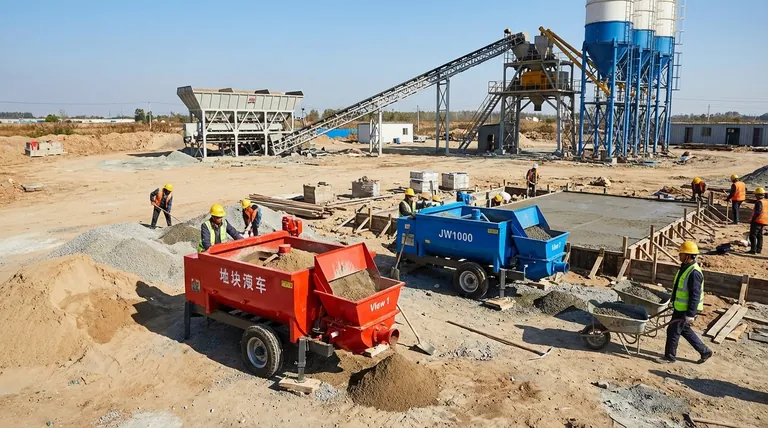
- Volumetric Mixers: These are often called "mobile concrete plants." The truck carries all ingredients in separate compartments. The materials are metered and mixed on-demand at the job site, producing fresh concrete to the exact amount required.
- Manual & Portable Mixers: For very small jobs like a fence post or a small repair, concrete can be mixed manually with a hoe in a wheelbarrow or mixing box. For slightly larger DIY projects like a small slab, portable drum mixers are used.
Understanding the Trade-offs
Choosing a mixing method involves balancing project needs for quality, volume, and flexibility. Neither approach is universally superior.
The Case for Central-Mix (Ready-Mix)
Ready-mix concrete is produced in a highly controlled plant environment, which generally leads to excellent quality control and consistency between batches.
Its primary advantage is the ability to deliver large, verified quantities of concrete very quickly, making it ideal for large structural pours like foundations, slabs, and bridges. The main drawback is its limited time frame; a "hot load" that sits too long in traffic can be rejected, and you must pay for a full truckload, even if you don't use it all.
The Case for On-Site Mixing (Volumetric)
The key benefit of a volumetric mixer is supreme flexibility. The concrete is always perfectly fresh because it's mixed moments before being poured.
This eliminates waste from over-ordering, as you pay only for what you use. It also allows for easy adjustments to the mix design on-site and is perfect for remote locations or projects with multiple small, separate pours. The potential downside is that quality control is highly dependent on the operator and the calibration of the machine.
Making the Right Choice for Your Project
Selecting the appropriate mixing method is crucial for project success. Your decision should be guided by the scale, location, and specific requirements of your work.
- If your primary focus is large-scale, high-volume pours with stringent quality control: Central-mixed (ready-mix) concrete is almost always the correct choice.
- If your primary focus is flexibility, eliminating waste, or working in remote areas: An on-site volumetric mixer provides unparalleled control and efficiency.
- If your primary focus is a small DIY project or minor repair: Manual mixing or a portable batch mixer is the most practical and cost-effective solution.
Ultimately, understanding these mixing methods empowers you to source concrete in a way that best serves your project's timeline, budget, and quality standards.
Summary Table:
| Method | Principle | Best For | Key Advantage |
|---|---|---|---|
| Central-Mixed (Ready-Mix) | Batch Mixing | Large-scale, high-volume pours | Consistent quality & high-speed delivery |
| On-Site (Volumetric) | Batch Mixing | Flexible schedules, remote sites | Zero waste & fresh concrete on-demand |
| Manual/Portable | Batch Mixing | Small DIY projects & repairs | Cost-effective for minimal quantities |
Need the Right Concrete Mixer for Your Project?
Choosing the correct mixing method is critical for your project's budget, timeline, and success. GARLWAY specializes in construction machinery, offering robust and reliable concrete mixers and concrete batching plants designed for construction companies and contractors globally.
Let us help you select the perfect equipment to match your project's scale and requirements.
Contact GARLWAY today for a consultation and discover how our solutions can enhance your efficiency and profitability!
Visual Guide
Related Products
- Construction Products Concrete Plant Machine Mixing Concrete Mixer
- Commercial Electric Concrete Mixer Machine HZS 50 Small Batch Plant for Sale
- HZS35 Small Cement Concrete Mixing Batch Plant
- HZS120 Ready Mix Concrete Batching Plant Commercial Mud Cement Mixer
- HZS75 Concrete Batching Plant Cement Mixer Price Concrete Mixer Bunnings Mixing Plant
People Also Ask
- What factors should be considered when choosing between volumetric and traditional mixers? Optimize Your Concrete Project Strategy
- What is the difference between pan and planetary mixers? Choose the Right Mixer for Your Concrete Project
- When was the first concrete mixer developed and by whom? Discover the 1900 Breakthrough
- What is the average lifespan of a concrete mixer? Maximize Your Equipment's Lifespan & ROI
- What are the two broad types of concrete mixers? Choose the Right Mixer for Your Project