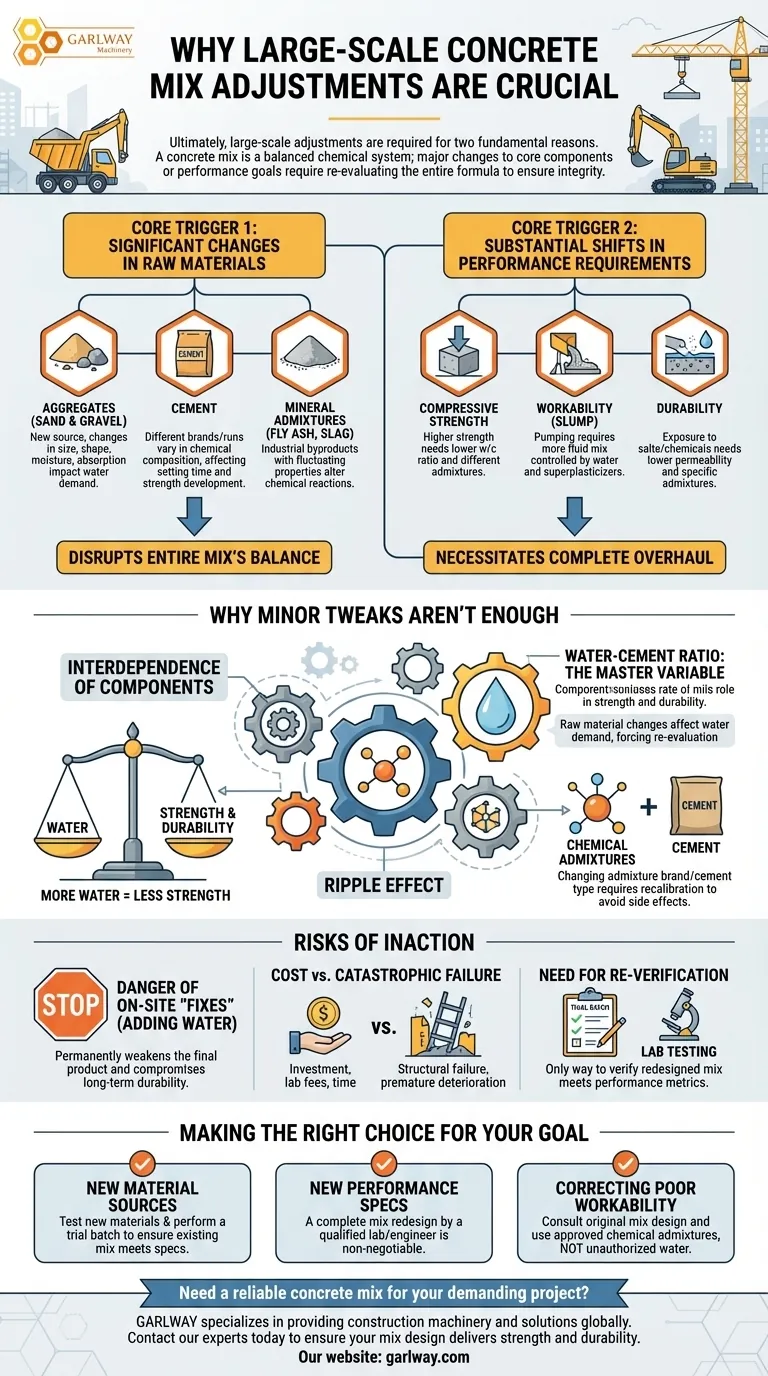
Ultimately, large-scale adjustments to a concrete mix ratio are required for two fundamental reasons: a significant change in the properties of the raw materials or a substantial change in the performance requirements for the final concrete. In these scenarios, simply adjusting one ingredient is insufficient and often dangerous; a comprehensive redesign is necessary to maintain the integrity of the mix.
A concrete mix is a balanced chemical system. Any major change to a core component or a performance goal requires re-evaluating the entire formula to ensure strength, durability, and workability are not compromised.
The Core Triggers for a Mix Redesign
A concrete mix design, or "recipe," is engineered to be precise. When foundational assumptions of that design change, the recipe itself must be revisited.
Factor 1: Significant Changes in Raw Materials
The properties of concrete's constituent materials are not always constant. A change in the source or even the production batch of a key ingredient can disrupt the entire mix's balance.
Key materials that can vary include:
- Aggregates (Sand and Gravel): A new quarry or supplier can introduce changes in particle size, shape, moisture content, and absorption. This directly impacts the amount of water needed to achieve proper workability.
- Cement: Different brands or even different production runs of cement can have varying chemical compositions, affecting setting time and the rate of strength development.
- Mineral Admixtures: Materials like fly ash or slag are industrial byproducts. Their chemical and physical properties can fluctuate, altering their reaction within the concrete matrix.
Factor 2: Substantial Shifts in Performance Requirements
A concrete mix designed for a residential patio is fundamentally different from one engineered for a high-rise column or a bridge deck.
When project specifications change, the mix must be redesigned to match. Key performance metrics include:
- Compressive Strength: Moving from a 3,000 psi requirement to a 6,000 psi requirement necessitates a complete overhaul, primarily by lowering the water-to-cement ratio and potentially using different admixtures.
- Workability (Slump): Concrete that must be pumped vertically up 30 stories requires a much more fluid mix than concrete poured directly into a foundation form. This is controlled by water content and superplasticizers.
- Durability: A mix exposed to de-icing salts or saltwater requires special considerations—like lower permeability and specific admixtures—to resist chemical attack, which is not a concern for interior applications.
Why Minor Tweaks Aren't Enough
The impulse to make a simple, isolated adjustment is tempting but fails to respect the interconnected nature of the concrete mix. This is where an "optimized adjustment," or a full redesign, becomes critical.
The Interdependence of Components
A concrete mix is not a simple sum of its parts. Changing one variable creates a ripple effect. For example, adding more water to increase workability will directly decrease the final strength and durability.
The Water-Cement Ratio: The Master Variable
The ratio of water to cementitious materials (the w/c ratio) is the single most important factor governing concrete's strength and durability. Nearly any change to raw materials affects water demand, forcing a re-evaluation of this critical ratio to meet performance targets.
The Role of Chemical Admixtures
Modern concrete almost always includes chemical admixtures like superplasticizers (water-reducers). These are not simple additives; they interact chemically with the cement. Changing the brand of admixture or the type of cement can alter this chemical reaction, requiring recalibration to achieve the desired performance without unintended side effects like rapid setting or air entrainment issues.
Understanding the Trade-offs and Risks
Failing to conduct a large-scale adjustment when one is warranted introduces significant risk to a project.
The Danger of On-Site "Fixes"
The most common—and dangerous—mistake is adding excess water to a concrete truck on-site to make the mix easier to place. This single, isolated adjustment permanently weakens the final product and compromises its long-term durability.
Cost vs. Catastrophic Failure
Properly redesigning and testing a new mix has an upfront cost in time and lab fees. However, this cost is insignificant compared to the potential expense of structural failure, premature deterioration, or falling short of project specifications.
The Need for Re-Verification
Any significant adjustment to a mix is not complete until a new trial batch is produced and tested in a lab. This is the only way to verify that the redesigned mix meets all required performance metrics before it is deployed on a project.
Making the Right Choice for Your Goal
To ensure safety and quality, your response should be guided by the nature of the change you are facing.
- If your primary focus is accommodating new material sources: You must test the new materials and perform a trial batch to ensure the existing mix design still meets performance specifications before proceeding.
- If your primary focus is meeting new, demanding project specifications: A complete mix redesign is non-negotiable and must be developed and verified by a qualified lab or engineer.
- If your primary focus is correcting poor workability on-site: The solution is to consult the original mix design and use approved chemical admixtures as specified, not to make unauthorized additions of water.
Treating concrete as a precise chemical formula, not just a simple building material, is the key to ensuring structural integrity and long-term performance.
Summary Table:
| Factor | Key Changes | Impact on Mix |
|---|---|---|
| Raw Materials | New aggregate source, cement type, or admixture batch | Alters water demand, setting time, and chemical balance |
| Performance Needs | Higher strength, different workability (slump), or enhanced durability | Requires new water-cement ratio and admixture calibration |
Need a reliable concrete mix for your demanding project? GARLWAY specializes in providing construction machinery and solutions—including concrete batching plants, mixers, and expert support—to help contractors and construction companies globally achieve precise, high-performance concrete. Contact our experts today to discuss your project requirements and ensure your mix design delivers the strength and durability you need.
Visual Guide
Related Products
- Portable Concrete Mixer Machine Equipment for Mixing Concrete
- Portable Cement Mixer with Lift Concrete Machine
- Portable Ready Mix Concrete Mixer Equipment
- HZS180 Ready Mix Concrete Plant for Foundations with Sand and Cement
- Construction Products Concrete Plant Machine Mixing Concrete Mixer
People Also Ask
- Why is it necessary to use a portable concrete mixer? Gain Total Control & Efficiency
- How much concrete can you pour with a portable mixer? Find the Perfect Fit for Your Project
- What types of projects are portable concrete mixers suitable for? Ideal for DIY & Small-Scale Construction
- How much does a portable concrete mixer hold? A Guide to Choosing the Right Capacity
- What types of portable concrete mixers exist? Find the Perfect Mixer for Your Project