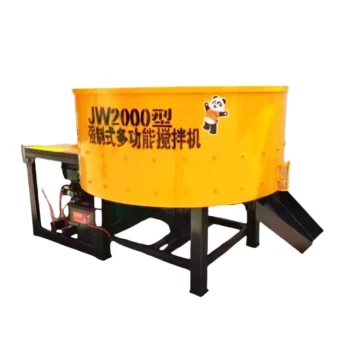
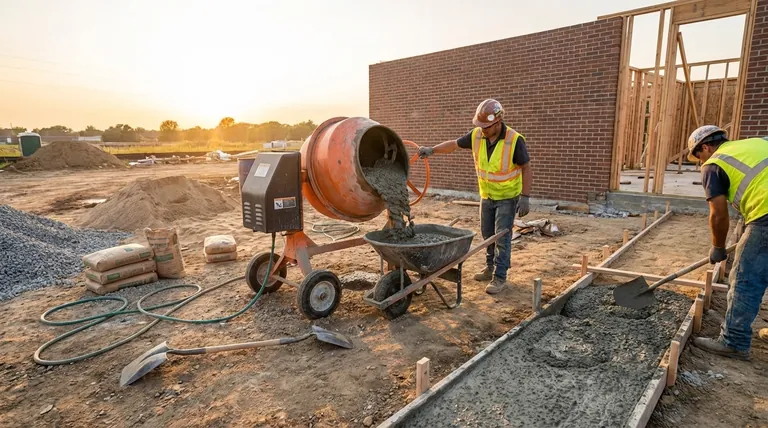
At its core, a small cement mixer's primary use on a construction site is to precisely and efficiently mix cement, sand, water, and other aggregates like gravel or lime. Its purpose is to transform these individual components into a single, homogeneous, and high-quality mixture such as concrete or mortar, which is essential for ensuring the strength and durability of any structure.
The true value of a small cement mixer lies not just in its ability to mix materials, but in its capacity to provide on-demand, consistent, and manageable batches for small to medium-sized jobs, directly boosting site efficiency and work quality.
The Core Function: Creating a Homogeneous Mixture
The fundamental goal of any mixer is to achieve a perfectly uniform blend. A small cement mixer accomplishes this through a simple yet effective mechanical process, ensuring the final product meets structural requirements.
Mixing Concrete and Cement
This is the number one job. The mixer combines cement powder, aggregates (like sand and gravel), and water in precise ratios to create concrete. The constant tumbling action ensures every particle is coated in cement paste, which is critical for proper curing and ultimate strength.
Combining Other Materials
Beyond standard concrete, these mixers are versatile. They are used to create mortar by mixing sand, lime, and cement, or to combine various other aggregates for specialized applications.
How It Achieves Consistency
A small mixer consists of a few key parts working in concert. A motor powers a rotating drum (or bowl), while internal paddles or blades continuously lift, fold, and integrate the materials. This process eliminates clumps and ensures a uniform consistency that is impossible to replicate quickly or reliably by hand.
The Strategic Advantages on a Construction Site
Choosing to use a small mixer over manual methods or large-scale delivery is a strategic decision rooted in efficiency and control.
On-Demand Material Production
A small mixer allows you to produce fresh material exactly when and where you need it. This eliminates the waste associated with leftover ready-mix concrete and prevents batches from hardening before they can be used.
Increased Efficiency and Reduced Labor
Automating the mixing process is dramatically faster and less physically demanding than mixing with a shovel in a wheelbarrow. This directly reduces human capital costs and frees up workers to focus on placement and finishing.
Improved Worker Health and Safety
Using a mixer significantly reduces the risk of repetitive strain and back injuries associated with manual mixing. The contained process also minimizes dust and splash, contributing to a safer work environment.
A More Organized Work Site
Mixing is contained within the drum, which helps maintain a tidier and more organized construction site. This prevents piles of raw materials from spreading and creating hazards.
Understanding the Trade-offs
While incredibly useful, a small cement mixer is a specialized tool with clear limitations. Understanding these trade-offs is key to using it effectively.
Volume and Scale
The most significant limitation is batch size. A small mixer is ideal for repairs, footings, small slabs, or setting posts. It is entirely unsuitable for large-scale projects like a building's foundation, which requires a continuous pour from ready-mix trucks.
Power Dependency
Whether electric or gas-powered, the mixer requires a reliable power source. On remote sites or during early construction phases, ensuring access to power can be a logistical challenge.
Maintenance and Cleaning
The mixer must be cleaned thoroughly after each use. Hardened concrete is extremely difficult to remove and can damage the drum and blades, rendering the machine useless. This cleaning process requires time and access to water.
Matching the Mixer to the Task
To make the right decision, align the tool's capabilities with your project's specific goals.
- If your primary focus is small repairs, setting posts, or creating custom mortar: A small mixer is the ideal tool, providing perfect batch control and preventing material waste.
- If your primary focus is pouring a small patio slab, walkway, or foundation footings: The on-site capability of a small mixer gives you control over your timeline without relying on a ready-mix delivery schedule.
- If your primary focus is a large foundation, commercial floor, or high-volume pour: A small mixer is inadequate; your project requires the scale and speed of a professional ready-mix concrete supplier.
Ultimately, a small cement mixer empowers you with control and efficiency for the right-sized job.
Summary Table:
| Use Case | Key Benefit |
|---|---|
| Mixing Concrete & Mortar | Creates consistent, high-strength batches on-site |
| Small Repairs & Foundations | Provides precise, on-demand material, reducing waste |
| Setting Posts & Small Slabs | Increases efficiency and reduces manual labor |
| Improving Worker Safety | Minimizes physical strain and creates a tidier worksite |
Ready to enhance your project's efficiency and quality?
GARLWAY specializes in providing robust construction machinery, including durable concrete mixers, for construction companies and contractors globally. Our equipment is designed to deliver the reliable performance you need for small to medium-sized jobs, ensuring consistent results and maximizing your on-site productivity.
Contact GARLWAY today to find the perfect cement mixer for your specific project requirements and experience the GARLWAY difference in quality and support.
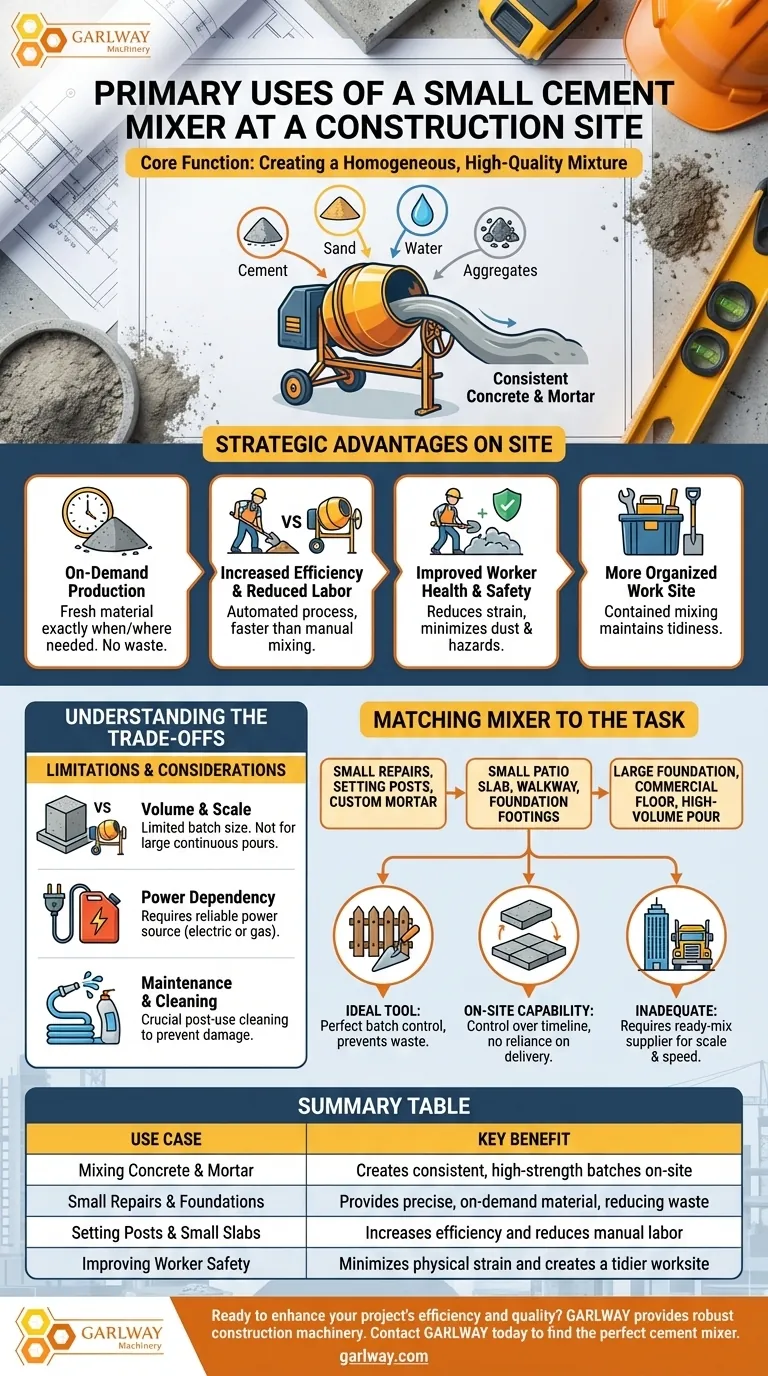
Visual Guide
Related Products
- JDC350 Small Cement Concrete Mortar Mixer
- JZC400 Mobile Small Concrete Mixer Cement Mixer Machine
- Portable Electric Small Cement Mixer Concrete Machine
- HZS35 Small Cement Concrete Mixing Batch Plant
- Mini Cement Mortar Mixer Truck for Construction
People Also Ask
- What are the physical benefits of using a small cement mixer? Reduce Strain and Prevent Injury
- What are the cost benefits of using a small cement mixer? Save on Labor, Materials & Time
- What makes small cement mixers easy and convenient to use? Boost Productivity on Any Job Site
- What factors should be considered before purchasing a small cement mixer? Find the Perfect Match for Your Project
- What are the primary uses of small cement mixers on construction sites? Maximize Efficiency for Small-Scale Projects