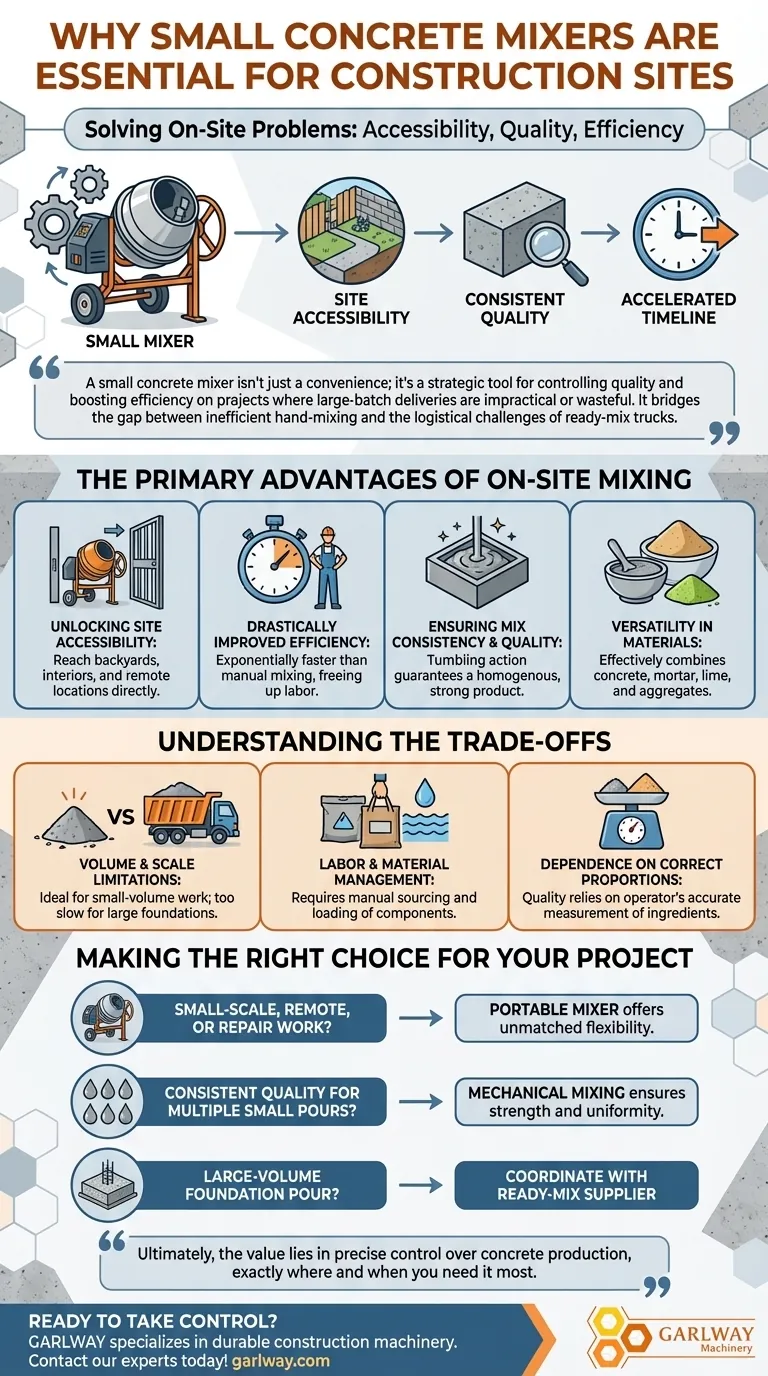
At their core, small concrete mixers solve three critical on-site problems. They provide access to jobs in hard-to-reach areas, deliver a consistent, high-quality mix that is far superior to manual methods, and significantly accelerate the timeline for smaller-volume concrete work. This combination makes them an essential tool for efficiency and quality control.
A small concrete mixer isn't just a convenience; it's a strategic tool for controlling quality and boosting efficiency on projects where large-batch deliveries are impractical or wasteful. It bridges the gap between inefficient hand-mixing and the logistical challenges of ready-mix trucks.

The Primary Advantages of On-Site Mixing
The utility of a small concrete mixer goes beyond simply stirring ingredients. It fundamentally changes how smaller construction projects can be approached, offering distinct advantages over both manual labor and large-scale solutions.
Unlocking Site Accessibility
Many construction sites have areas inaccessible to large ready-mix concrete trucks, such as backyards, interior renovation spaces, or remote locations. A portable mixer can be moved directly to the point of use, eliminating the need for long and laborious wheelbarrow runs from the curb.
Drastically Improved Efficiency
Compared to mixing concrete by hand in a wheelbarrow or on a tarp, a mechanical mixer is exponentially faster. This reduction in time and labor frees up personnel for other critical tasks, directly increasing the overall productivity of the crew and shortening project timelines.
Ensuring Mix Consistency and Quality
The single most important factor for concrete strength is the uniform mixture of cement, water, and aggregates. Hand-mixing often results in inconsistent batches with dry pockets or areas with too much water, compromising structural integrity. A mixer's tumbling action ensures a homogenous and consistent product every time.
Versatility in Materials
While their primary purpose is mixing concrete, these machines are also highly effective for combining other materials. They are frequently used for mixing mortar, lime, sand, and various aggregates, making them a versatile tool for a wide range of masonry and construction tasks.
Understanding the Trade-offs
While highly beneficial, small mixers are a specific tool for a specific job. Understanding their limitations is key to using them effectively.
Volume and Scale Limitations
A portable mixer is designed for small-volume work. It is the ideal solution for patios, footings, sidewalks, or repair jobs. For large-scale projects like a full foundation slab, it is far too slow and labor-intensive compared to ordering from a ready-mix supplier.
Labor and Material Management
Using a small mixer still requires significant manual effort. You are responsible for sourcing, storing, and loading all the individual components—cement bags, sand, gravel, and water. This contrasts with a ready-mix truck, which delivers a finished product with no on-site material handling.
Dependence on Correct Proportions
The mixer guarantees a good blend, but it cannot guarantee a good recipe. The final quality and strength of the concrete are still entirely dependent on the operator's ability to accurately measure the ingredients. An incorrect water-to-cement ratio will produce weak concrete, regardless of how well it is mixed.
Making the Right Choice for Your Project
Deciding whether a small mixer is the right tool depends entirely on the scale, location, and quality requirements of your work.
- If your primary focus is small-scale, remote, or repair work: A portable mixer provides unmatched flexibility and access that large trucks cannot offer.
- If your primary focus is consistent quality for multiple small pours: The mechanical mixing action ensures a level of strength and uniformity that hand-mixing cannot guarantee.
- If your primary focus is a large-volume foundation pour: A small mixer is the wrong tool; coordinating with a ready-mix concrete supplier is the correct and most efficient approach.
Ultimately, the value of a small concrete mixer lies in its ability to give you precise control over your concrete production, exactly where and when you need it most.
Summary Table:
| Key Advantage | Description |
|---|---|
| Site Accessibility | Access hard-to-reach areas like backyards or interior spaces. |
| Improved Efficiency | Drastically faster than manual mixing, saving time and labor. |
| Mix Consistency | Ensures a homogenous, high-quality mix for superior strength. |
| Material Versatility | Effective for mixing concrete, mortar, lime, and other aggregates. |
Ready to take control of your concrete quality and efficiency?
GARLWAY specializes in durable and efficient construction machinery, including concrete mixers, winches, and batching plants designed for contractors and construction companies worldwide. Let us help you find the perfect equipment for your project's needs.
Contact our experts today for a personalized solution!
Visual Guide
Related Products
- JZC400 Mobile Small Concrete Mixer Cement Mixer Machine
- JDC350 Small Cement Concrete Mortar Mixer
- Commercial Electric Concrete Mixer Machine HZS 50 Small Batch Plant for Sale
- Portable Electric Small Cement Mixer Concrete Machine
- HZS35 Small Cement Concrete Mixing Batch Plant
People Also Ask
- What are the different names for mobile concrete mixing equipment? Understand Volumetric vs. On-Site Mixers
- In what way do mobile mixers enhance quality control? Achieve Superior Concrete Quality On-Site
- What is a mobile mixer? The Ultimate Guide to On-Site Concrete Production
- How do mobile mixers improve labor efficiency? Automate Concrete Production & Boost Productivity
- What flexibility do mobile mixers offer in terms of material mixing? Unlock On-Demand Concrete Production