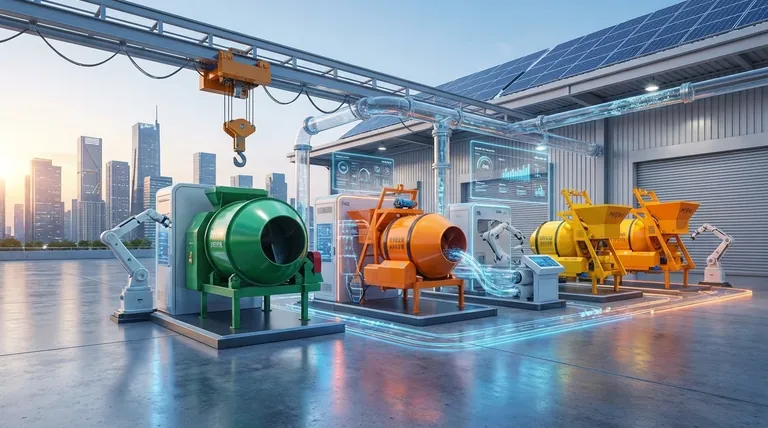
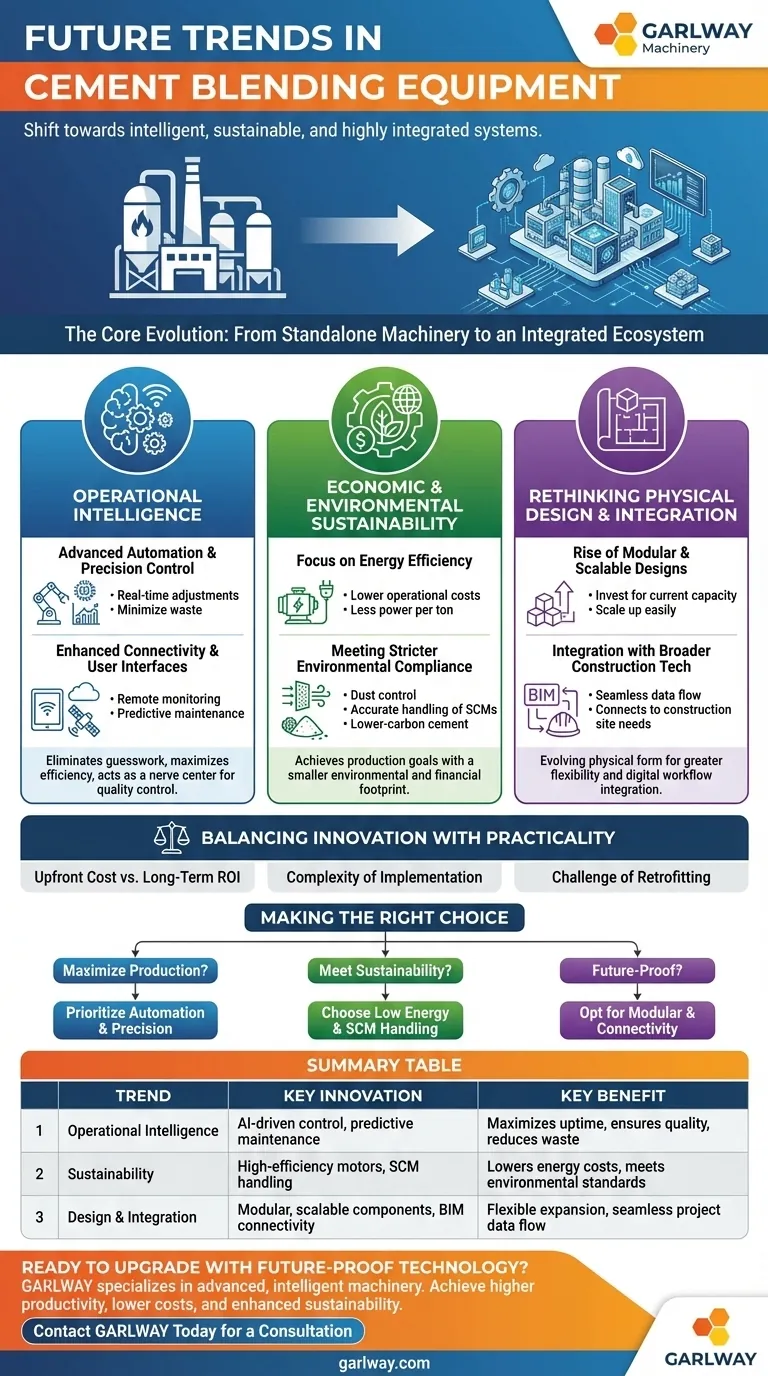
Looking ahead, the future of cement blending equipment is defined by a shift towards intelligent, sustainable, and highly integrated systems. Key innovations focus on advanced automation, energy efficiency, enhanced environmental compliance, modular designs for scalability, and seamless connectivity with broader construction technologies to meet modern economic and regulatory demands.
The core evolution is moving from standalone machinery to an integrated ecosystem. Future equipment is not just about blending cement more effectively; it's about doing so with less energy, greater precision, and in a way that generates actionable data for the entire operation.
The Push for Operational Intelligence
The next generation of equipment prioritizes data and automation to eliminate guesswork and maximize efficiency. This transition turns the blending plant into a nerve center of quality control and operational insight.
Advanced Automation and Precision Control
Modern systems are moving beyond simple automated batching. They leverage advanced sensors and AI-driven algorithms to make real-time adjustments, ensuring perfect blending ratios for both traditional and novel materials.
This level of precision control is critical for maintaining quality and performance specifications while minimizing waste and the overuse of expensive additives.
Enhanced Connectivity and User Interfaces
Equipment is no longer an isolated island. Future systems feature intuitive user interfaces and are fully connected, allowing for remote monitoring, diagnostics, and performance tracking from a central office or even a mobile device.
This connectivity enables predictive maintenance, which significantly reduces unplanned downtime and extends the life of the machinery.
The Drive for Economic and Environmental Sustainability
Rising energy costs and stricter regulations are powerful forces shaping equipment design. The focus is now on achieving production goals with a smaller environmental and financial footprint.
A Focus on Energy Efficiency
Manufacturers are engineering systems with high-efficiency motors, variable frequency drives (VFDs), and optimized mechanical designs to drastically cut down on power consumption per ton of cement produced.
This directly lowers operational expenditures, making it one of the most compelling reasons for upgrading older equipment.
Meeting Stricter Environmental Compliance
New blenders are designed for superior dust control and containment. More importantly, they offer the flexibility needed to accurately handle a wider range of supplementary cementitious materials (SCMs) like fly ash and slag.
This allows producers to create lower-carbon cement blends that meet evolving environmental standards without sacrificing performance.
Rethinking Physical Design and Integration
The physical form of the equipment is also evolving to offer greater flexibility and to fit within a larger digital construction workflow.
The Rise of Modular and Scalable Designs
Instead of monolithic, one-size-fits-all plants, the trend is toward modular components. This approach allows a company to invest in a system that meets its current production capacity and scale up easily as demand grows.
This design philosophy de-risks the initial capital investment and provides a clear, cost-effective path for future expansion.
Integration with Broader Construction Tech
Future blending systems will integrate with Building Information Modeling (BIM) and other project management software. This creates a seamless data flow, connecting material production specifications directly with the requirements of the construction site.
Balancing Innovation with Practicality
While these advancements offer significant benefits, adopting them requires careful consideration of the associated challenges and costs.
The Upfront Cost vs. Long-Term ROI
Advanced automation and energy-efficient technologies carry a higher initial price tag. It is crucial to balance this upfront cost against the long-term savings from reduced energy use, lower labor costs, and improved material consistency.
The Complexity of Implementation
Sophisticated control systems require a higher level of technical skill to operate and maintain. Companies must invest in training their workforce to fully leverage the capabilities of new, smarter equipment.
The Challenge of Retrofitting
Integrating state-of-the-art components into an existing, older plant can be more complex and costly than a completely new installation. A thorough assessment is needed to determine the feasibility and a clear upgrade path.
Making the Right Choice for Your Goal
Selecting the right equipment depends entirely on your primary strategic objectives.
- If your primary focus is maximizing production efficiency: Prioritize systems with advanced automation, precision batching controls, and predictive maintenance capabilities.
- If your primary focus is meeting sustainability targets: Choose equipment specifically designed for low energy consumption and the flexible handling of various SCMs.
- If your primary focus is future-proofing your investment: Opt for modular, scalable designs with robust connectivity and a clear path for integration into larger digital workflows.
Ultimately, viewing your cement blending equipment as a strategic asset, rather than just a production tool, is the key to unlocking future success.
Summary Table:
| Trend | Key Innovation | Key Benefit |
|---|---|---|
| Operational Intelligence | AI-driven control, predictive maintenance | Maximizes uptime, ensures quality, reduces waste |
| Sustainability | High-efficiency motors, SCM handling | Lowers energy costs, meets environmental standards |
| Design & Integration | Modular, scalable components, BIM connectivity | Flexible expansion, seamless project data flow |
Ready to upgrade your cement blending operations with future-proof technology?
GARLWAY specializes in providing construction companies and contractors globally with advanced, intelligent machinery. Our concrete batching plants and mixers are engineered for the trends that matter: superior energy efficiency, precise automation, and scalable, modular designs.
Let us help you achieve your goals of higher productivity, lower operational costs, and enhanced sustainability.
Contact GARLWAY today for a consultation and discover the right solution for your project.
Visual Guide
Related Products
- Hydraulic Concrete Mixer Machine Cement Mixing Equipment for Mixture Concrete
- Portable Concrete Mixer Machine Equipment for Mixing Concrete
- Auto Concrete Cement Mixer Machine New
- Concrete Cement Mixer Machine Drum Mixer for Construction
- Portable Electric Small Cement Mixer Concrete Machine
People Also Ask
- How does the hydraulic system function in these mixers? Unlock the Power Behind Heavy-Duty Mixing
- What are hydraulic concrete mixers used for? Powering Large-Scale Construction Projects
- What are hydraulic cement mixers best used for? Powering Large-Scale Construction Projects
- What are some recent innovations in concrete mixing equipment? Boost Efficiency & Quality Now
- What are the four factors to consider when selecting a concrete mixer? Optimize Your Construction Project