Understanding how a cement mixer functions is the fundamental difference between a weak, temporary patch and a durable, professional-grade DIY project. Proper operation ensures the precise consistency and chemical hydration needed for strong concrete, saving you significant time, physical labor, and the risk of premature failure.
A cement mixer is more than a convenience; it's a tool for ensuring structural integrity. By controlling the mix, you are directly controlling the final strength, durability, and longevity of your project, from a simple footing to an entire patio slab.

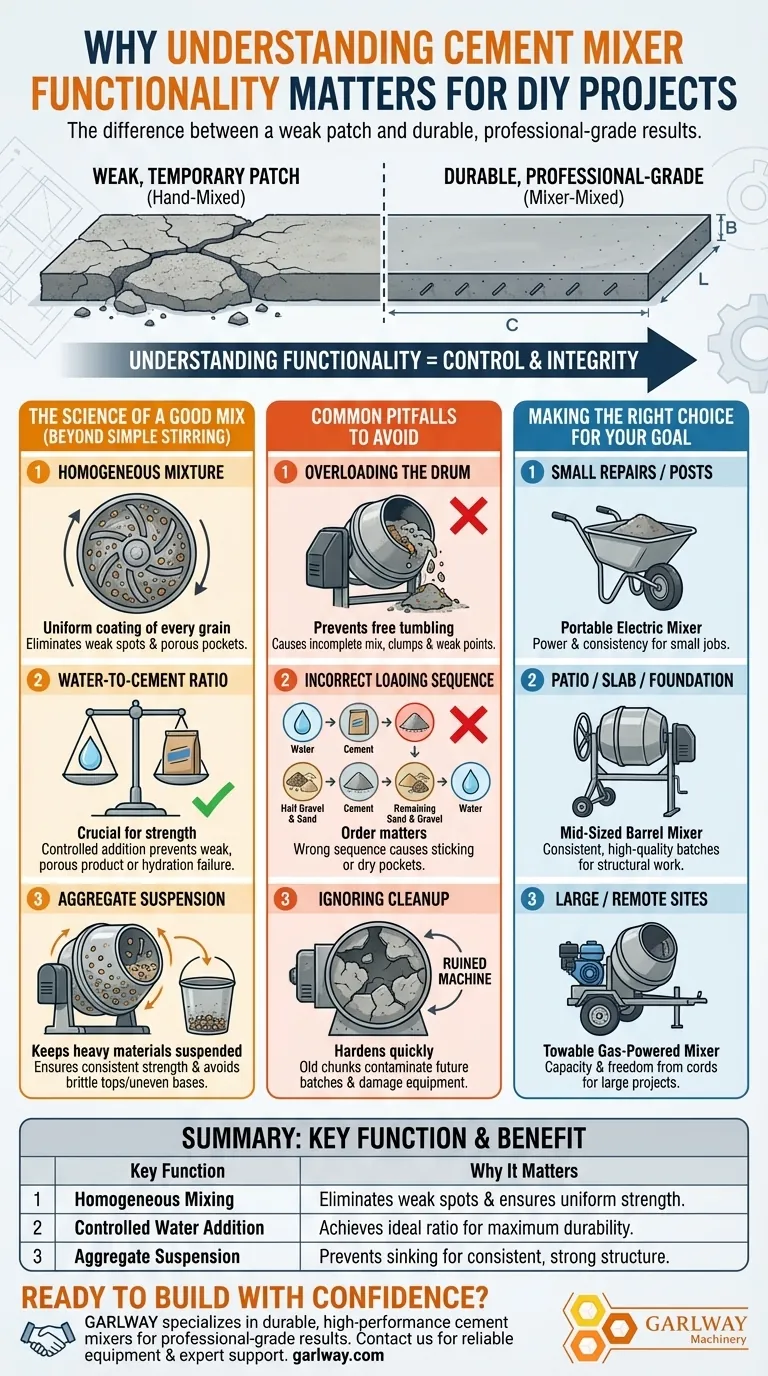
Beyond Simple Stirring: The Science of a Good Mix
Many first-time users assume a mixer just saves them from back-breaking work with a shovel. While true, its primary role is to produce a chemically consistent and structurally sound material that hand-mixing can rarely replicate.
Achieving a Homogeneous Mixture
A mixer’s rotating drum and internal fins are designed to lift, tumble, and fold the materials. This action ensures every grain of sand and piece of aggregate is fully coated with cement paste (cement and water).
This homogeneity is critical. Inconsistent mixes lead to pockets of weakness, porous spots that absorb water, and an overall lack of strength in the final cured concrete.
Mastering the Water-to-Cement Ratio
The strength of concrete is largely determined by the water-to-cement ratio. Too much water creates a weak, porous final product, while too little prevents the cement from hydrating and curing properly.
A mixer allows for the gradual and controlled addition of water, making it far easier to achieve the ideal "plastic" consistency without over-saturating the mix.
Ensuring Proper Aggregate Suspension
Heavy aggregates like gravel are essential for concrete's compressive strength. A mixer's constant motion keeps these heavy materials suspended evenly throughout the mix.
When mixing by hand, aggregates often sink to the bottom, resulting in an uneven slab that is brittle at the top and inconsistent at the base.
Common Pitfalls to Avoid
Understanding the mechanics helps you sidestep common errors that compromise the quality of your concrete. Avoiding these mistakes is just as important as knowing the right steps to take.
Overloading the Drum
Every mixer has a maximum capacity. Exceeding it prevents the materials from tumbling freely, leading to an incomplete mix with dry clumps and weak spots.
Incorrect Loading Sequence
The order in which you add materials matters. A common, effective method is to add half the gravel, half the sand, all the cement, the remaining sand and gravel, and finally, the water.
Adding all the water first can cause cement to stick to the drum, while adding cement first can create dry pockets at the bottom.
Ignoring Cleanup
Cement hardens quickly. Failing to thoroughly rinse the drum and fins immediately after use will ruin the machine. Hardened chunks of old concrete will break off into future batches, creating weak points and ruining consistency.
Making the Right Choice for Your Goal
By seeing the mixer as a tool for precision, you can ensure your project is built to professional standards. The key is to match your understanding of the process with the right equipment for the job.
- If your primary focus is small repairs or setting fence posts: A portable, wheelbarrow-style electric mixer provides more than enough power and consistency.
- If your primary focus is a patio slab, walkway, or small foundation: A durable, mid-sized barrel mixer is essential for producing the consistent, high-quality batches required for structural work.
- If your primary focus is working on a large or remote site: A towable, gas-powered mixer offers the capacity and freedom from electrical cords needed for larger-scale projects.
Ultimately, mastering your cement mixer empowers you to produce concrete work that is not just complete, but built to last.
Summary Table:
| Key Function | Why It Matters for Your Project |
|---|---|
| Homogeneous Mixing | Eliminates weak spots & ensures uniform strength throughout the concrete. |
| Controlled Water Addition | Achieves the ideal water-to-cement ratio for maximum durability. |
| Aggregate Suspension | Prevents gravel from sinking, creating a consistent, strong slab or structure. |
Ready to build with confidence?
For your next DIY project or professional job, the right equipment makes all the difference. GARLWAY specializes in durable, high-performance construction machinery, including a range of cement mixers designed for contractors and serious DIYers.
We provide:
- Reliable Equipment: From portable electric mixers for small jobs to robust towable mixers for large sites.
- Expert Support: Get the right tool for your specific project goals.
- Global Service: Trusted by construction companies and contractors worldwide.
Don't let a poor mix compromise your hard work. Contact GARLWAY today to find the perfect cement mixer for durable, professional-grade results!
Visual Guide
Related Products
- HZS25 Best Cement Mixer for Quick Mix Concrete at Bunnings
- JDC350 Small Cement Concrete Mortar Mixer
- JW1000 Mobile Cement Mixer Concrete Mixer Truck and Batching Plant
- JZC400 Mobile Small Concrete Mixer Cement Mixer Machine
- Concrete Cement Mixer Machine Drum Mixer for Construction
People Also Ask
- How do cement mixers enhance safety on construction sites? Reduce Strain, Hazards, and Accidents
- What are the main components of a cement mixer? A Guide to Core Parts & Functions
- What are some tips for using a cement mixer effectively? Maximize Your Mixer's Performance & Concrete Quality
- How does cleaning a cement mixer after use benefit its performance? Maximize Lifespan and Mix Quality
- Why is it important to clean the cement mixer after use? Prevent Costly Damage and Ensure Quality Concrete