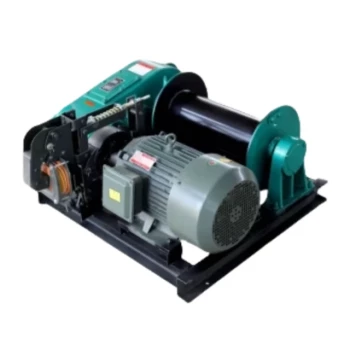
In the world of heavy pulling and material handling, slow speed is not a limitation—it's a critical feature. A slow-speed winch is primarily used for applications where immense control, precision, and safety are more important than speed. Its core functions are lifting goods and executing large-scale hoisting projects in industrial, construction, and mining environments where heavy loads must be moved or lowered with extreme care.
A slow-speed winch isn't about getting the job done fast; it's about getting it done with maximum control. Its fundamental value lies in its ability to precisely position and carefully manage extremely heavy loads in high-stakes situations.
Why Slower is Better: The Principle of Control
The deliberate, slow operation of these winches is an engineered advantage. This control stems from the winch's core design, which prioritizes power and precision over velocity.
The Role of the Gear Train
A winch's power comes from its motor, but its force is amplified by a gear train. A slow-speed winch uses a higher gear ratio to significantly increase torque, providing immense pulling power at a reduced output speed, typically around 7 to 12 meters per minute.
Preventing Shock Loads
A fast, jerky pull can create a "shock load"—a sudden spike in force that can snap a cable or damage anchor points. A slow, steady pull distributes the force evenly, ensuring a much safer operation when dealing with multi-ton objects.
Enabling Micro-Adjustments
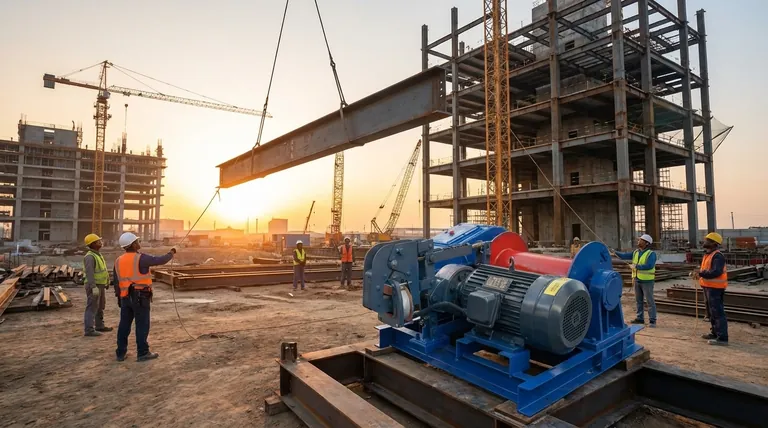
In construction or installation, success is measured in millimeters. A slow-speed winch allows operators to make tiny, precise adjustments when aligning massive steel beams, setting heavy machinery onto foundations, or fitting prefabricated modules into place.
Core Industrial and Commercial Applications
While any winch can pull, a slow-speed winch excels in specific, demanding scenarios where a mistake is not an option.
Large-Scale Hoisting Projects
This is the primary application. A slow-speed winch gives operators the control needed to lift and, more importantly, safely lower heavy machinery, structural components, or large material bundles in a controlled manner.
Construction and Civil Engineering
From building bridges to erecting skyscrapers, these winches are essential for carefully positioning critical components. Their slow, deliberate action is vital for ensuring everything aligns perfectly.
Mining and Dock Operations
In mines, they are used for hoisting materials from deep shafts. On docks, they carefully lift and move heavy cargo, where precision movement prevents damage to valuable goods and ensures the safety of personnel.
Controlled Horizontal Pulling
These winches are also used to pull heavy objects horizontally. This includes tasks like loading heavy equipment onto a trailer, repositioning large boulders, or skidding machinery across a factory floor where a steady, controlled pull is required.
Understanding the Trade-offs
Choosing a slow-speed winch means accepting a clear set of compromises in exchange for its precision.
Speed is the Obvious Sacrifice
The most significant trade-off is time. For tasks like rapid off-road vehicle recovery, where speed can be a factor in a dynamic situation, a high-speed winch is often preferred to get the job done quickly.
Inefficiency Over Long Distances
If you need to pull a load over a significant distance, a slow-speed winch can be highly inefficient. Its design is optimized for power and control during shorter, more precise movements.
Requires Patience and Planning
Operating a slow-speed winch effectively requires a methodical approach. It is not a tool for quick fixes but for planned, deliberate operations where every phase of the lift or pull is carefully considered.
Making the Right Choice for Your Goal
Your application's core requirement—speed or control—should be the deciding factor.
- If your primary focus is precision and safety: A slow-speed winch is the definitive choice for industrial lifting, construction, or carefully positioning any heavy and valuable object.
- If your primary focus is rapid vehicle recovery: A high-speed winch is typically more suitable, as it minimizes the time required to complete the task in a potentially unstable environment.
- If your primary focus is general utility and safe loading: A slow-speed winch offers superior control for tasks like winching a car onto a trailer, where a steady, predictable pace prevents accidents.
Ultimately, selecting a slow-speed winch is a conscious decision to prioritize meticulous control over raw velocity.
Summary Table:
| Application | Key Benefit |
|---|---|
| Large-Scale Hoisting | Controlled lifting and lowering of heavy machinery |
| Construction & Engineering | Precise positioning of structural components |
| Mining & Dock Operations | Safe material handling in high-stakes environments |
| Horizontal Pulling | Steady, controlled movement of heavy objects |
Need a reliable slow-speed winch for your next project? GARLWAY specializes in construction machinery, offering durable winches, concrete mixers, and batching plants designed for construction companies and contractors globally. Our winches provide the precision and safety you need for heavy lifting operations. Contact us today to discuss your requirements and discover how we can enhance your project's efficiency and safety!
Visual Guide
Related Products
- Quick Windlass Portable Winch for Truck and Boat Best Boat Winch
- Portable Small Trailer Winch
- Electric 120V Boat Winch by Badlands
- Small Electric Winch 120V and 240V for Compact Applications
- Best 18000 Pound Drum Anchor Trailer Winch
People Also Ask
- What features were incorporated into the upgraded portable winch system? Boost Your Recovery Power & Safety
- What are some uses mentioned for portable winches beyond vehicle recovery? Essential Versatility for Property & Work
- How could the twisting issue with a portable winch be mitigated? Achieve Safe, Centered Pulls with Proper Rigging
- What are the primary uses of a portable winch for a truck? Boost Your Truck's Capability and Self-Reliance
- What is the single rope traction force of the quick winch without a pulley block? 0.5 to 40 Tons Explained