
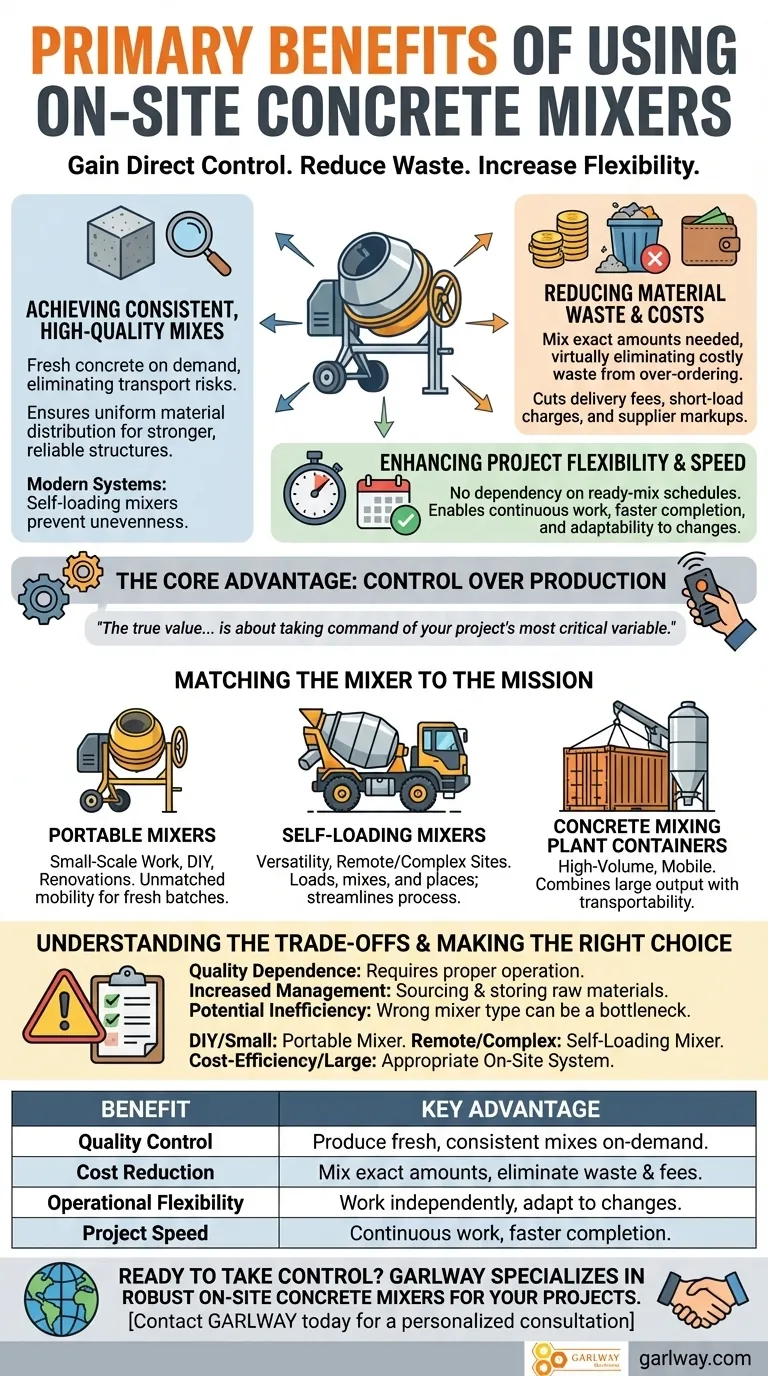
The primary benefits of using on-site concrete mixers are gaining direct control over concrete quality, significantly reducing material waste and project costs, and achieving greater operational flexibility on the job site. This allows you to produce fresh, high-quality concrete exactly when and where you need it, avoiding the logistical constraints of ready-mix deliveries.
The true value of on-site mixing is not just convenience; it's about taking command of your project's most critical variable. By managing production directly, you gain control over your timeline, material integrity, and budget in ways that relying on external suppliers cannot match.
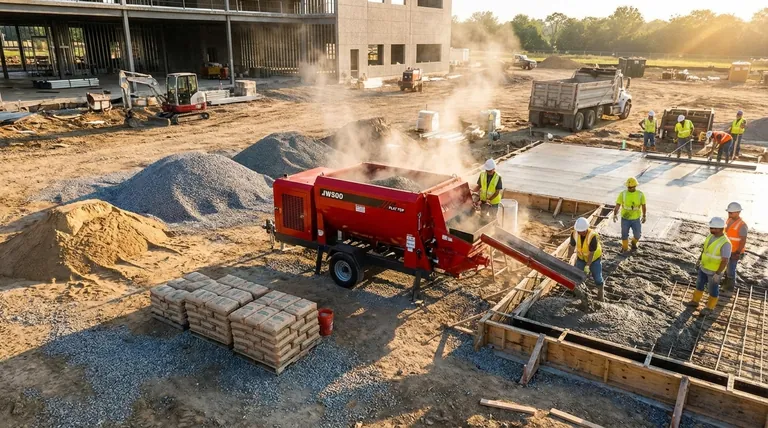
The Core Advantage: Control Over Production
Bringing concrete mixing to the job site fundamentally changes project dynamics. You shift from being a customer waiting for a delivery to the direct manager of a key manufacturing process.
Achieving Consistent, High-Quality Mixes
On-site mixers allow for the creation of fresh concrete on demand. This eliminates the risk of premature hardening or segregation that can occur during the transport of ready-mix concrete.
Modern systems, especially self-loading mixers, ensure a uniform distribution of all materials. This precision prevents the unevenness common in less-controlled methods, leading to a stronger, more reliable final product.
Reducing Material Waste and Costs
The most significant financial benefit is the ability to mix only the exact amount of concrete required. This virtually eliminates the costly waste associated with over-ordering from a batch plant.
Furthermore, on-site mixing can reduce overall project costs by cutting out delivery fees, short-load charges, and the high price markup of pre-mixed concrete.
Enhancing Project Flexibility and Speed
With an on-site mixer, you are no longer bound by the schedule of a ready-mix supplier. This allows for continuous work, as concrete can be produced instantly whenever a new pour is ready.
This flexibility is crucial for meeting tight deadlines and adapting to unforeseen changes in project scope or weather conditions, allowing for much faster completion times.
Matching the Mixer to the Mission
The term "on-site mixer" covers a range of equipment, each designed for a specific scale and application. Choosing the correct type is essential to realizing the potential benefits.
Portable Mixers for Small-Scale Work
These lightweight and easily transportable units are ideal for DIY projects, renovations, and small construction sites.
While their capacity is limited (often up to 9 cubic feet), their mobility provides unmatched flexibility for jobs requiring small, fresh batches of concrete in various locations.
Self-Loading Mixers for Versatility
These advanced machines are designed for adaptability. They can handle complex terrains, including mountainous or hilly areas, making them perfect for infrastructure projects or remote sites.
Their ability to load, mix, and place concrete with a single piece of equipment streamlines the entire process, improving efficiency and ensuring high-quality results.
Concrete Mixing Plant Containers
For larger projects that still require mobility, containerized mixing plants offer a powerful solution. They combine the high-volume output of a stationary plant with the ability to be transported and set up relatively easily.
Understanding the Trade-offs
While the benefits are substantial, they are not automatic. Shifting to on-site mixing also means assuming responsibilities that were previously outsourced.
The Myth of Automatic Quality
The quality of on-site mixed concrete is entirely dependent on proper operation. An inexperienced team, incorrect mix ratios, or poor material storage can lead to unstable concrete quality, negating the primary benefit.
Increased On-Site Management
You are now responsible for sourcing, storing, and managing all raw materials—cement, sand, aggregate, and water. This adds a layer of logistical complexity to project management.
Potential for Inefficiency
Using the wrong type or size of mixer can lead to low construction efficiency and high personnel input. A small portable mixer on a large slab pour, for example, will become a bottleneck and increase labor costs.
Making the Right Choice for Your Project
Selecting the right on-site mixing strategy depends entirely on the scale and logistical realities of your work.
- If your primary focus is DIY projects or small renovations: A simple portable concrete mixer provides the ideal balance of cost, convenience, and control for small-batch work.
- If your primary focus is working on remote or logistically complex sites: A self-loading mixer is the superior choice, as it provides material independence and adapts to challenging terrain.
- If your primary focus is maximizing cost-efficiency on medium-to-large projects: An appropriate on-site system eliminates ready-mix delivery costs and waste, but requires robust management of raw material logistics.
Ultimately, choosing the right on-site mixing strategy empowers you to control the foundation of your project from the ground up.
Summary Table:
| Benefit | Key Advantage |
|---|---|
| Quality Control | Produce fresh, consistent mixes on-demand, avoiding transport issues. |
| Cost Reduction | Mix exact amounts needed, eliminating delivery fees and material waste. |
| Operational Flexibility | Work independently of supplier schedules, adapting to project changes. |
| Project Speed | Enable continuous work and faster completion by producing concrete instantly. |
Ready to take control of your concrete production and project costs?
At GARLWAY, we specialize in providing robust construction machinery, including a range of on-site concrete mixers, for construction companies and contractors globally. Our equipment is engineered to deliver the reliability and efficiency your projects demand.
Let us help you select the perfect mixer—whether it's a portable model for small jobs, a versatile self-loading mixer for complex sites, or a high-volume batching plant—to maximize your ROI.
Contact GARLWAY today for a personalized consultation and discover how our solutions can build a stronger foundation for your success.
Visual Guide
Related Products
- Harbor Freight JS1500 On Site Concrete Mixing Volumetric Cement Mixer
- Construction Products Concrete Plant Machine Mixing Concrete Mixer
- JW1000 Mobile Cement Mixer Concrete Mixer Truck and Batching Plant
- Portable Concrete Mixer Machine Equipment for Mixing Concrete
- HZS25 Best Cement Mixer for Quick Mix Concrete at Bunnings
People Also Ask
- What is the basic working principle of volumetric concrete mixers? On-Demand Mixing for Zero Waste
- How does a volumetric concrete mixer contribute to sustainability? Reduce Waste, Water, and Emissions On-Site
- What is a volumetric concrete mixer? A Mobile Concrete Batch Plant for On-Demand Mixing
- What is the predicted future for volumetric concrete mixers? Growth Driven by On-Demand Efficiency
- How does volumetric concrete compare to ready-mix concrete? Choose the Right Method for Your Project




