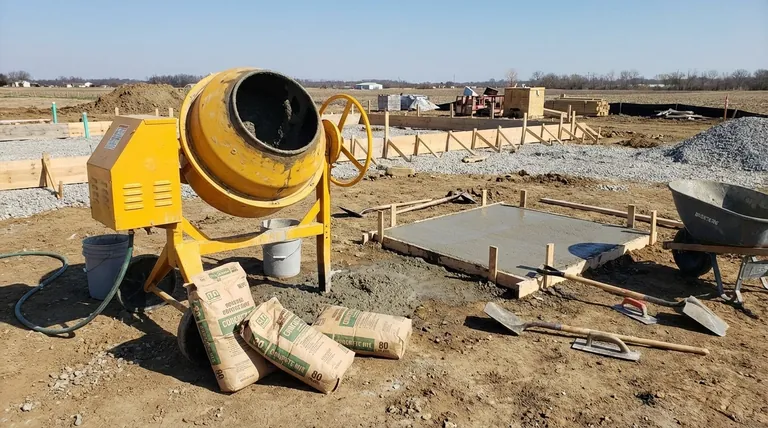
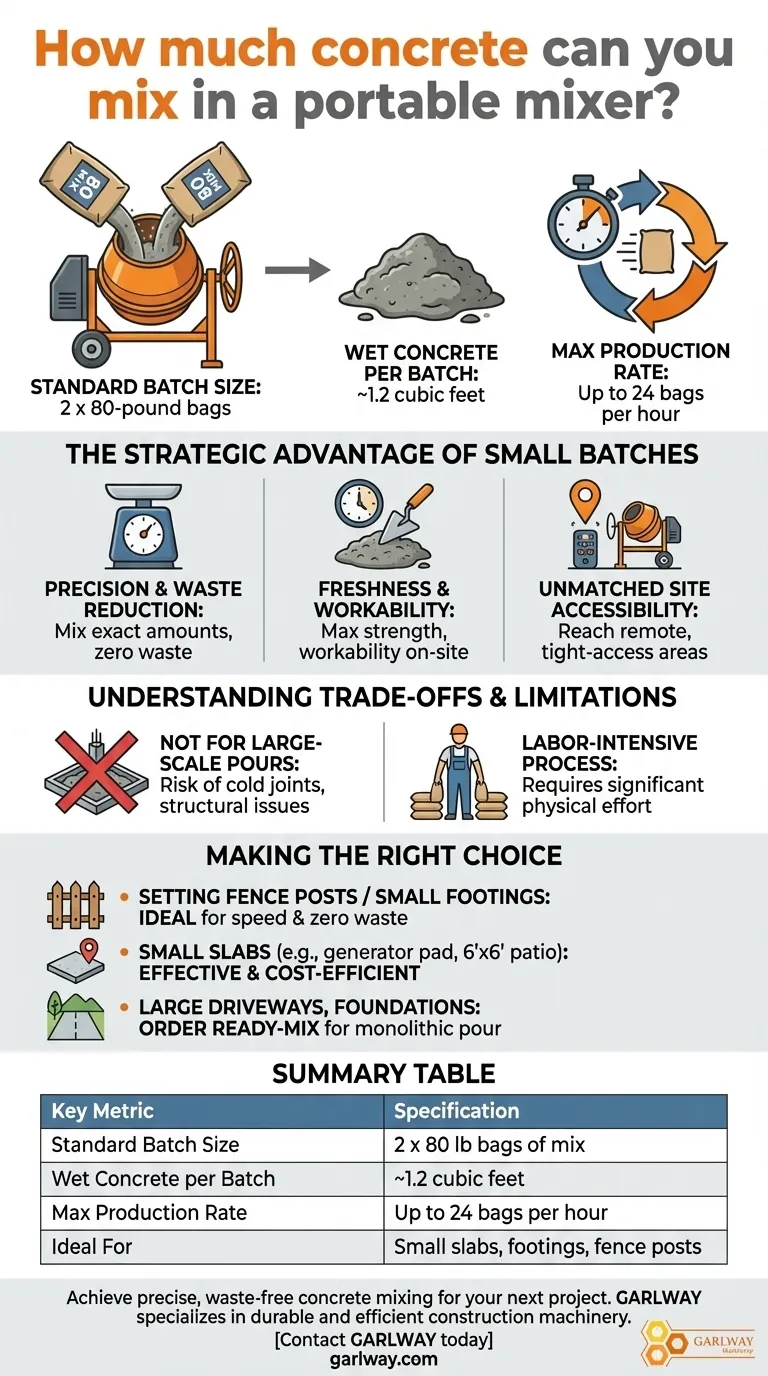
For most projects, a standard portable concrete mixer can effectively handle two 80-pound bags of dry concrete mix per batch. Following this guideline allows for a consistent workflow, enabling you to mix and pour up to 24 bags in a single hour without overloading the machine or compromising the quality of the concrete.
The limited capacity of a portable mixer is not a flaw, but its core feature. It is engineered for precision, control, and waste reduction on small-to-medium scale jobs, ensuring you mix only what you need, exactly when you need it.
Understanding Mixer Capacity in Practice
A portable mixer's specifications can be listed in liters or cubic feet, but the most practical measure for planning a project is the number of standard bags it can handle. Understanding this relationship is key to an efficient workflow.
The Two-Bag Rule
The industry standard for most common rental and homeowner-grade portable mixers is a maximum of two 80-pound bags of mix. This volume allows enough free space in the drum for the material to tumble and mix thoroughly.
Translating Bags to Volume
An 80-pound bag of concrete mix yields approximately 0.6 cubic feet of wet concrete. Therefore, a two-bag batch produces about 1.2 cubic feet of usable concrete.
Why Not Fill the Drum?
A typical portable mixer drum may have a total volume of 3 to 5 cubic feet (around 140 liters). However, effective mixing requires the material to cascade. Overfilling the drum prevents this action, resulting in a poorly blended, inconsistent mix with dry pockets.
Calculating Your Production Rate
Assuming a smooth process of loading, mixing for 3-5 minutes, and discharging, you can realistically complete a batch every 10-15 minutes. This is how you can achieve a production rate of up to 24 bags per hour with an organized team.
The Strategic Advantage of Small Batches
The deliberate capacity limit of a portable mixer provides significant benefits for certain types of projects, making it a superior choice over hand-mixing or ordering a small load of ready-mix concrete.
Precision and Waste Reduction
Small batches give you complete control. You can mix the exact amount needed for setting a few posts or pouring a small landing, virtually eliminating the material waste and disposal costs associated with leftover concrete.
Freshness and Workability
Concrete begins to set the moment water is added. Mixing on-site, right next to your forms, ensures you are always working with fresh, plastic concrete at its maximum strength and workability.
Unmatched Site Accessibility
Portable mixers can be wheeled directly to remote or tight-access areas where a large concrete truck simply cannot go. This flexibility saves immense labor that would otherwise be spent transporting concrete with wheelbarrows.
Understanding the Trade-offs and Limitations
While excellent for its intended purpose, a portable mixer is not the right tool for every job. Recognizing its limitations is crucial for avoiding project delays and quality issues.
Not Designed for Large-Scale Pours
A portable mixer is entirely unsuitable for large projects like a full driveway, a large patio, or a house foundation. The slow production rate would make it impossible to pour the slab monolithically, creating "cold joints" between batches that severely compromise its structural integrity and finish.
It Is a Labor-Intensive Process
The convenience of a portable mixer is paid for with labor. The process involves repeatedly lifting and handling heavy bags, water, and tools. A project requiring 20+ bags is a significant physical undertaking.
Portable vs. Self-Loading Mixers
It's important to distinguish a standard portable mixer from larger "self-loading" or mobile batch mixers. Those larger machines can produce several cubic meters per batch but are heavy industrial equipment, not tools for typical DIY or small contracting jobs.
Making the Right Choice for Your Project
Use your project's total volume as the primary guide for deciding if a portable mixer is the right tool.
- If your primary focus is setting fence posts or pouring small footings: A portable mixer is the ideal tool, offering speed and zero waste.
- If your primary focus is a small slab, like a generator pad or a 6'x6' patio: A portable mixer is a very effective and cost-efficient choice.
- If your primary focus is a large driveway, garage floor, or building foundation: You must order ready-mix concrete delivered by a truck to ensure a proper pour.
Choosing the right mixing method is the foundational step toward a successful and durable concrete project.
Summary Table:
| Key Metric | Specification |
|---|---|
| Standard Batch Size | 2 x 80 lb bags of mix |
| Wet Concrete per Batch | ~1.2 cubic feet |
| Max Production Rate | Up to 24 bags per hour |
| Ideal For | Small slabs, footings, fence posts |
Achieve precise, waste-free concrete mixing for your next project. GARLWAY specializes in durable and efficient construction machinery, including portable concrete mixers designed for contractors and construction companies. Our equipment ensures you mix only what you need, right on site. Contact GARLWAY today to find the perfect mixer for your job!
Visual Guide
Related Products
- Portable Concrete Mixer Machine Equipment for Mixing Concrete
- Portable Ready Mix Concrete Mixer Equipment
- Portable Electric Concrete Mixer Machine for Cement Mixing
- Portable Cement Mixer with Lift Concrete Machine
- Portable Electric Small Cement Mixer Concrete Machine
People Also Ask
- Why is it necessary to use a portable concrete mixer? Gain Total Control & Efficiency
- How much concrete can you pour with a portable mixer? Find the Perfect Fit for Your Project
- What types of projects are portable concrete mixers suitable for? Ideal for DIY & Small-Scale Construction
- How much does a portable concrete mixer hold? A Guide to Choosing the Right Capacity
- What types of portable concrete mixers exist? Find the Perfect Mixer for Your Project