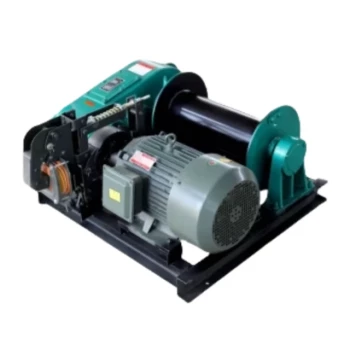
Operating a drum winch effectively hinges on understanding its two unique physical behaviors and adhering to strict safety protocols. Unlike other winches, a drum winch has a variable retrieval speed that increases as more rope accumulates on the drum, and the rope itself will move from side to side during operation.
The core challenge of drum winch operation is not to fight its inherent characteristics—like changing speeds and lateral rope movement—but to anticipate and manage them through proper equipment and operator technique.
The Core Principle: A Changing Drum Diameter
The operational quirks of a drum winch all stem from one simple fact: as the rope or chain winds onto the spool, the effective diameter of that spool increases. This has direct consequences for both speed and power.
Understanding Variable Retrieval Speed
As rope layers onto the drum, the motor pulls from a larger effective radius.
For a constant motor speed, this increasing diameter directly translates to a faster linear retrieval speed. The winch will pull slowest when the drum is empty and fastest when it is full.
Managing Lateral Rope Movement
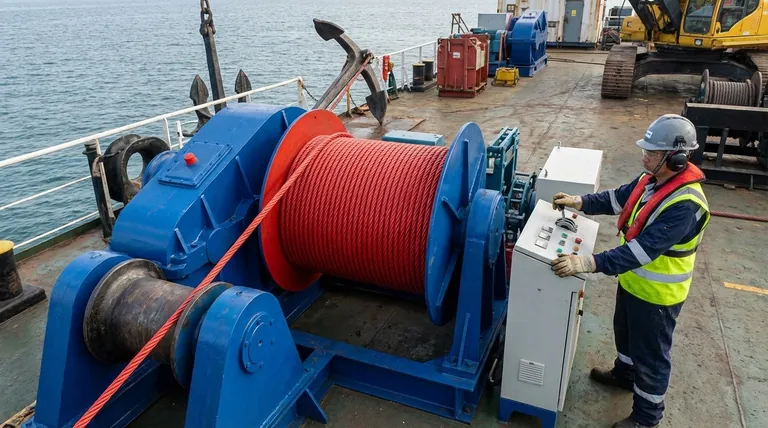
As the rope winds onto the drum, it lays itself side-to-side to fill the spool evenly.
This "walking" motion is a normal and necessary part of the operation. Without proper guidance, this movement can cause the rope to chafe against a vessel's anchor well or gunwale.
The Impact on Pulling Power
The relationship between speed and power is inverse.
A winch has the most pulling power (torque) on its first layer, when the drum diameter is smallest and retrieval speed is slowest. As the drum fills, retrieval speed increases, but the maximum pulling force slightly decreases.
Essential Handling and Mitigation Techniques
You can manage the drum winch's inherent behaviors with the right hardware and a disciplined operator approach.
The Role of Guided Rollers
A properly installed bow roller or hawsepipe is not optional; it is a critical component.
These guides ensure the rope feeds cleanly to the winch and contains the side-to-side movement, protecting both the rope and the vessel from damage.
Controlled Operation During Final Retrieval
The final moments of retrieval are the most critical. At this point, the drum is nearly full, and the anchor or load is moving at its maximum speed.
Operators must "jog" or pulse the control switch to slow the retrieval. This prevents the load from slamming into the rollers and causing costly damage to the vessel, winch, or anchor.
Critical Safety Protocols to Prevent Failure
The power of a drum winch demands an unwavering commitment to safety. Ignoring these protocols can lead to equipment failure and serious injury.
Operator Competency is Non-Negotiable
Only trained and authorized personnel should ever operate a drum winch. A complete understanding of its variable speed characteristics is essential for safe use.
The Pre-Operation Inspection
Before every use, conduct a thorough check.
Ensure the rope or wire is free of frays and kinks. Verify all connections, shackles, and mounting bolts are secure and in good condition.
Never Exceed Rated Capacity
Overloading a winch is the primary cause of catastrophic failure.
Exceeding the winch's capacity can stall or burn out the motor, strip the gears, or, most dangerously, snap the rope, turning it into a lethal projectile.
Personal Protective Equipment (PPE)
Always wear appropriate protective gear.
This includes heavy-duty gloves to protect hands and safety glasses to protect against debris or in the event of a rope failure.
Applying This to Your Operation
Your operational priority will determine which aspect of the winch's behavior requires the most attention.
- If your primary focus is precision and control: Be most vigilant during the final stage of retrieval, using controlled switch operation to manage the winch's peak speed.
- If your primary focus is equipment longevity: Ensure guided rollers are properly installed and the rope lays evenly to prevent premature wear on the line and vessel.
- If your primary focus is safety: The pre-operation inspection and a strict adherence to the winch's rated load capacity are the most critical steps to prevent failure.
Understanding these core principles transforms the drum winch from a simple tool into a predictable and powerful asset.
Summary Table:
| Consideration | Key Principle | Mitigation Technique |
|---|---|---|
| Variable Speed | Speed increases as drum fills; power is highest on the first layer. | Pulse controls during final retrieval to manage peak speed. |
| Lateral Movement | Rope moves side-to-side as it spools; this is normal but must be guided. | Use properly installed bow rollers or hawsepipes to guide the rope. |
| Safety & Longevity | Overloading causes failure; improper handling damages equipment. | Conduct pre-op inspections, never exceed rated capacity, and wear proper PPE. |
Need a reliable and powerful drum winch for your construction or marine project? GARLWAY specializes in high-performance construction machinery, including robust winches, concrete mixers, and batching plants designed for the demanding needs of contractors and construction companies globally. Our equipment is engineered for safety, durability, and predictable operation. Contact our experts today to find the perfect winch solution for your specific operational requirements and enhance your site's efficiency and safety.
Visual Guide

Related Products
- Best 18000 Pound Drum Anchor Trailer Winch
- Warn Winch Windlass Boat Trailer Winch
- Portable Small Trailer Winch
- Heavy Duty Electric Boat Winch Windlass Anchor
- Quick Windlass Portable Winch for Truck and Boat Best Boat Winch
People Also Ask
- In what scenarios is a winch particularly useful for trailers? Load Heavy Items Safely & Efficiently
- How do you install a trailer winch? A Step-by-Step Guide for a Safe & Secure Setup
- What should be considered when mounting a winch on a trailer? Ensure a Safe, Aligned Installation
- What are the considerations for equipping a trailer with a winch for hauling a car? A Guide to Safe and Efficient Vehicle Loading
- What are the main types of trailer winches? Choose the Right Power Source for Your Load