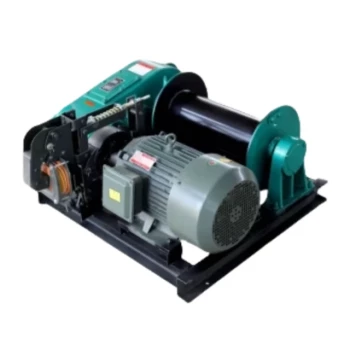
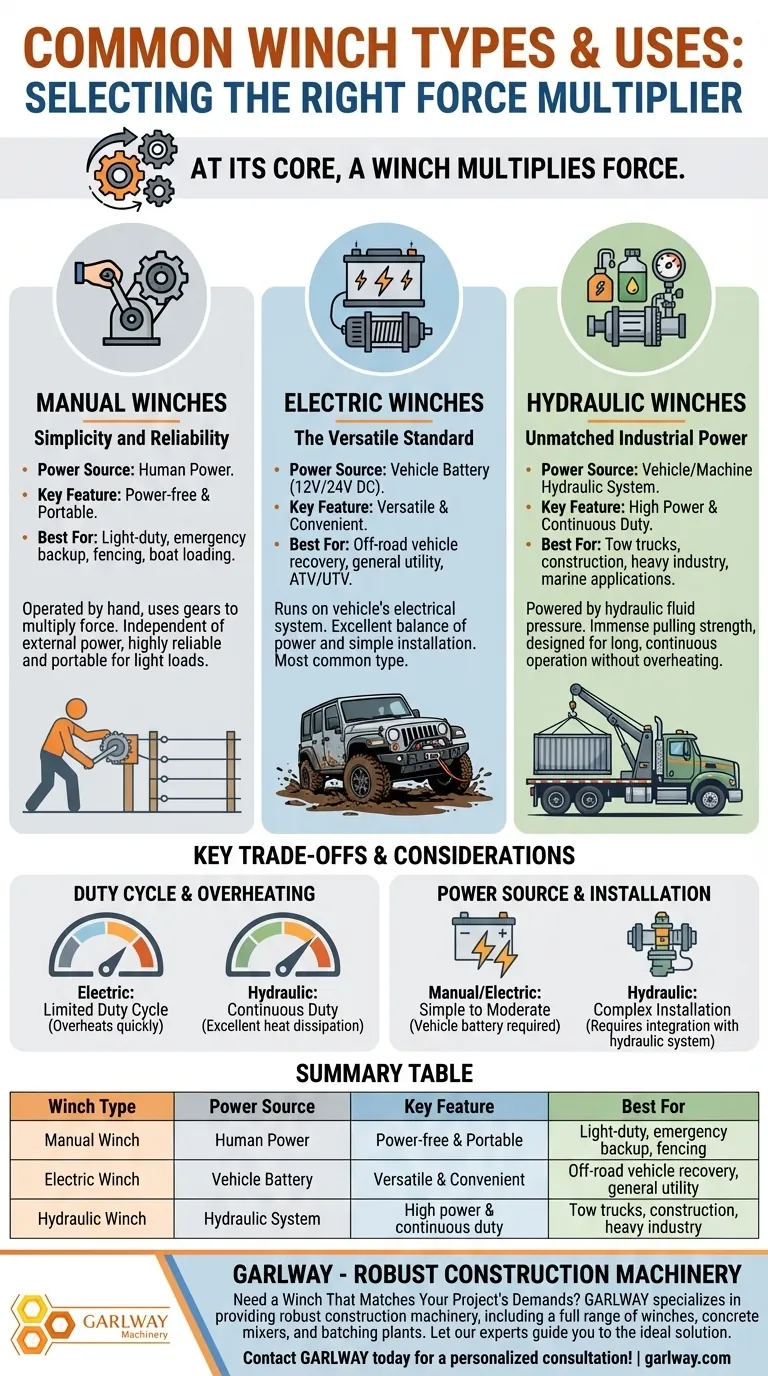
At its core, a winch is a tool that multiplies force. The most common types are categorized by their power source: manual, electric, and hydraulic. While electric winches are the most versatile and widely used for vehicle recovery and general tasks, hydraulic winches dominate heavy industrial applications, and manual winches serve as reliable, power-free solutions for light-duty work.
Choosing the right winch is not about finding the "best" type, but about matching the tool's power source and operational limits to your specific needs for power, portability, and usage frequency.
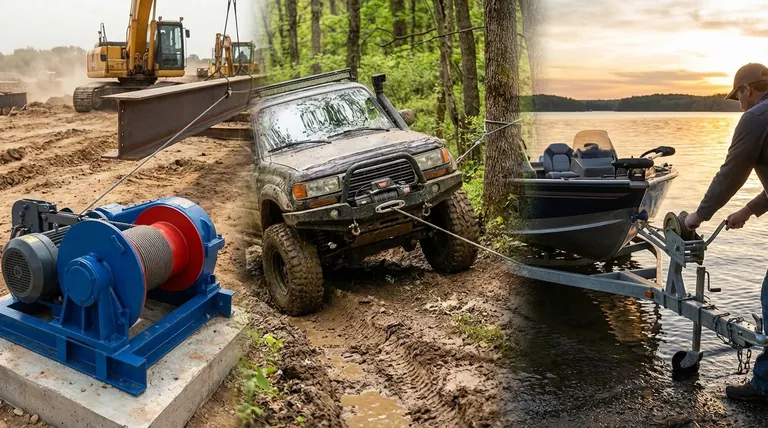
The Three Core Winch Types Explained
The fundamental difference between winches lies in how they generate pulling power. This dictates their size, strength, cost, and ideal application.
Manual Winches: Simplicity and Reliability
A manual winch is operated by hand, typically with a lever or crank. It uses a system of gears to multiply the force you apply, allowing you to move heavy objects with minimal effort.
Their primary advantage is their complete independence from any external power source. This makes them exceptionally reliable and portable.
They are best suited for light-duty applications like loading a boat onto a trailer, tensioning fence lines, or as an emergency backup tool in a remote location.
Electric Winches: The Versatile Standard
Electric winches are the most common type found on consumer vehicles. They run on 12-volt or 24-volt DC power, drawing directly from your vehicle's battery and alternator.
Their popularity stems from their excellent balance of power, relatively simple installation, and convenience. They are the go-to choice for off-road vehicle recovery, utility work, and general-purpose pulling.
Specialized versions, such as smaller ATV/UTV winches, are simply scaled-down electric winches designed specifically for the power systems and size constraints of smaller off-road vehicles.
Hydraulic Winches: Unmatched Industrial Power
Hydraulic winches are powered by a vehicle's or machine's hydraulic system, often tapping into the power steering pump. They convert hydraulic fluid pressure into immense rotational force.
These are the workhorses of the industrial world, prized for their incredible pulling strength and their ability to run for very long periods without overheating.
You will find hydraulic winches on tow trucks, industrial equipment, construction vehicles, and in marine applications where heavy, continuous-duty performance is non-negotiable.
Understanding the Trade-offs
Selecting a winch involves balancing competing factors. What you gain in one area, you often sacrifice in another.
Duty Cycle and Overheating
An electric winch's motor generates significant heat and has a limited duty cycle. This means it can only run for a short period before it must cool down to prevent damage, making it unsuitable for long, continuous pulls.
Hydraulic systems, by contrast, are excellent at dissipating heat. A hydraulic winch can operate almost continuously as long as the engine powering the hydraulic pump is running, which is essential for commercial applications.
Power Source and Installation
Manual winches require no power source, offering ultimate simplicity. Their limitation is purely the physical effort of the operator.
Electric winches demand a robust vehicle electrical system. A powerful winch can draw hundreds of amps, potentially draining a battery quickly if the engine isn't running to power the alternator.
Hydraulic winches require a more complex installation, as they must be integrated with a vehicle's hydraulic pump and fluid lines. This makes them a less common choice for a typical consumer vehicle.
How to Select the Right Winch for Your Task
Your choice should be driven entirely by your primary use case.
- If your primary focus is occasional self-recovery for an off-road vehicle: An electric winch offers the best combination of power, convenience, and affordability for this task.
- If your primary focus is heavy, continuous-duty commercial or industrial work: A hydraulic winch is the only reliable choice due to its immense power and superior duty cycle.
- If your primary focus is a lightweight, portable solution for emergencies or areas without power: A manual winch provides unmatched reliability and simplicity for light to moderate loads.
Understanding these core differences empowers you to choose a tool perfectly matched to your specific challenge.
Summary Table:
| Winch Type | Power Source | Key Feature | Best For |
|---|---|---|---|
| Manual Winch | Human Power | Power-free & portable | Light-duty, emergency backup, fencing |
| Electric Winch | Vehicle Battery | Versatile & convenient | Off-road vehicle recovery, general utility |
| Hydraulic Winch | Hydraulic System | High power & continuous duty | Tow trucks, construction, heavy industry |
Need a Winch That Matches Your Project's Demands?
Choosing the right winch is critical for safety and efficiency. GARLWAY specializes in providing robust construction machinery, including a full range of winches, concrete mixers, and batching plants.
We help construction companies and contractors globally select the perfect equipment for their specific challenges, ensuring powerful performance and reliability on every job.
Let our experts guide you to the ideal solution. Contact GARLWAY today for a personalized consultation!
Visual Guide
Related Products
- Warn Winch Windlass Boat Trailer Winch
- Small Electric Winch 120V and 240V for Compact Applications
- Electric and Hydraulic Winch for Heavy Duty Applications
- Quick Windlass Portable Winch for Truck and Boat Best Boat Winch
- Portable Small Trailer Winch
People Also Ask
- What are the main components of a boat trailer winch? A Guide to Safe & Efficient Boat Loading
- What factors should be considered when choosing a boat trailer winch? Ensure Safe and Effortless Boat Loading
- What is the purpose of boat trailer winches? Safely and Efficiently Load Your Boat
- What are the two main types of boat trailer winches? Manual vs. Electric Explained
- How often should a boat trailer winch be replaced? Your Guide to Safety and Longevity