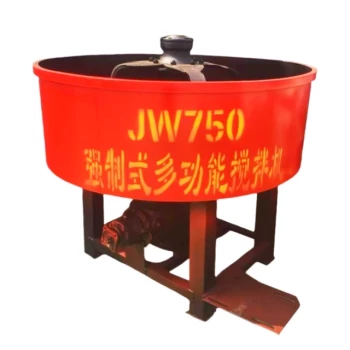
At its core, a concrete batching plant follows four primary stages: raw material handling, precision batching (weighing), mixing, and discharging. Each stage is a distinct and automated process designed to transform individual ingredients into a homogeneous, high-quality final product ready for transport.
The critical insight is that a batching plant's primary function is not just mixing, but precise, automated proportioning. The accuracy of the batching stage—weighing each component exactly as specified—is the single most important factor in determining the final strength and consistency of the concrete.
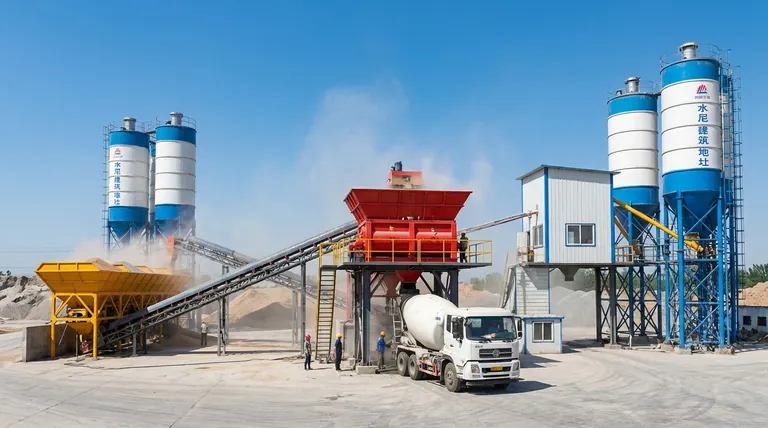
A Breakdown of the Concrete Production Flow
The entire operation is a systematic sequence, managed by a central control system to ensure accuracy and repeatability from one batch to the next. The duration of this full cycle, from weighing to discharge, is known as the batch time.
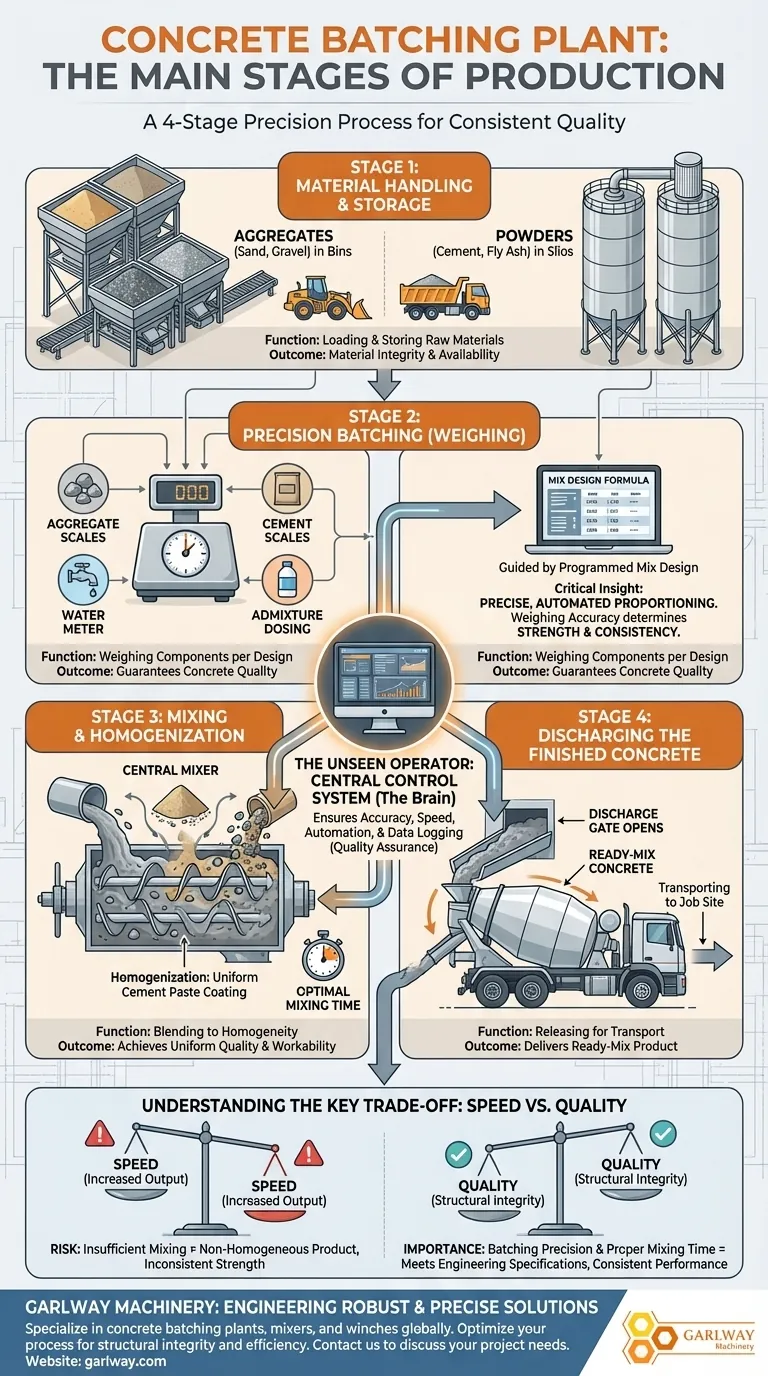
Stage 1: Material Handling and Storage
Before any mixing can occur, the raw materials must be loaded and stored correctly. This is the foundational logistics step.
Aggregates like sand and gravel are loaded into separate aggregate bins. Powders, primarily cement and fly ash, are stored in tall, enclosed silos to protect them from moisture.
Stage 2: Precision Batching (Weighing)
This is the most critical stage for quality control. Guided by a specific mix design programmed into the control system, the plant precisely measures each raw material.
Separate scales are used for each component. Aggregates are weighed, cement and other powders are weighed, water is metered by volume or weight, and chemical admixtures are dosed with high precision.
Stage 3: Mixing and Homogenization
Once batched, all materials are delivered into the central mixer. This powerful unit, often a twin-shaft or planetary mixer, rotates to blend the components together.
The goal is homogenization—ensuring every grain of sand and piece of aggregate is evenly coated with cement paste (the mixture of cement, water, and admixtures). The mixing time is carefully controlled to achieve this without over-mixing.
Stage 4: Discharging the Finished Concrete
After the specified mixing time is complete, the mixer's discharge gate opens. The fresh, ready-mix concrete is then released directly into a transit mixer truck or a concrete pump waiting below.
The truck then agitates the concrete during transport to the job site to maintain its consistency.
The Unseen Operator: The Central Control System
It's impossible to discuss the batching process without highlighting the control system. This is the brain of the entire operation, automating every step from weighing to discharge.
Ensuring Accuracy and Speed
The control system receives the mix design formula and executes it flawlessly. It ensures that every batch produced has the exact same proportions, eliminating human error and guaranteeing consistent quality.
Providing Critical Data
Modern systems also log data for every batch, creating a detailed record for quality assurance. This includes the exact weights of all materials, mixing times, and other vital parameters.
Understanding the Key Trade-off: Speed vs. Quality
While efficiency is crucial, compromising on process time can have serious consequences for the structural integrity of the final product.
The Risk of Insufficient Mixing
The most common pitfall is reducing the mixing time to increase plant output. Insufficient mixing leads to a non-homogeneous product with inconsistent strength, workability, and durability.
The Importance of Batching Precision
Similarly, poorly calibrated scales or a rushed weighing process will compromise the mix design. This deviation directly impacts the concrete's performance, potentially causing it to fail to meet required engineering specifications.
How to Apply This to Your Project
Understanding this process allows you to make more informed decisions and ensure your project's success.
- If your primary focus is structural integrity: Pay closest attention to the plant's batching system and quality control records to verify mix design accuracy.
- If your primary focus is large-volume pours: Coordinate closely on the plant's batch time and logistical capacity to ensure a continuous and reliable supply of concrete.
- If your primary focus is specialized concrete (e.g., high-strength): Confirm the plant has a precise dosing system for the chemical admixtures that are critical to performance.
Ultimately, a modern concrete batching plant is a precision manufacturing process designed for one purpose: delivering consistent quality, batch after batch.
Summary Table:
| Stage | Key Function | Critical Outcome |
|---|---|---|
| 1. Material Handling | Loading and storing raw materials (aggregates, cement) | Ensures material integrity and availability |
| 2. Precision Batching | Weighing each component per the mix design | Guarantees concrete strength and consistency |
| 3. Mixing | Blending materials into a homogeneous mixture | Achieves uniform quality and workability |
| 4. Discharging | Releasing finished concrete for transport | Delivers ready-mix product to the job site |
Ready to achieve consistent, high-quality concrete for your construction projects?
GARLWAY specializes in engineering robust and precise construction machinery, including concrete batching plants, mixers, and winches for contractors and construction companies globally. Our solutions are designed to optimize your batching process, ensuring structural integrity and efficiency on every pour.
Contact our experts today to discuss how we can support your specific project needs and deliver unmatched value.
Visual Guide
Related Products
- HZS120 Ready Mix Concrete Batching Plant Commercial Mud Cement Mixer
- HZS35 Small Cement Concrete Mixing Batch Plant
- HZS75 Concrete Batching Plant Cement Mixer Price Concrete Mixer Bunnings Mixing Plant
- HZS180 Ready Mix Concrete Plant for Foundations with Sand and Cement
- Commercial Electric Concrete Mixer Machine HZS 50 Small Batch Plant for Sale
People Also Ask
- What is a ready mix concrete batching plant? The Engine of Modern Construction
- What is the name of the machine used in ready mix? Unpacking the Complete Concrete System
- What is the core component of a concrete batching plant? The Mixer Unit Defines Your Concrete Quality
- What are the types of concrete mixers used in batching plants? Choose the Right Mixer for Your Project
- What are the advantages and disadvantages of concrete batching plants? Maximize Quality & Efficiency