
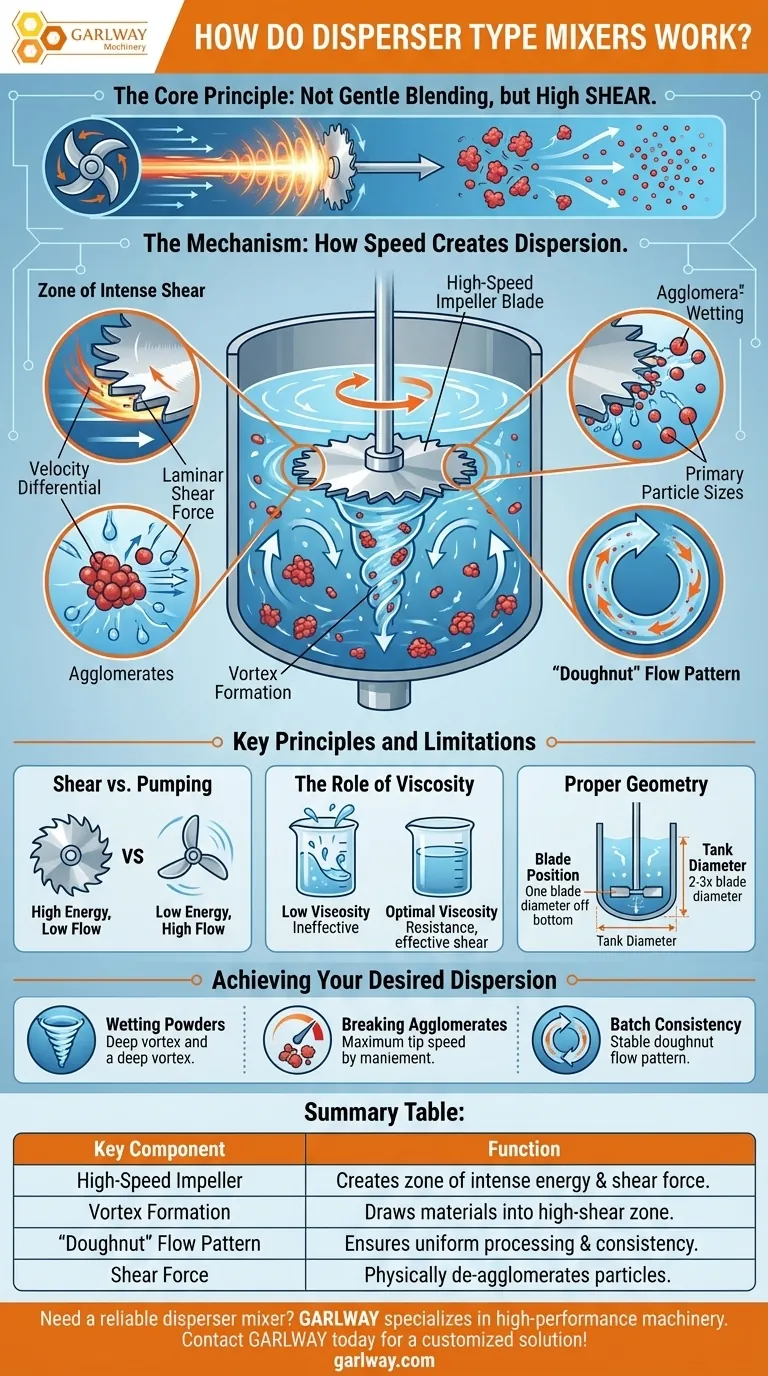
In essence, a disperser-type mixer works by using a high-speed, disc-shaped blade to create a zone of intense energy. This concentrated force physically tears apart and dissolves clumps of solid particles within a liquid, ensuring a smooth, consistent, and stable final product.
The core principle is not gentle blending, but the application of high shear. The immense speed difference between the blade's edge and the surrounding liquid generates a violent force that de-agglomerates particles, which is something a simple stirrer cannot achieve.
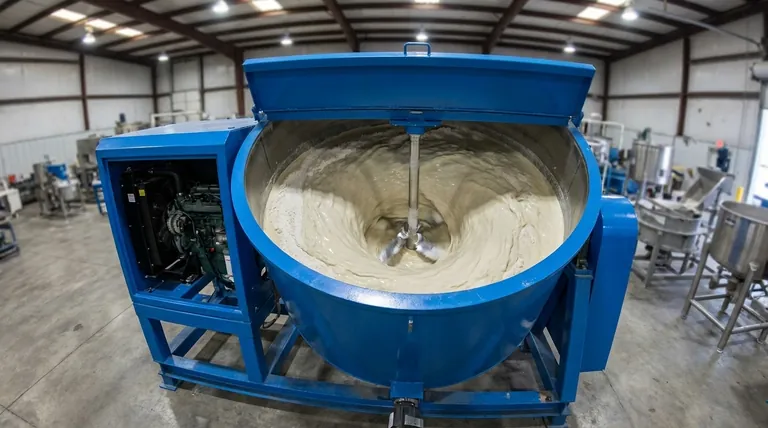
The Mechanism: How Speed Creates Dispersion
A high-speed disperser (HSD) operates on a simple but powerful principle of physics. The process can be broken down into a distinct sequence of events driven by the unique design of the impeller blade.
The High-Speed Impeller Blade
The heart of the system is the blade, often a flat disc with serrated or saw-toothed edges. This is not designed to simply push liquid around like a propeller. Its purpose is to create extreme turbulence and velocity differences.
Creating the Vortex
When the machine is started, the blade's rotation pulls liquid and solids downward from the surface, forming a distinct vortex. This initial flow is critical for drawing raw materials into the working area of the blade.
The Zone of Intense Shear
The real work happens at the tips of the rotating blade. The blade spins at such a high velocity that the liquid just millimeters away from its edge is moving significantly slower. This velocity differential creates intense laminar shear, a force that rips apart clumps of solid particles.
Disintegration and Wetting
This powerful shear force physically disintegrates agglomerates back into their primary particle sizes. Simultaneously, it forces the liquid medium to coat the surface of each individual particle, a process known as "wetting."
The "Doughnut" Flow Pattern
The material that is subjected to high shear at the blade is flung horizontally outward at high speed. It travels to the vessel walls, flows up to the surface, and is then pulled back down into the vortex. This circular, doughnut-shaped flow pattern ensures the entire batch repeatedly passes through the high-shear zone, leading to a uniform dispersion.
Key Principles and Limitations
While powerful, high-speed dispersers are not a universal solution. Their effectiveness is governed by specific physical principles and they have clear operational boundaries.
Shear vs. Pumping
A disperser is a high-shear, low-pumping device. It is exceptionally good at imparting energy into a small zone but is inefficient at creating bulk flow or blending in a large tank. Its primary job is particle size reduction, not simple mixing.
The Role of Viscosity
The process requires a degree of product viscosity to work correctly. The liquid must provide enough resistance for the shear forces to take effect. In very low-viscosity liquids, like water, the blade may simply splash material without establishing the necessary flow pattern.
Proper Blade and Vessel Geometry
Optimal performance depends on the relationship between the blade and the mixing vessel. The blade is typically positioned in the center, about one blade diameter off the bottom of the tank. The tank diameter itself is usually about two to three times the blade diameter to allow the "doughnut" flow pattern to establish properly.
Achieving Your Desired Dispersion
To use a disperser effectively, you must align its operational parameters with your specific material goal.
- If your primary focus is rapidly wetting out powders: Run the disperser at a speed that creates a deep, stable vortex to quickly pull powders down from the surface into the liquid.
- If your primary focus is breaking down tough agglomerates: Maximize the blade's tip speed, as this directly correlates to the intensity of the shear force being applied to the particles.
- If your primary focus is overall batch consistency: Pay close attention to the blade's position and the vessel's geometry to ensure a stable "doughnut" flow is established, guaranteeing all material is processed evenly.
By understanding that a disperser works by creating controlled violence on a microscopic level, you can effectively control your formulation's final quality and stability.
Summary Table:
| Key Component | Function |
|---|---|
| High-Speed Impeller | Creates a zone of intense energy and shear force. |
| Vortex Formation | Draws materials into the high-shear zone for processing. |
| 'Doughnut' Flow Pattern | Ensures all material is uniformly processed for consistency. |
| Shear Force | Physically de-agglomerates particles for a smooth final product. |
Need a reliable disperser mixer for your production line? GARLWAY specializes in high-performance construction and industrial machinery, including mixers and batching plants designed for durability and efficiency. Let our experts help you select the perfect equipment to improve your product quality and operational stability. Contact GARLWAY today for a customized solution!
Visual Guide
Related Products
- HZS25 Best Cement Mixer for Quick Mix Concrete at Bunnings
- Commercial Electric Concrete Mixer Machine HZS 50 Small Batch Plant for Sale
- HZS90 Large Multiquip Concrete Mixers for Construction
- JDY350 Electric Hydraulic Mortar Mud Concrete Mixer
- HZS120 Ready Mix Concrete Batching Plant Commercial Mud Cement Mixer
People Also Ask
- How do cement mixers enhance safety on construction sites? Reduce Strain, Hazards, and Accidents
- What are the main components of a cement mixer? A Guide to Core Parts & Functions
- What are some tips for using a cement mixer effectively? Maximize Your Mixer's Performance & Concrete Quality
- How does cleaning a cement mixer after use benefit its performance? Maximize Lifespan and Mix Quality
- Why is it important to clean the cement mixer after use? Prevent Costly Damage and Ensure Quality Concrete


