There is no single "best" tool for mixing concrete; the ideal choice is entirely dependent on the scale of your project. For very small repairs, manual mixing is adequate, but for most DIY projects, a portable mixer is essential for achieving the strength and consistency required for a durable result. Large-scale construction demands even more powerful equipment.
The most critical factor in choosing a mixing tool is the volume of concrete you need. Matching the tool to the job ensures you don't compromise on quality for a small project or waste significant time and effort on a large one.
Matching the Tool to the Project Scale
The effectiveness of any tool is measured by its suitability for the task at hand. Concrete is no different. Let's break down the options based on the size of your job.
For Very Small Repairs: Manual Mixing
If you are setting a single fence post or patching a small crack, mixing by hand is a practical option. This is typically done in a wheelbarrow or a plastic mixing tub.
You will need a sturdy hoe or a flat shovel to combine the dry mix, and then slowly add water while continuously turning the material over.
The goal is to achieve a uniform color and consistency, ensuring there are no dry pockets left in the mix.
For Small to Medium Projects: The Portable Drum Mixer
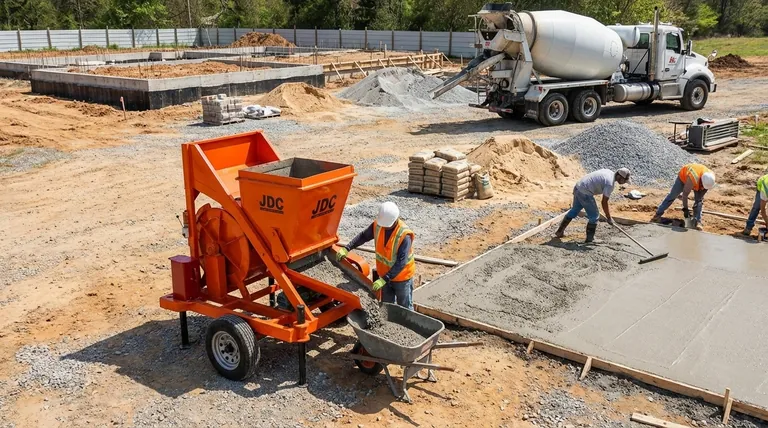
This is the most common and effective tool for homeowners and serious DIYers. Projects like pouring a small slab for a shed, creating a walkway, or setting multiple posts benefit immensely from a mixer.
These mixers, often called "cement mixers," use a rotating drum with internal paddles to tumble the aggregate, sand, cement, and water together.
Using a portable electric or gas-powered mixer guarantees a far more consistent and evenly hydrated mix than you can achieve by hand. This leads directly to stronger, higher-quality concrete.
For Large-Scale Jobs: High-Capacity Mixers or Ready-Mix
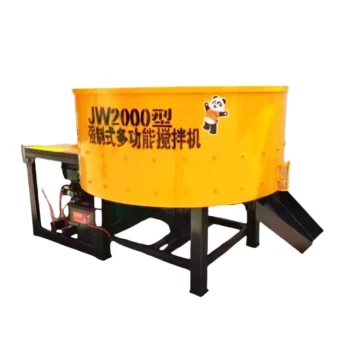
For foundations, large driveways, or commercial construction, you need to handle massive volumes efficiently. Large, high-capacity drum mixers are used on professional job sites for this purpose.
However, for projects of this scale, the most practical solution is often to order ready-mix concrete delivered by a truck.
This eliminates the labor of mixing on-site, guarantees a professionally engineered mix, and allows you to place a large volume of concrete very quickly.
Understanding the Trade-offs
Every method comes with its own set of advantages and disadvantages. Being aware of them is key to making an informed decision.
The Risk of Manual Mixing
The primary trade-off with hand mixing is quality for cost. You save money on equipment rental or purchase, but it is physically demanding and makes achieving a perfectly consistent mix very difficult.
Inconsistent mixing can lead to weak spots in the final product, severely compromising its long-term durability.
The Investment of a Portable Mixer
A portable mixer requires an upfront investment, whether you rent it for a day or purchase one.
The trade-off is this cost versus a dramatic reduction in physical labor and a significant increase in the quality and strength of your finished concrete. For any project of meaningful size, the mixer is a worthwhile investment.
The Logistics of Ready-Mix
Ordering a concrete truck is the most efficient way to handle large volumes, but it introduces logistical challenges.
You trade on-site control for speed and scale. You must be fully prepared to place, spread, and finish the concrete the moment the truck arrives, as it operates on a strict schedule.
Making the Right Choice for Your Project
Your decision should be guided by the scope of your work and your desired outcome.
- If your primary focus is a quick patch or setting a single post: Manual mixing in a wheelbarrow is a perfectly acceptable and cost-effective method.
- If your primary focus is a new patio, walkway, or multiple footings: A portable electric drum mixer is the best tool to ensure a strong, consistent, and long-lasting result.
- If your primary focus is a large foundation, driveway, or commercial work: Ordering ready-mix concrete is almost always the most efficient and reliable choice.
Choosing the right mixing method is the foundational step toward a successful concrete project that will stand the test of time.
Summary Table:
| Project Scale | Recommended Tool | Key Benefit |
|---|---|---|
| Very Small Repairs (e.g., patching a crack) | Manual Mixing (Wheelbarrow/Hoe) | Cost-effective for tiny jobs |
| Small to Medium DIY Projects (e.g., patio, walkway) | Portable Drum Mixer | Consistent, strong mix with less labor |
| Large-Scale Construction (e.g., foundation, driveway) | High-Capacity Mixer or Ready-Mix Truck | Maximum efficiency and volume |
Ready to achieve professional-grade results on your concrete project?
GARLWAY specializes in providing durable and efficient construction machinery, including concrete mixers and batching plants, tailored for construction companies and contractors worldwide. Whether you're working on a DIY project or a large commercial site, our equipment ensures a consistent, high-strength mix every time.
Contact GARLWAY today to discuss your project needs and discover the perfect mixing solution for superior durability and performance!
Visual Guide

Related Products
- Portable Concrete Mixer Machine Equipment for Mixing Concrete
- Construction Products Concrete Plant Machine Mixing Concrete Mixer
- Portable Electric Concrete Mixer Machine for Cement Mixing
- JZC400 Mobile Small Concrete Mixer Cement Mixer Machine
- Hydraulic Concrete Mixer Machine Cement Mixing Equipment for Mixture Concrete
People Also Ask
- Why is it necessary to use a portable concrete mixer? Gain Total Control & Efficiency
- How much concrete can you pour with a portable mixer? Find the Perfect Fit for Your Project
- What types of projects are portable concrete mixers suitable for? Ideal for DIY & Small-Scale Construction
- How much does a portable concrete mixer hold? A Guide to Choosing the Right Capacity
- What types of portable concrete mixers exist? Find the Perfect Mixer for Your Project