
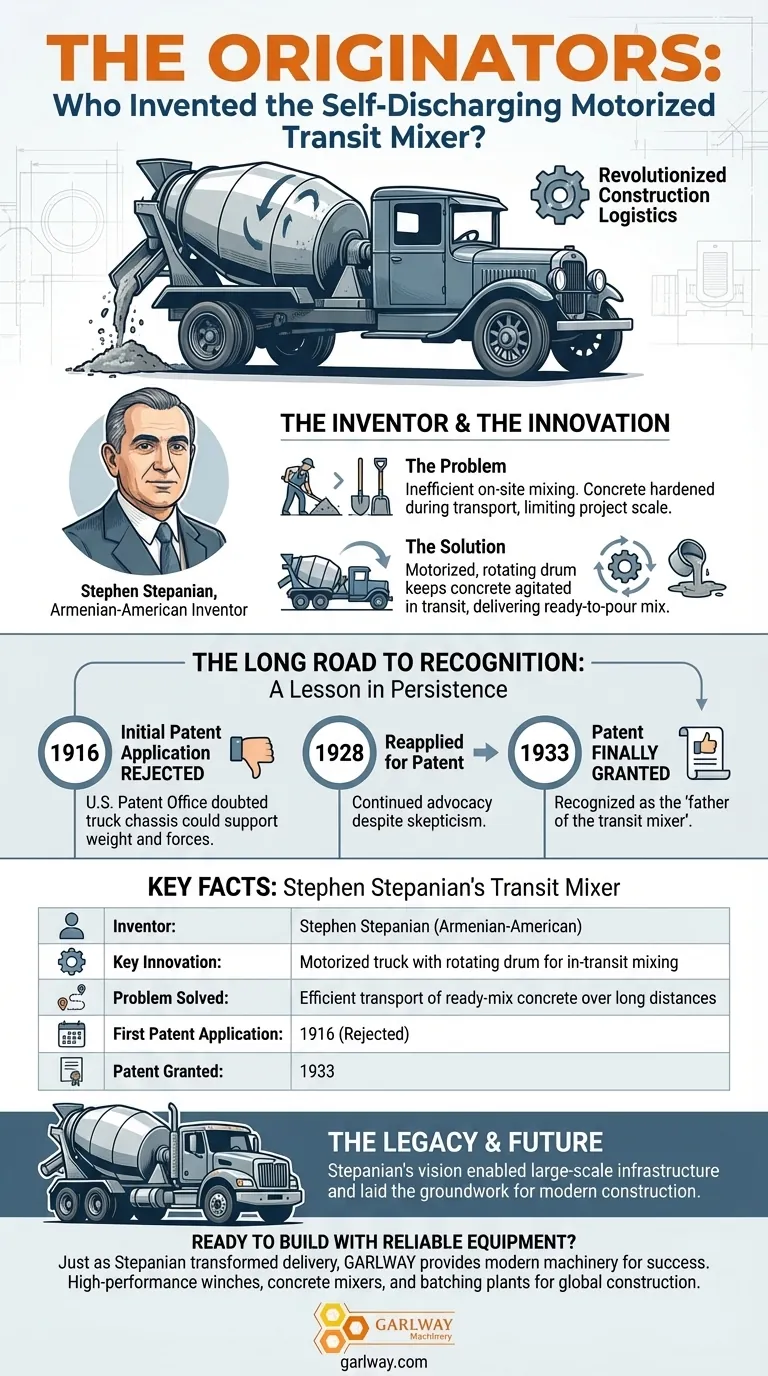
The individual credited with inventing the self-discharging motorized transit mixer is Stephen Stepanian, an Armenian-American inventor. This groundbreaking machine, which serves as the direct predecessor to the modern concrete mixer truck, revolutionized the construction industry by allowing concrete to be mixed while being transported to a job site.
While Stephen Stepanian is credited as the inventor, his story is a lesson in persistence. The path to recognition was not immediate, involving a patent application that was initially rejected and only approved nearly two decades later.
The Inventor and the Innovation
Stephen Stepanian's invention solved a fundamental logistics problem in construction. Before his transit mixer, concrete had to be mixed on-site, a labor-intensive and inefficient process that limited the scale and speed of projects.
Who Was Stephen Stepanian?
Stephen Stepanian was an inventor who saw a critical inefficiency in the building industry. He envisioned a way to combine the transportation and mixing of concrete into a single, motorized vehicle.
The Core Problem Being Solved
The primary challenge was ensuring concrete remained in a usable, liquid state from the mixing plant to the pour site. Transporting pre-mixed concrete over any significant distance was impossible, as it would begin to set and harden.
The Self-Discharging Mixer Concept
Stepanian’s design mounted a mixing drum on a truck chassis. The drum was engineered to rotate during transit, keeping the aggregate materials, cement, and water in a constant state of agitation. This prevented the concrete from setting, ensuring it was ready to be poured upon arrival.
The Long Road to Recognition
The revolutionary nature of Stepanian's idea was not immediately accepted by authorities. His journey from concept to a secured patent was a long and arduous one, highlighting the skepticism that often meets true innovation.
The Initial 1916 Patent Application
Stepanian first applied for a patent for his "motor-driven, self-discharging transit mixer" in 1916. However, his application was rejected by the U.S. Patent Office.
The Reason for Rejection
The patent office initially did not believe a truck chassis of that era could successfully support the immense weight and dynamic forces of a large, rotating drum full of wet concrete. The concept was considered impractical with the available automotive technology.
Persistence and Final Approval
Undeterred, Stepanian continued to advocate for his design. He reapplied for the patent in 1928, and after a lengthy process, it was finally approved and granted in 1933.
The Legacy of the Transit Mixer
Stepanian’s persistence paid off, and his invention fundamentally altered the construction landscape. He is now widely recognized by the industry as the father of the transit mixer.
- If your focus is on innovation: Stepanian's story demonstrates that a groundbreaking idea often requires immense perseverance to overcome initial institutional skepticism.
- If your focus is on construction history: His invention was a pivotal moment that enabled the development of large-scale infrastructure by making the delivery of consistent, high-quality concrete efficient and reliable.
Ultimately, Stephen Stepanian's vision transformed a central element of modern construction, laying the groundwork for the familiar concrete trucks we see today.
Summary Table:
| Key Fact | Details |
|---|---|
| Inventor | Stephen Stepanian (Armenian-American) |
| Key Innovation | Motorized truck with a rotating drum to mix concrete in transit |
| Problem Solved | Enabled efficient transport of ready-mix concrete over long distances |
| First Patent Application | 1916 (initially rejected) |
| Patent Granted | 1933 |
Ready to build with reliable concrete equipment? Just as Stephen Stepanian's invention transformed concrete delivery, GARLWAY provides the modern machinery you need for success. We specialize in high-performance construction equipment, including winches, concrete mixers, and concrete batching plants for construction companies and contractors worldwide.
Contact GARLWAY today to discuss how our durable and efficient solutions can power your next project.
Visual Guide
Related Products
- Ready Mixer Machine for Construction Ready Mix Machinery
- Skid Steer Self Loading Concrete Mixers for Construction
- Belle Mixer Drum Self Loading Mortar Mixers JS3000
- JW1000 Mobile Cement Mixer Concrete Mixer Truck and Batching Plant
- JZC400 Mobile Small Concrete Mixer Cement Mixer Machine
People Also Ask
- What are the purposes of low-speed agitation in truck mixers? Preserve Concrete Quality During Transit
- How is ready-mixed concrete transported from a commercial concrete batching plant? Ensuring Quality & Timely Delivery
- What are the main ingredients mixed in a concrete mixer truck? Master the Formula for Strong Concrete
- In what ways does a mobile concrete mixer improve quality control and consistency? Achieve Superior On-Site Concrete Quality
- What types of construction projects typically use concrete mixer trucks? From Highways to Home Foundations


