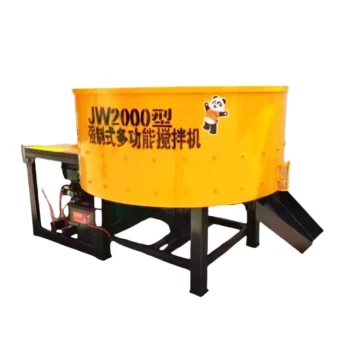
Beyond simply combining ingredients, a concrete mixer fundamentally transforms a construction site's workflow. Its core benefits are a dramatic increase in operational efficiency, the production of consistent, high-quality material, and significantly improved logistical flexibility. This allows teams to complete tasks faster while ensuring the structural integrity of their work.
The true advantage of using a concrete mixer is gaining direct control over your concrete supply. It decouples your project's timeline from third-party delivery schedules and removes the quality guesswork inherent in manual mixing.
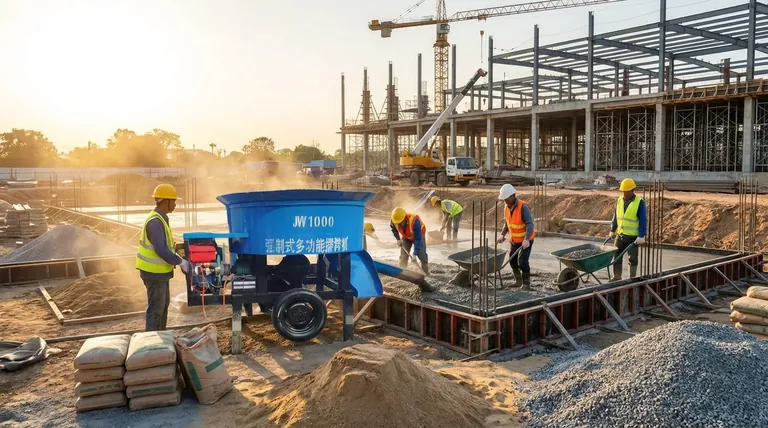
The Core Benefits of On-Site Mixing
Adopting a concrete mixer is less about the machine itself and more about the capabilities it unlocks. It allows for better management of time, materials, and labor, which are the cornerstones of any successful construction project.
Drastically Increased Efficiency
A concrete mixer allows a small team to produce large volumes of concrete in a fraction of the time it would take to mix by hand. This acceleration has a direct impact on the project's bottom line.
Faster mixing means crews can place concrete sooner, moving the entire project schedule forward. This reduction in labor hours and potential for early project completion translates directly into significant cost savings.
Unmatched Quality and Consistency
Manual mixing in a wheelbarrow or on a tarp is notoriously inconsistent. It's difficult to achieve a homogenous mixture, often resulting in weak spots or an improper water-to-cement ratio that compromises the final strength and durability.
A mechanical mixer ensures all components—cement, aggregate, and water—are thoroughly and evenly distributed. This process guarantees a predictable, high-quality batch every time, which is critical for structural applications.
Unlocking Job Site Flexibility
Projects rarely go exactly as planned. A key benefit of a portable or mobile mixer is the ability to produce fresh concrete on demand, exactly when and where it's needed.
This on-site capability is invaluable for accessing tight or hard-to-reach areas where a large ready-mix truck cannot go. It also allows teams to adapt quickly to unforeseen needs or changes without waiting for a new delivery.
Precise Material Control
Using an on-site mixer means you only produce the exact amount of concrete required. This minimizes material waste compared to ordering a minimum volume from a ready-mix supplier, which is both cost-effective and more environmentally responsible.
Understanding the Trade-offs: Mixer vs. Alternatives
While powerful, a concrete mixer isn't the universal solution for every scenario. Understanding its place relative to manual mixing and ready-mix delivery is key to making an informed decision.
On-Site Mixer vs. Manual Mixing
For anything beyond the smallest patch repair, a mechanical mixer is superior. Manual mixing is labor-intensive, slow, and produces inconsistent quality. A mixer is a clear investment in quality and efficiency for any significant volume of work.
On-Site Mixer vs. Ready-Mix Delivery
The choice here depends entirely on scale. On-site mixers are ideal for small to medium-sized jobs, remote sites, or projects where the pace of work is unpredictable. They offer unparalleled flexibility and control.
Ready-mix trucks are the standard for large, continuous pours like building foundations or large slabs. Their ability to deliver massive, pre-certified quantities of concrete is a logistical necessity for high-volume work.
How to Choose Your Concrete Method
Selecting the right approach depends entirely on the specific demands of your project. Align your method with your primary goal to ensure the best outcome.
- If your primary focus is minor repairs or an extremely limited budget: Manual mixing may be sufficient, but you must accept the compromise in structural quality and speed.
- If your primary focus is consistent quality and efficiency on small-to-medium jobs: An on-site portable concrete mixer is the most effective and professional solution.
- If your primary focus is pouring massive volumes for large-scale projects: Coordinating with a reliable ready-mix concrete supplier is the necessary and standard industry practice.
Ultimately, integrating a concrete mixer into your workflow is about taking control of a critical project variable and empowering your team to deliver better results.
Summary Table:
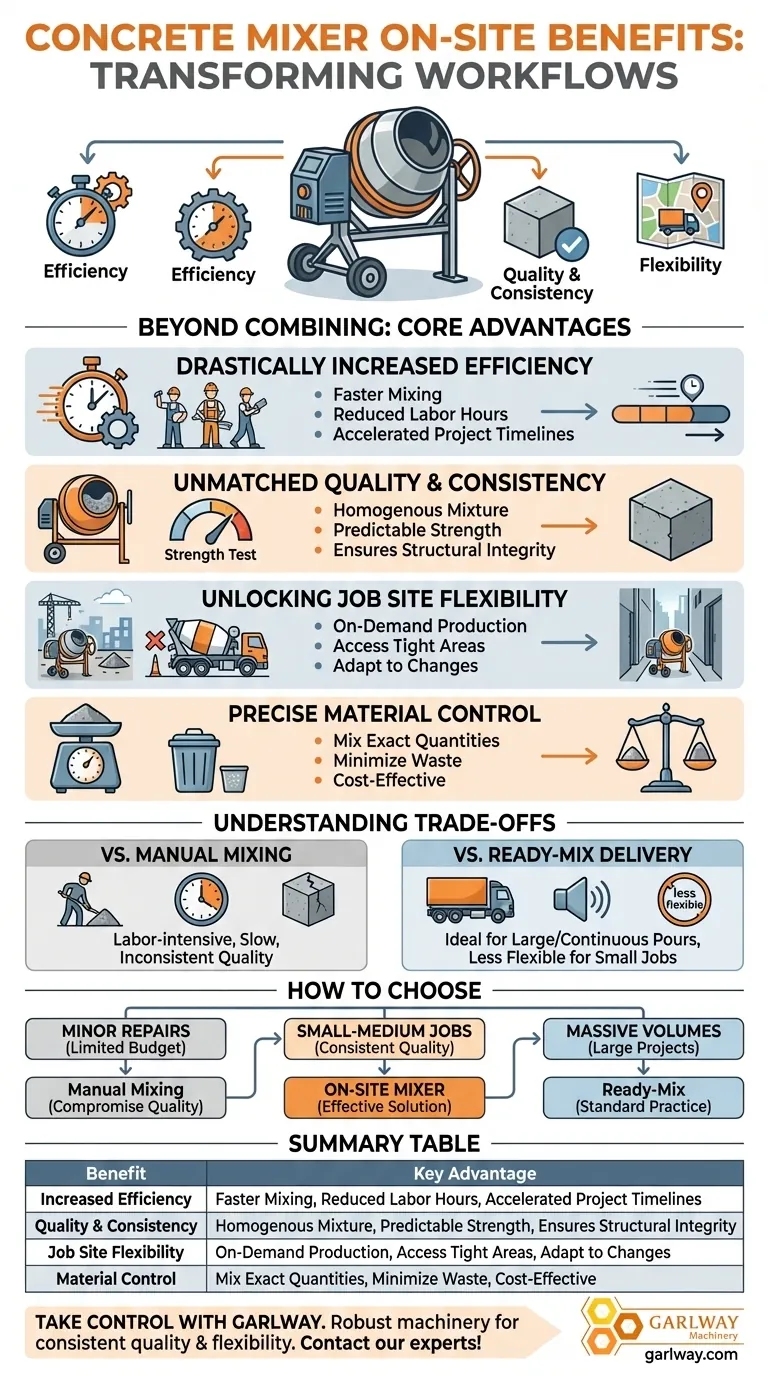
| Benefit | Key Advantage |
|---|---|
| Increased Efficiency | Faster mixing, reduces labor hours, accelerates project timelines. |
| Quality & Consistency | Homogenous mixture, predictable strength, ensures structural integrity. |
| Job Site Flexibility | Produce concrete on-demand, access tight areas, adapt to changes. |
| Material Control | Mix exact quantities needed, minimizes waste, cost-effective. |
Ready to take control of your concrete supply and boost your project's efficiency?
At GARLWAY, we specialize in providing robust and reliable construction machinery, including high-performance concrete mixers, for construction companies and contractors worldwide. Our equipment is designed to deliver the consistent quality and operational flexibility your projects demand.
Contact our experts today to find the perfect concrete mixing solution for your specific job site needs!
Visual Guide
Related Products
- Portable Concrete Mixer Machine Equipment for Mixing Concrete
- Construction Products Concrete Plant Machine Mixing Concrete Mixer
- Portable Electric Concrete Mixer Machine for Cement Mixing
- JZC400 Mobile Small Concrete Mixer Cement Mixer Machine
- Hydraulic Concrete Mixer Machine Cement Mixing Equipment for Mixture Concrete
People Also Ask
- Why is it necessary to use a portable concrete mixer? Gain Total Control & Efficiency
- How much concrete can you pour with a portable mixer? Find the Perfect Fit for Your Project
- What types of projects are portable concrete mixers suitable for? Ideal for DIY & Small-Scale Construction
- How much does a portable concrete mixer hold? A Guide to Choosing the Right Capacity
- What types of portable concrete mixers exist? Find the Perfect Mixer for Your Project