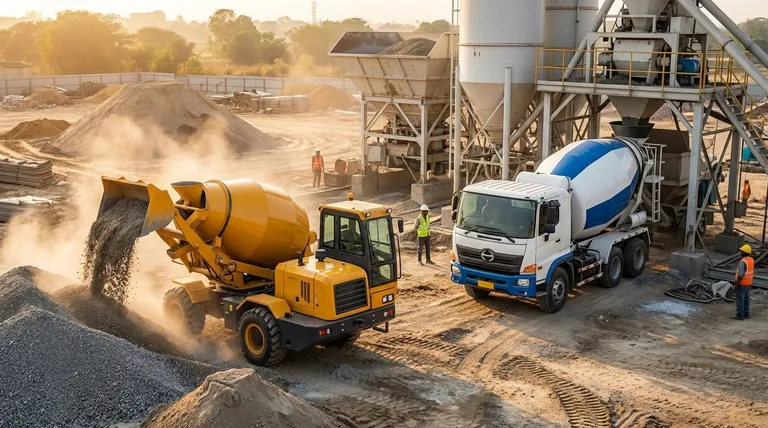
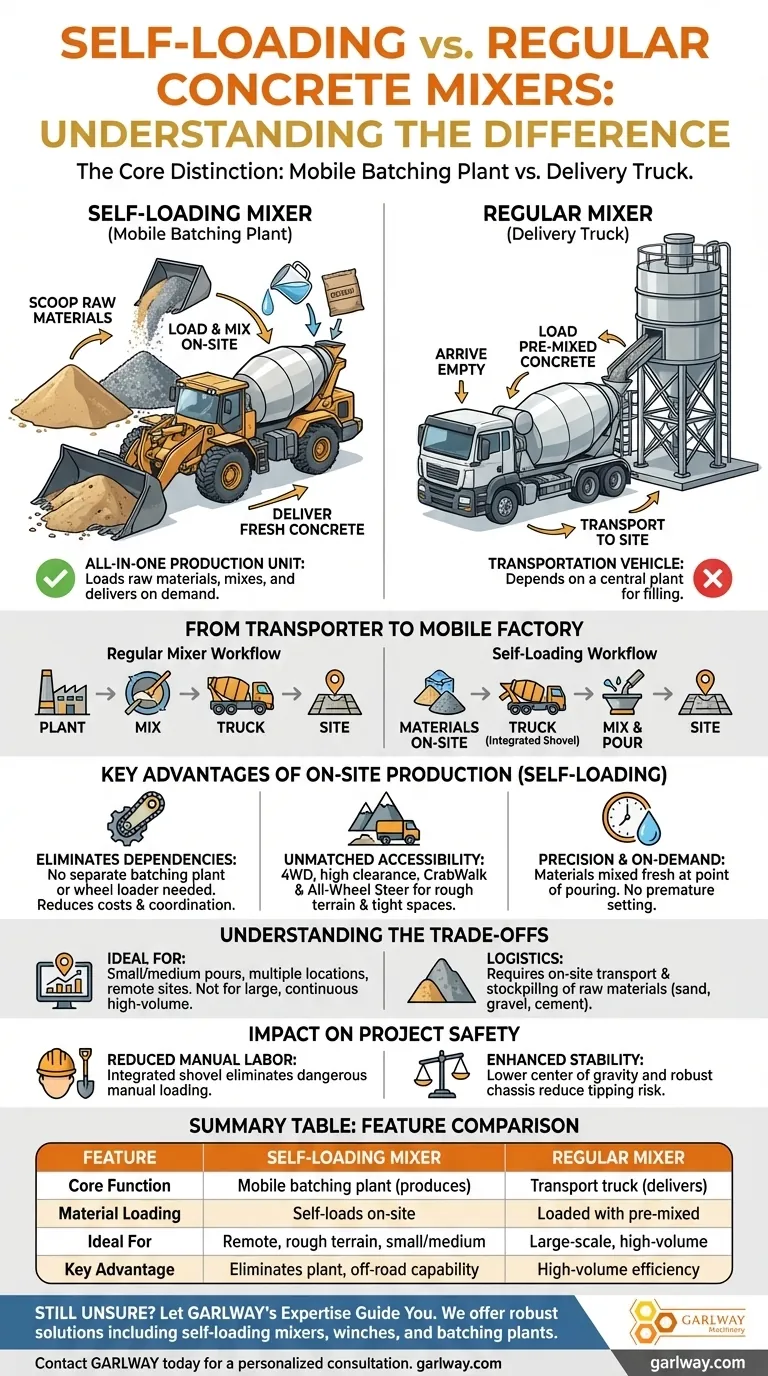
The fundamental difference is in their core function: a self-loading mobile concrete mixer is an all-in-one production unit that loads its own raw materials, mixes them, and delivers concrete on-site. In contrast, a regular mixer is simply a transportation vehicle that must be filled with pre-mixed concrete from a separate batching plant.
The core distinction is one of capability. A self-loading mixer acts as a mobile batching plant, creating fresh concrete wherever it's needed. A regular mixer functions solely as a delivery truck, transporting a finished product from a central factory to the job site.
From Transporter to Mobile Factory
The self-loading mechanism fundamentally changes the machine's role in the construction workflow, shifting it from a single-purpose vehicle to a multi-functional piece of production equipment.
The Regular Mixer: A Transportation Vessel
A standard concrete mixer, often called a transit mixer, is entirely dependent on external infrastructure. It arrives at a concrete batching plant, where a large, separate system mixes the concrete and loads it into the truck's drum for transportation.
The Self-Loading Mixer: An All-in-One Solution
The self-loading mixer integrates the batching plant's functions directly into the vehicle. It uses a front-mounted bucket or shovel to scoop raw materials like sand and gravel from piles on the ground and load them directly into its own mixing drum.
This process is automated by a control system that precisely dispenses all ingredients—aggregates, cement, and water—to create a fresh, high-quality mix on demand.
Key Advantages of On-Site Production
This integrated design provides significant logistical and operational advantages, especially for specific types of construction projects.
Eliminating Logistical Dependencies
By producing concrete on-site, the self-loading mixer eliminates the need for a separate batching plant and a wheel loader. This reduces equipment costs, coordination complexity, and potential delays caused by plant trips.
Unmatched Site Accessibility
These machines are engineered for difficult environments. Key features like four-wheel drive, high ground clearance, and advanced weight distribution allow them to operate on rough terrain and steep inclines of up to 30 degrees.
Furthermore, multiple steering modes, such as CrabWalk and All-Wheel Steer, enable them to navigate tight spaces and narrow roads that are inaccessible to larger, conventional mixer trucks.
Precision and On-Demand Mixing
Materials are stored separately on the vehicle and only mixed when needed. This ensures the concrete is always fresh at the point of pouring, avoiding issues with premature setting that can occur during long transit times from a central plant.
Understanding the Trade-offs
While powerful, the self-loading model is not a universal replacement for the traditional system. The choice depends entirely on the project's scale and requirements.
Production Volume and Scale
Self-loading mixers are ideal for small to medium-sized projects or for jobs requiring multiple, smaller pours at different locations. For large-scale, continuous pours like a major building foundation, the high-volume output of a dedicated batching plant feeding a fleet of regular mixers is far more efficient.
Raw Material Logistics
While the mixer itself is a self-contained production unit, you still need to transport and stockpile the raw materials (sand, gravel, cement bags) at the job site. This requires careful planning and adequate space.
Impact on Project Safety
The automated nature of the self-loading mechanism brings tangible safety benefits to the work site.
Reduced Manual Labor
The integrated loading shovel completely eliminates manual loading, a physically demanding task that carries a high risk of worker injury.
Enhanced Vehicle Stability
These mixers are often designed with a lower center of gravity compared to top-heavy transit mixers. This feature, combined with their robust chassis, significantly reduces the risk of tipping over on the uneven surfaces common to construction sites.
Making the Right Choice for Your Project
Selecting the appropriate mixer requires analyzing the specific demands of your job site and workflow.
- If your primary focus is large-scale, high-volume production: A central batching plant paired with a fleet of regular mixers is the most efficient and economical solution.
- If your primary focus is work on remote, tight, or rough-terrain sites: The self-loading mixer's all-in-one capability and superior off-road performance are indispensable.
- If your primary focus is flexibility and cost savings on varied projects: A self-loading mixer offers unparalleled versatility by removing dependency on external batching plants.
Ultimately, choosing the right mixer is about matching the machine's function—either transportation or production—to the logistical realities of your construction project.
Summary Table:
| Feature | Self-Loading Mixer | Regular Mixer |
|---|---|---|
| Core Function | Mobile batching plant (produces concrete) | Transport truck (delivers concrete) |
| Material Loading | Self-loads raw materials on-site | Loaded with pre-mixed concrete from a plant |
| Ideal For | Remote sites, rough terrain, small/medium pours | Large-scale, high-volume projects |
| Key Advantage | Eliminates need for a batching plant; superior off-road capability | High-volume efficiency for large, continuous pours |
Still unsure which concrete mixer is right for your project's unique challenges?
Let GARLWAY's expertise guide you. We specialize in construction machinery, offering a range of robust solutions including self-loading mixers, winches, and concrete batching plants designed for construction companies and contractors globally.
Our team can help you determine the perfect equipment to maximize efficiency, reduce costs, and conquer difficult job sites.
Contact GARLWAY today for a personalized consultation and discover how our machinery can build success for your business.
Visual Guide
Related Products
- JZC400 Mobile Small Concrete Mixer Cement Mixer Machine
- JW1000 Mobile Cement Mixer Concrete Mixer Truck and Batching Plant
- Portable Concrete Mixer Machine Equipment for Mixing Concrete
- Ready Mixer Machine for Construction Ready Mix Machinery
- Portable Ready Mix Concrete Mixer Equipment
People Also Ask
- What are the different names for mobile concrete mixing equipment? Understand Volumetric vs. On-Site Mixers
- In what way do mobile mixers enhance quality control? Achieve Superior Concrete Quality On-Site
- What is a mobile mixer? The Ultimate Guide to On-Site Concrete Production
- How do mobile mixers improve labor efficiency? Automate Concrete Production & Boost Productivity
- What flexibility do mobile mixers offer in terms of material mixing? Unlock On-Demand Concrete Production