
At their core, electric winches offer a powerful combination of simplicity, control, and efficiency. Their primary advantages stem from using an electric motor, which provides reliable operation without the complexity of hydraulic systems. This makes them quieter, cleaner, and significantly easier to install and control for a vast range of applications.
The fundamental advantage of an electric winch is its self-contained, accessible power. It trades the continuous raw force of hydraulics for superior precision, lower installation costs, and cleaner, quieter operation, making it the more versatile choice for most applications.
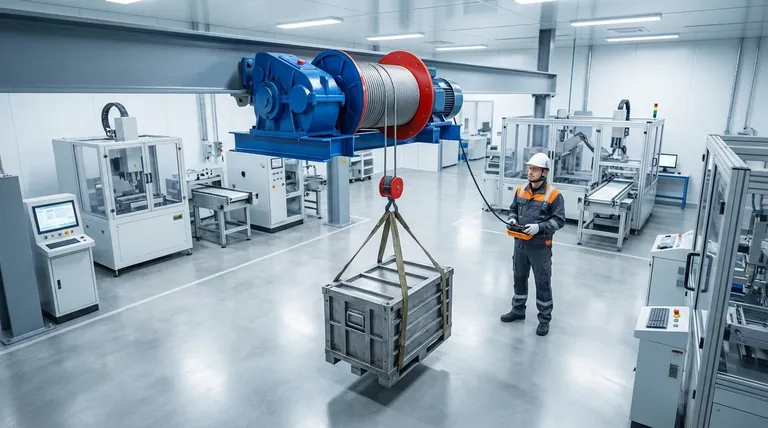
The Core Operational Advantages
The design of an electric winch directly translates into significant benefits in its operation, cost, and environmental impact.
### Simple and Cost-Effective Installation
Electric winches have a significantly lower installation cost compared to hydraulic systems.
They are self-contained units that primarily require a connection to a suitable electrical power source, eliminating the need for complex hydraulic pumps, reservoirs, and fluid lines.
### Clean and Quiet Operation
Because they run on electricity, there is zero risk of hydraulic fluid leaks. This makes them an ideal choice for environmentally sensitive areas or clean-room industrial settings.
They also operate at a greatly reduced noise level, as they don't rely on a loud hydraulic power unit. This improves worksite safety and communication.
### Precision and Programmability
Electric winches offer highly precise and repeatable control.
Using components like a Variable Frequency Drive (VFD), operators can program specific speeds, acceleration/deceleration ramps, and exact stopping positions, automating complex tasks.
Design and Usability Benefits
Beyond their core operation, electric winches are designed for versatility and ease of use.
### High Versatility and Compact Design
These winches are known for their compact structure, small size, and light weight.
This high versatility makes them easy to integrate into vehicles, workshops, or trailers where space is a premium. They are also much easier to transfer between job sites.
### Enhanced User Control
Most electric winches can be operated with a push-button or remote control, enhancing both safety and convenience. This allows the operator to stand clear of the load and line for a better vantage point.
Some models also offer a "power-out" feature, which uses the motor in reverse for a controlled release of the load, which is especially useful on steep ramps or for delicate lowering tasks.
Understanding the Trade-offs
While highly advantageous, electric winches are not the solution for every scenario. Understanding their limitations is key to making an informed decision.
### Power Source Dependency
An electric winch's performance is entirely dependent on its power source. For vehicle-mounted winches, this means a heavy pull can significantly drain the battery if the engine is not running.
### Heat and Duty Cycle
Electric motors generate heat under load. They are rated for a specific duty cycle, which is the amount of time the winch can run before it needs to cool down. Exceeding this can damage the motor.
For continuous, heavy-pulling industrial applications, a hydraulic system may be more suitable as it can often run for longer periods without overheating.
Making the Right Choice for Your Goal
Selecting the right winch depends entirely on your specific needs and operational context.
- If your primary focus is off-road recovery or marine use: The compact size, remote control operation, and simple installation make an electric winch the superior choice.
- If your primary focus is industrial lifting and automation: The precise, programmable control and clean operation are invaluable for manufacturing or workshop environments.
- If your primary focus is versatility and cost-effectiveness: An electric winch provides powerful capability for a lower upfront investment and can be adapted to many different jobs.
Ultimately, the electric winch stands out as a modern, adaptable, and highly controllable tool for a majority of pulling and lifting challenges.
Summary Table:
| Key Advantage | Key Benefit |
|---|---|
| Simple Installation | Lower cost, no complex hydraulics required |
| Clean & Quiet Operation | No fluid leaks, reduced noise for better safety |
| Precision Control | Programmable speeds & positions via VFD |
| Versatile & Compact | Easy to integrate and move between job sites |
| Enhanced User Safety | Remote control operation, power-out feature |
Ready to enhance your project's efficiency and safety with a reliable electric winch?
At GARLWAY, we specialize in providing robust construction machinery, including high-performance electric winches, concrete mixers, and batching plants for contractors and construction companies worldwide. Our solutions are designed for durability, precision, and ease of use, helping you complete projects on time and within budget.
Contact our experts today to discuss your specific needs and find the perfect winch solution for your application!
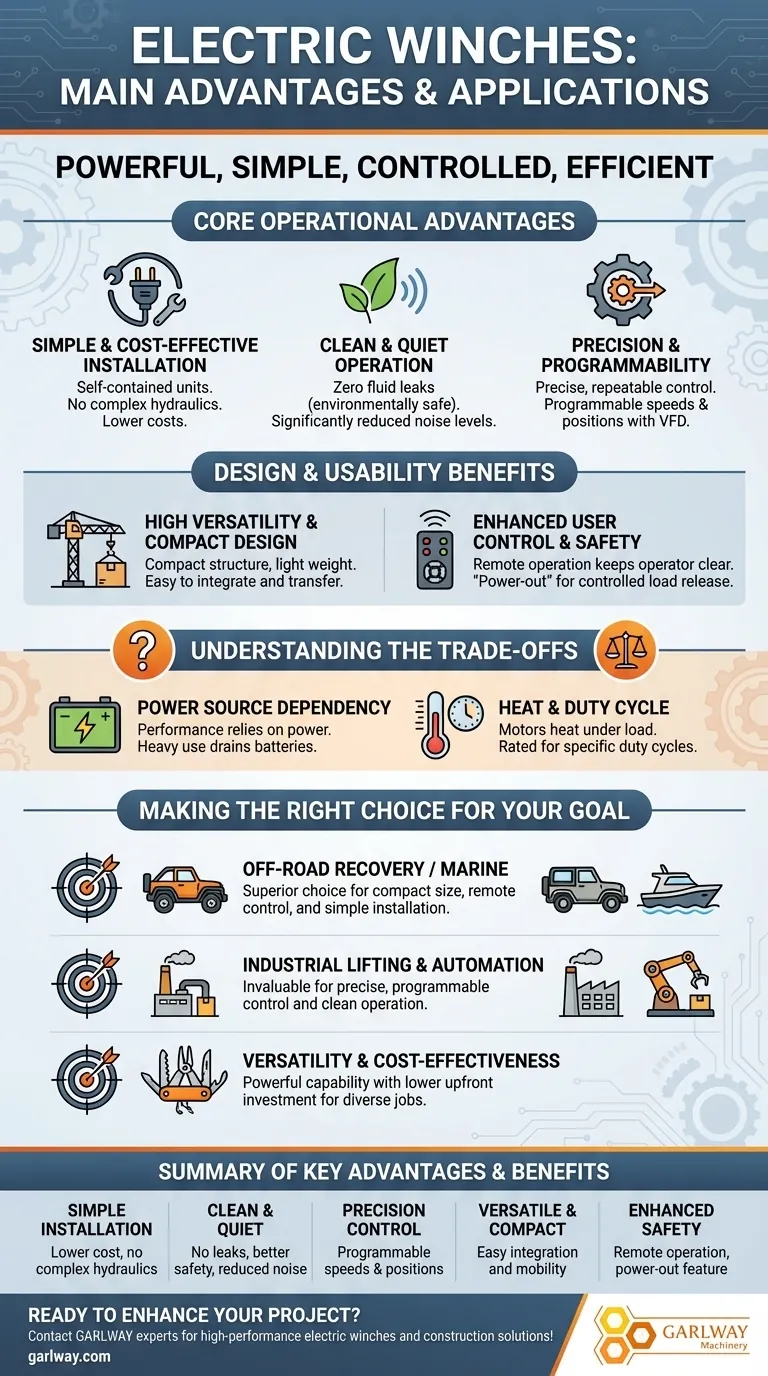
Visual Guide
Related Products
- Electric 120V Boat Winch by Badlands
- Electric and Hydraulic Winch for Heavy Duty Applications
- Small Electric Winch 120V and 240V for Compact Applications
- 12000 lb Electric Boat Trailer Winch with Windlass Anchor Warn
- Electric Hoist Winch Boat Anchor Windlass for Marine Applications
People Also Ask
- How do electric boat winches work? Unlock Effortless Launching & Retrieval
- How much current does an electric boat winch draw? Plan Your Electrical System for Peak Performance
- Can I run a winch straight from a battery? Essential Power Setup for Safe Operation
- What are the types of electric winches available? Choose the Right Winch for Your Job
- What are the uses of electric winches in mining and tunneling? Enhance Safety and Efficiency Underground





