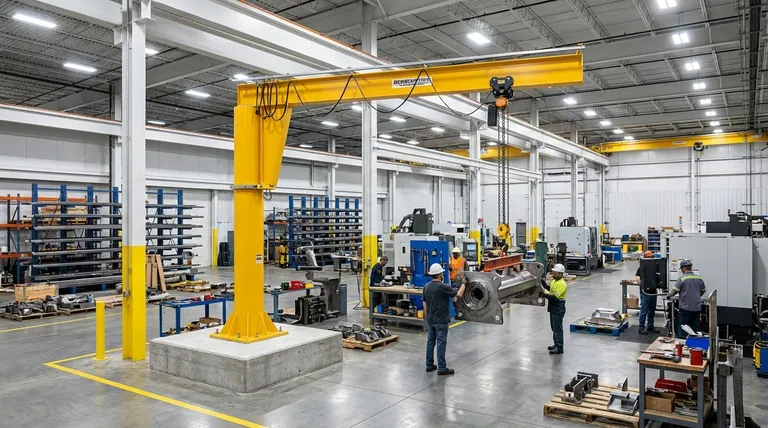
The defining characteristic of a floor-mounted jib crane is its complete structural independence. It is a self-supporting lifting system with a vertical mast anchored directly to a concrete floor foundation, which allows it to handle heavy loads and often provide a full 360-degree rotation without relying on any building support columns.
A floor-mounted jib crane offers maximum lifting flexibility and capacity by functioning as a standalone structure. Its independence from building walls makes it the most versatile jib crane option, but also the most demanding in terms of installation.
Core Design and Construction
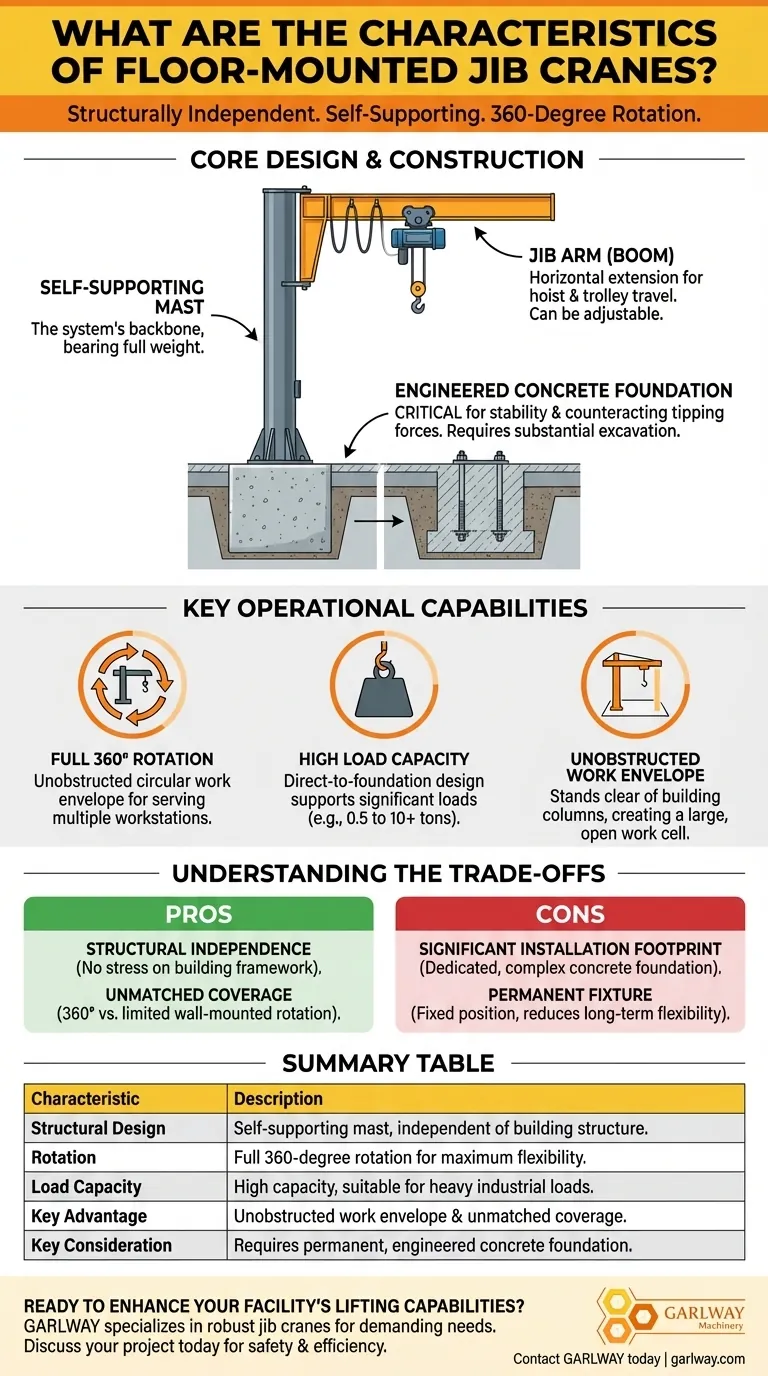
The effectiveness of a floor-mounted jib crane stems from its simple yet robust design, centered around a vertical mast that transfers all forces directly into the foundation.
The Self-Supporting Mast
The entire system is built around a heavy-duty vertical steel mast or pillar. This component is the crane's backbone, bearing the full weight of the boom, hoist, and the load being lifted.
Foundation Requirements
Because the crane is self-supporting, it requires a substantial, specially engineered concrete foundation. This base is critical for safely anchoring the mast and counteracting the immense tipping forces generated when a load is extended on the boom.
The Jib Arm (Boom)
The horizontal boom is the arm that extends from the mast, on which the hoist and trolley travel. Some models feature adjustable booms that can be modified for different height requirements, adding to their operational flexibility.
Key Operational Capabilities
The floor-mounted design directly enables its primary advantages in rotation, capacity, and overall coverage area.
Full 360-Degree Rotation
A key advantage is the ability to rotate up to a full 360 degrees. This provides an unobstructed, circular work envelope, allowing a single crane to serve multiple workstations or a large assembly area efficiently.
High Load Capacity
The direct-to-foundation design allows these cranes to support significant loads, with standard capacities often ranging from half a ton to ten tons or more. This makes them suitable for heavy-duty industrial applications.
Unobstructed Work Envelope
By standing clear of building columns and walls, a floor-mounted jib creates a large, open work cell. This design is ideal for open floor plans where lifting needs to occur far from existing structural supports.
Understanding the Trade-offs
While powerful, the floor-mounted design has specific pros and cons that dictate where it is best applied.
Pro: Structural Independence
The crane does not impose any stress on your building's structural framework. This makes it a perfect solution for older buildings or structures not designed to support crane loads.
Pro: Unmatched Coverage
The 360-degree rotation provides a larger and more versatile coverage area than wall-mounted alternatives, which are typically limited to 200 degrees of rotation.
Con: Significant Installation Footprint
Installation is a major consideration. It requires a dedicated, permanent concrete foundation, which can involve significant floor excavation and construction, making it more complex and costly to install.
Con: A Permanent Fixture
Once installed, a floor-mounted jib crane is not easily relocated. It occupies a permanent, fixed position, which reduces long-term flexibility in your floor layout.
Making the Right Choice for Your Application
Choosing the correct jib crane depends entirely on your facility's layout, structural capacity, and workflow needs.
- If your primary focus is heavy loads and maximum work area coverage: The floor-mounted jib is the superior choice due to its high capacity and 360-degree rotation.
- If your primary focus is conserving floor space in a structurally sound building: Investigate wall-mounted options, which have no floor footprint but offer more limited rotation and capacity.
- If your primary focus is serving a long, narrow bay: You may find that a series of smaller wall-mounted jibs or an overhead bridge crane is a more effective solution.
Ultimately, selecting a floor-mounted jib crane is a commitment to a powerful, permanent lifting solution for a dedicated, high-production work cell.
Summary Table:
| Characteristic | Description |
|---|---|
| Structural Design | Self-supporting mast anchored to a concrete foundation, independent of building structure. |
| Rotation | Full 360-degree rotation for maximum coverage and flexibility. |
| Load Capacity | High capacity, typically from 0.5 to 10+ tons, suitable for heavy loads. |
| Key Advantage | Unobstructed work envelope and unmatched coverage in open floor plans. |
| Key Consideration | Requires permanent, engineered concrete foundation; not easily relocated. |
Ready to enhance your facility's lifting capabilities with a reliable, high-capacity solution?
GARLWAY specializes in robust construction machinery, including industrial jib cranes designed for the demanding needs of construction companies and contractors globally. Our floor-mounted jib cranes provide the independent lifting power and 360° coverage to maximize productivity in your work cells.
Contact GARLWAY today to discuss your project requirements and discover how our durable lifting solutions can bring safety and efficiency to your operations.
Visual Guide
Related Products
- Small Electric Winch 120V and 240V for Compact Applications
- Electric Hoist Winch Boat Anchor Windlass for Marine Applications
- Portable Small Trailer Winch
- Commercial Electric Concrete Mixer Machine HZS 50 Small Batch Plant for Sale
- HZS35 Small Cement Concrete Mixing Batch Plant
People Also Ask
- What makes electric winches suitable for off-road use? Key Features for Reliable Vehicle Recovery
- What are the common applications of electric winches? Power Your Lifting & Pulling Tasks
- What are the common uses of an electric winch? A Guide to Safe and Efficient Heavy Lifting
- What are the uses of electric winches in mining and tunneling? Enhance Safety and Efficiency Underground
- How do electric winches contribute to energy savings? Maximize Efficiency and Lower Costs