In essence, the primary benefits of a dry batching plant are its high production speed, operational flexibility, and lower initial investment cost. These advantages stem directly from its unique method of operation, where dry ingredients are weighed at the plant and then mixed with water in a transit mixer truck, either in transit or at the job site.
The core principle to understand is that a dry batch plant separates the batching (weighing) of materials from the mixing process. This fundamental difference unlocks significant speed and flexibility but shifts the final responsibility for concrete quality control to the field.
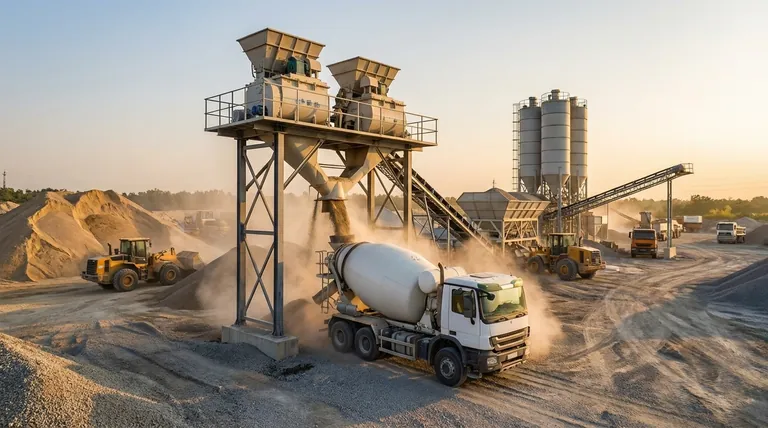
How a Dry Batch Plant Delivers Its Advantages
A dry batch plant, also known as a transit mix plant, operates on a simple and efficient principle. This design choice is the source of its primary benefits.
The Core Operating Principle
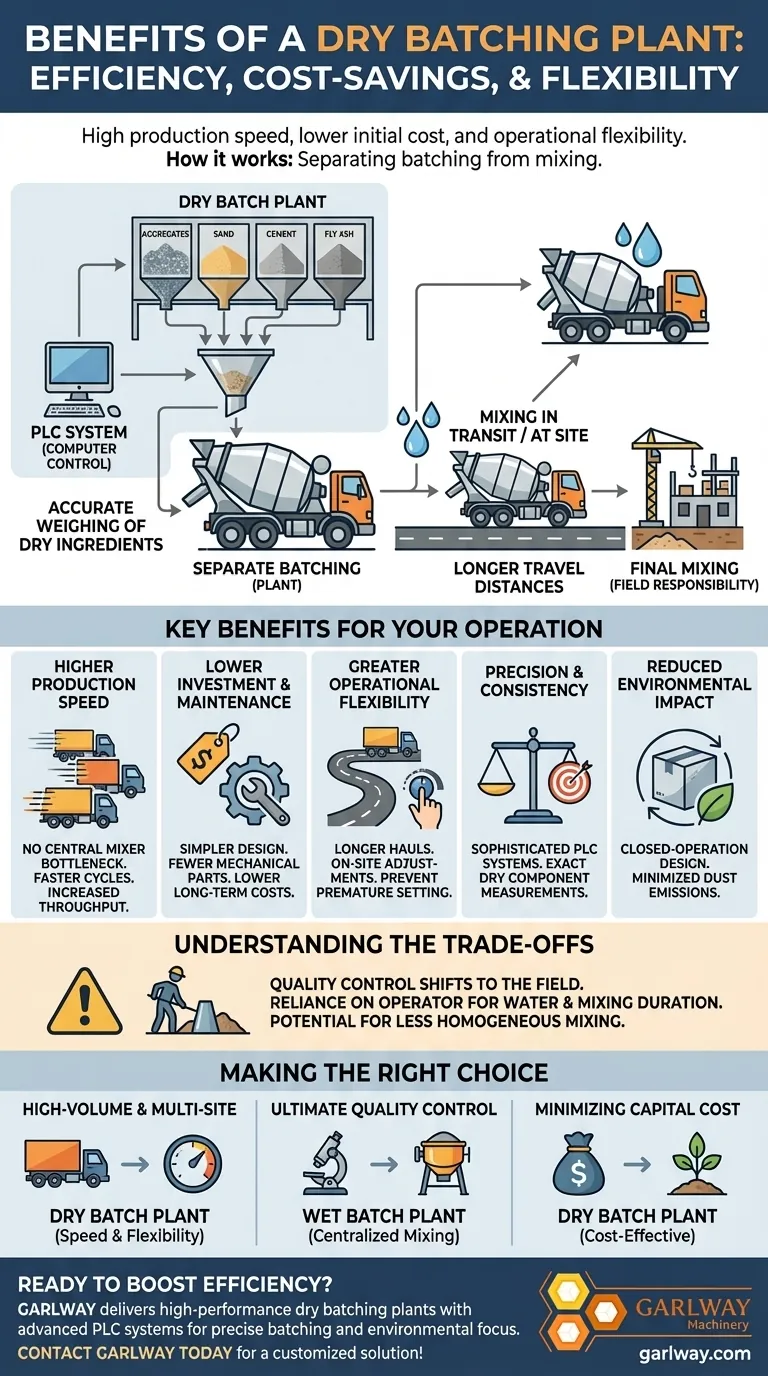
The process begins by feeding aggregates (sand, gravel) and powders (cement, fly ash) into separate storage bins. The computer-controlled system then accurately weighs these dry materials for a specific batch.
These weighed, dry ingredients are then discharged directly into a transit mixer truck. Water is added to the truck's mixer drum separately, and the concrete is mixed while the truck travels to the construction site.
Higher Production Speed
Because there is no central mixer in the plant itself, the production cycle is much faster. The plant can begin weighing the next batch as soon as the previous one has been discharged into a truck.
This eliminates the time-consuming step of central mixing, allowing for a higher throughput of trucks per hour compared to a wet batch plant of similar size.
Greater Operational Flexibility
Mixing in the truck allows for longer travel distances. Since the cement hydration process doesn't begin until water is added, there is less risk of the concrete setting prematurely during long hauls.
This also allows for last-minute adjustments to the mix at the job site, providing flexibility to meet specific slump requirements.
Key Benefits for Your Operation
The operational design translates into tangible benefits for cost, consistency, and environmental management.
Lower Initial Investment and Maintenance
The absence of a large, complex central mixer significantly reduces the plant's initial purchase price.
This simpler design also means fewer high-wear mechanical parts, leading to lower long-term maintenance costs and less operational downtime.
Precision and Consistency
Modern dry batch plants use sophisticated PLC (Programmable Logic Controller) systems for highly accurate measurement of all dry components.
This computer control ensures that every batch receives the precise, specified weight of cement, sand, and aggregate, forming a consistent foundation for the final product.
Reduced Environmental Impact
These plants are designed as closed-operation systems. Materials are transferred via covered conveyors or enclosed systems, which significantly minimizes the release of cement and aggregate dust into the atmosphere.
Understanding the Critical Trade-offs
While highly efficient, the dry batch model presents a critical trade-off that you must consider.
Quality Control Shifts to the Field
The most significant consideration is that final quality control happens away from the plant. The consistency and water-to-cement ratio of the final product depend heavily on the transit mixer operator adding the correct amount of water and mixing for the specified duration.
This contrasts with a wet batch plant, where all mixing is done under controlled conditions at the plant before being discharged.
Potential for Inconsistent Mixing
While effective for most applications, a transit mixer may not achieve the same level of shear force and homogeneity as a dedicated stationary plant mixer.
For high-performance or specialized concrete specifications that demand exceptionally thorough mixing, this can be a limiting factor.
Making the Right Choice for Your Goal
Selecting the right type of plant depends entirely on your operational priorities and the nature of the projects you serve.
- If your primary focus is high-volume production and serving multiple sites: A dry batch plant provides the speed and flexibility to dispatch numerous trucks quickly, even over longer distances.
- If your primary focus is ultimate quality control for specialized concrete: A wet batch plant is often the superior choice, as it centralizes the entire mixing process for maximum consistency.
- If your primary focus is minimizing capital investment and startup costs: The simpler design and lower price point of a dry batch plant make it the most cost-effective option for standard concrete supply.
Choosing the right equipment begins with a clear understanding of where you need to exercise the most control in your production process.
Summary Table:
| Benefit | Key Advantage |
|---|---|
| Production Speed | Higher throughput with no central mixer bottleneck |
| Cost Efficiency | Lower initial investment and reduced maintenance |
| Operational Flexibility | Longer travel distances and on-site mix adjustments |
| Precision & Consistency | Computer-controlled weighing for accurate batching |
| Environmental Impact | Closed-operation system minimizes dust emissions |
Ready to boost your concrete production efficiency?
GARLWAY specializes in high-performance construction machinery, offering durable dry batching plants that deliver faster production cycles and significant cost savings for construction companies and contractors globally.
Our plants feature advanced PLC systems for precise batching and are designed as closed-operation systems to minimize environmental impact.
Contact GARLWAY today for a customized solution that meets your project's specific production needs and budget requirements!
Visual Guide
Related Products
- HZS120 Ready Mix Concrete Batching Plant Commercial Mud Cement Mixer
- HZS35 Small Cement Concrete Mixing Batch Plant
- HZS180 Ready Mix Concrete Plant for Foundations with Sand and Cement
- HZS75 Concrete Batching Plant Cement Mixer Price Concrete Mixer Bunnings Mixing Plant
- Commercial Electric Concrete Mixer Machine HZS 50 Small Batch Plant for Sale
People Also Ask
- What is a ready mix concrete batching plant? The Engine of Modern Construction
- What is the name of the machine used in ready mix? Unpacking the Complete Concrete System
- What is the core component of a concrete batching plant? The Mixer Unit Defines Your Concrete Quality
- What are the types of concrete mixers used in batching plants? Choose the Right Mixer for Your Project
- What are the advantages and disadvantages of concrete batching plants? Maximize Quality & Efficiency