
At their core, self-loading mixer trucks are designed for a wide range of applications where on-demand concrete is critical. They are most commonly used in general construction, road and bridge building, water conservancy projects, industrial facility development, and various forms of municipal engineering.
The true application of a self-loading mixer is not defined by an industry, but by a specific need: gaining control over concrete production for small-to-medium scale projects, especially in remote or space-constrained locations where a traditional batching plant is inefficient or impossible.
The Core Principle: A Mobile Batching Plant on Wheels
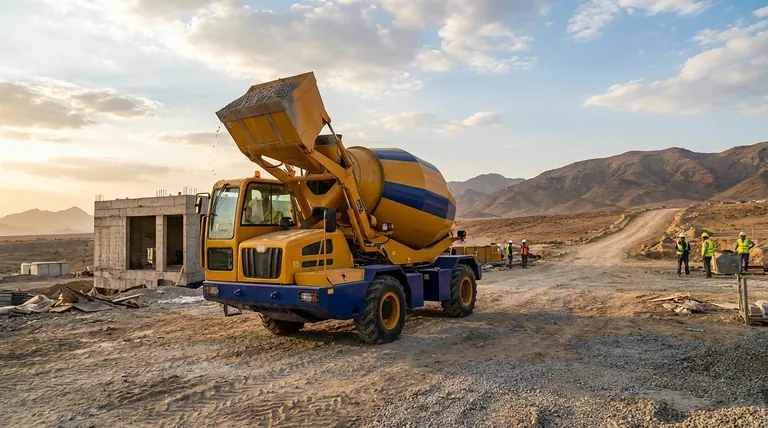
A self-loading mixer combines the functions of a wheel loader, a concrete mixer, and a transport truck into a single piece of machinery. This consolidation is its primary advantage.
How It Works
The operator uses the integrated bucket to load raw materials—sand, gravel, and cement—into the mixing drum. The truck’s onboard system automatically weighs these components for precise proportioning before water is added and the mixing process begins. The machine can then transport the freshly mixed concrete directly to the pour site.
The Self-Sufficiency Advantage
This all-in-one process creates a completely self-sufficient operation. It eliminates the need for separate loading equipment, a static batching plant, and traditional transit mixer trucks. This drastically reduces the required manpower, on-site footprint, and logistical complexity.
Key Applications Analyzed
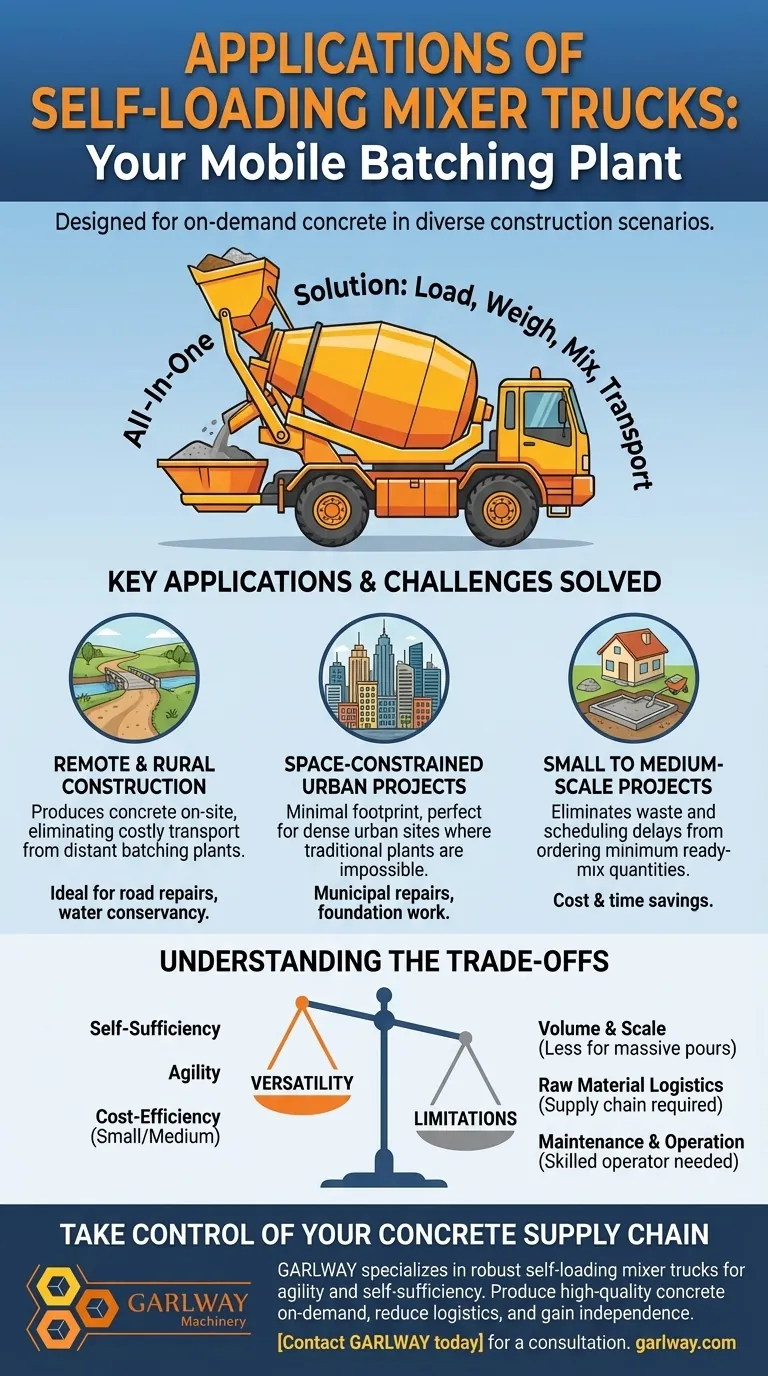
The value of a self-loading mixer becomes clear when you analyze the specific challenges it solves within its common applications.
Remote and Rural Construction
For projects like rural road maintenance, bridge repairs, or water conservancy infrastructure far from urban centers, getting ready-mix concrete delivered is often impractical and expensive. The self-loading mixer allows high-quality concrete to be produced on-site, using locally sourced aggregates when possible.
Space-Constrained Urban Projects
In dense urban environments, setting up even a small batching plant can be impossible due to space limitations. These trucks are highly maneuverable and require a minimal footprint, making them ideal for municipal repairs, foundation work, or industrial facility upgrades in tight quarters.
Small to Medium-Scale Projects
Many construction jobs require multiple, smaller concrete pours spread out over time. A self-loading mixer eliminates waste and scheduling delays associated with ordering minimum-quantity batches from a ready-mix supplier, providing significant cost and time savings.
Understanding the Trade-offs
While highly versatile, a self-loading mixer is not the right solution for every job. Objectivity requires acknowledging its limitations.
Volume and Scale Limitations
These machines are designed for efficiency on a smaller scale. For massive, continuous pours like a high-rise foundation or large-scale paving, the output volume of a dedicated central batching plant and a fleet of transit mixers is far superior.
Raw Material Logistics
The mixer solves the concrete production problem, but you still need a reliable supply chain for cement, sand, and aggregate. The efficiency of the entire operation depends on having these raw materials available on-site when needed.
Maintenance and Operation
Like any specialized machinery, a self-loading mixer requires a skilled operator to manage the automated weighing and mixing functions correctly. Regular maintenance, including checking fluids and replacing filters, is critical to ensure its reliability and the quality of the concrete it produces.
Making the Right Choice for Your Project
Choosing the correct concrete production method depends entirely on your project's specific goals and constraints.
- If your primary focus is maximum volume for a massive project: A traditional central batching plant and transit mixer fleet remains the most efficient choice.
- If your primary focus is agility and self-sufficiency in a remote location: The self-loading mixer is the ideal solution, giving you complete control over production.
- If your primary focus is cost-efficiency on small to medium jobs: A self-loading mixer can significantly reduce labor, transport, and material waste costs compared to ready-mix deliveries.
Ultimately, a self-loading mixer empowers you to take control of your concrete supply chain, wherever the job takes you.
Summary Table:
| Application | Key Challenge Solved |
|---|---|
| Remote & Rural Construction | Produces concrete on-site, eliminating costly transport from distant batching plants. |
| Space-Constrained Urban Projects | Requires minimal footprint, ideal for tight locations where a traditional plant is impossible. |
| Small to Medium-Scale Projects | Eliminates waste and scheduling delays from ordering minimum ready-mix quantities. |
| Water Conservancy & Infrastructure | Provides agility and control for projects far from urban centers. |
Take Control of Your Concrete Supply Chain with GARLWAY
Is your next project in a remote location or a tight urban space? Are you managing multiple small pours and need to reduce costs and delays?
GARLWAY specializes in construction machinery, offering robust self-loading mixer trucks designed for construction companies and contractors who value agility and self-sufficiency. Our machines combine a wheel loader, concrete mixer, and transport truck into one powerful unit, empowering you to:
- Produce high-quality concrete on-demand, directly at the job site.
- Drastically reduce logistical complexity, manpower, and material waste.
- Gain complete independence from ready-mix suppliers.
Let our experts help you determine if a GARLWAY self-loading mixer is the right solution to optimize your concrete operations.
Contact GARLWAY today for a consultation and discover how we can bring efficiency and control to your projects.
Visual Guide
Related Products
- Belle Mixer Drum Self Loading Mortar Mixers JS3000
- Skid Steer Self Loading Concrete Mixers for Construction
- Ready Mixer Machine for Construction Ready Mix Machinery
- JW1000 Mobile Cement Mixer Concrete Mixer Truck and Batching Plant
- Mini Cement Mortar Mixer Truck for Construction
People Also Ask
- What are the features of mobile transporting in a self loading mixer? Boost On-Site Efficiency
- Why is timely cleaning important for a self loading mixer? Prevent Costly Downtime and Mix Failure
- How is discharging accomplished in a self loading mixer? Master Precise Concrete Placement
- What is the purpose of keeping the drum rotating during transportation in a self loading concrete mixer? Ensure Quality & Consistency
- What components are involved in the loading process of a self loading concrete mixer? A Guide to the Key Systems


