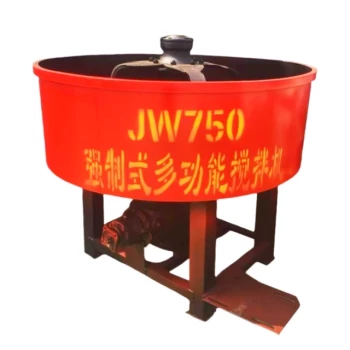
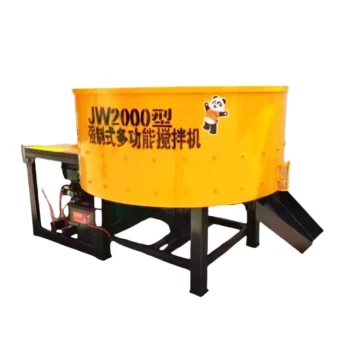
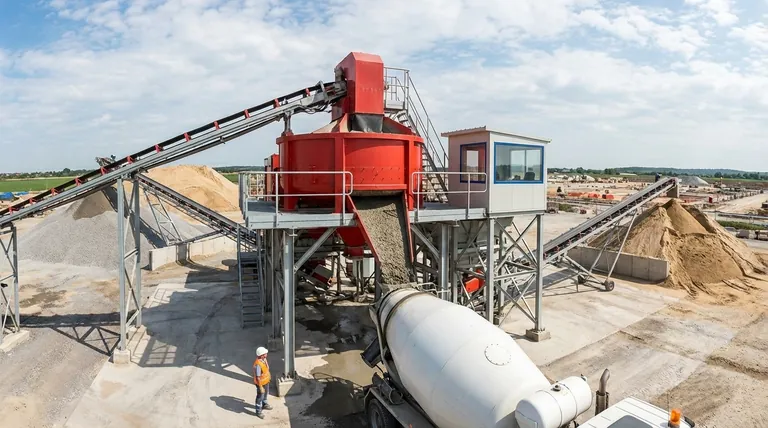
The primary advantage of a central mix plant is its ability to produce highly consistent, high-quality concrete at a rapid pace. This is achieved by completely mixing all constituent materials—including cement, aggregates, and water—in a large, stationary plant mixer before discharging the final product into a truck. This centralized process ensures superior quality control and batch-to-batch uniformity from the moment the concrete leaves the plant.
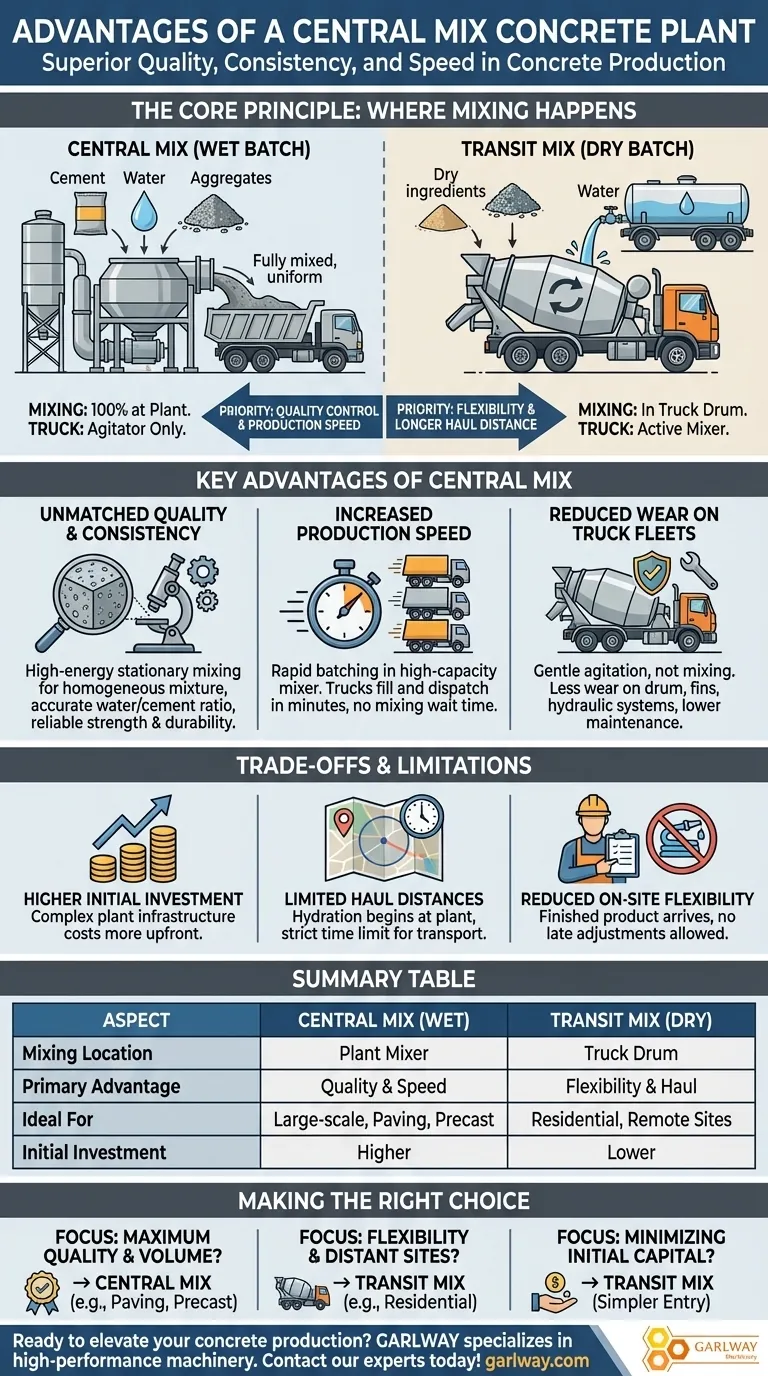
A central mix plant prioritizes quality control and production speed above all else. This approach contrasts sharply with transit mix (or dry batch) plants, which offer greater flexibility and longer delivery ranges by mixing the concrete in the truck en route to the job site.
The Core Principle: Centralized vs. Decentralized Mixing
To understand the advantages of a central mix plant, it's essential to compare it to its alternative. The fundamental difference lies in where the concrete is actually made.
What is a Central Mix Plant?
A central mix plant is also known as a "wet batch" plant.
All ingredients are precisely measured and combined in a large, highly efficient stationary mixer at the plant. The truck that arrives simply collects the already-prepared concrete and acts as an agitator to keep it from segregating during transport.
The Contrast: Transit Mix (Dry Batch) Plants
In a transit mix system, all the dry ingredients (cement, sand, stone) are loaded into the truck mixer. Water is then added to the drum either at the plant or during transport.
The truck's rotating drum is responsible for the actual mixing process. This makes the truck an active part of the manufacturing process, not just a delivery vehicle.
Key Advantages of the Central Mix Approach
The decision to mix concrete at the plant before transport creates several distinct operational benefits.
Unmatched Quality and Consistency
This is the single most important advantage. The large, powerful, and computer-controlled stationary mixer provides a level of mixing energy and precision that a truck drum cannot replicate.
This guarantees a highly homogeneous mixture with an accurate water-to-cement ratio, leading to more reliable strength, durability, and overall performance in the final product.
Increased Production Speed
Central mix plants can produce batches of concrete much faster than transit mix plants.
Because the mixing is done in a dedicated, high-capacity mixer, a truck can be filled and dispatched in just a few minutes. In a dry batch system, the truck must wait while materials are loaded and may need to mix for a period before leaving, creating a bottleneck.
Reduced Wear on Truck Fleets
In a central mix operation, the truck drum's primary job is gentle agitation, not the intense work of mixing raw materials.
This significantly reduces wear and tear on the truck's drum, fins, and hydraulic systems. Over the long term, this can lead to lower maintenance costs and a longer operational life for the fleet.
Understanding the Trade-offs and Limitations
The benefits of a central mix plant come with clear trade-offs that make it unsuitable for certain applications.
Higher Initial Investment
Central mix plants are more complex and require a significant capital investment. The cost of the large stationary mixer, along with the more robust plant infrastructure needed to support it, is substantially higher than that of a simpler dry batch plant.
Limited Haul Distances
Because the hydration process begins the moment water is added at the plant, there is a fixed time limit for transport and placement.
This makes central mix plants ideal for servicing job sites that are relatively close. For distant or remote projects, the risk of the concrete beginning to set in the truck is too high.
Reduced On-Site Flexibility
The concrete arrives at the job site as a finished product. Making adjustments, such as adding water to increase slump, is strongly discouraged as it compromises the precise quality control that is the plant's primary benefit.
Transit mix systems offer more flexibility for last-minute changes, as the final mixing happens closer to the point of delivery.
Making the Right Choice for Your Project
The best plant type is the one that aligns with your project's specific priorities of quality, speed, and logistical constraints.
- If your primary focus is maximum quality and high-volume production: A central mix plant is the superior choice, ideal for paving, precast manufacturing, and large-scale construction where consistency is paramount.
- If your primary focus is flexibility and servicing multiple, distant job sites: A transit mix (dry batch) plant offers the adaptability and longer haul times needed for residential builds or projects scattered across a wide area.
- If your primary focus is minimizing initial capital investment: A transit mix plant provides a more accessible entry point into concrete production due to its simpler design and lower cost.
Ultimately, understanding the fundamental trade-off between centralized quality control and decentralized flexibility is the key to making an informed decision.
Summary Table:
| Aspect | Central Mix Plant | Transit Mix (Dry Batch) Plant |
|---|---|---|
| Mixing Location | Stationary mixer at the plant | Rotating drum of the truck |
| Primary Advantage | Superior quality & consistency | Greater flexibility & haul distance |
| Ideal For | Large-scale projects, paving, precast | Residential, scattered, or remote sites |
| Initial Investment | Higher | Lower |
Ready to elevate your concrete production with superior quality and speed?
GARLWAY specializes in high-performance construction machinery, including advanced concrete batching plants. Our solutions are designed for construction companies and contractors who demand reliability and efficiency.
Let us help you select the perfect equipment to meet your project's specific needs. Contact our experts today for a personalized consultation!
Visual Guide
Related Products
- Commercial Electric Concrete Mixer Machine HZS 50 Small Batch Plant for Sale
- HZS180 Ready Mix Concrete Plant for Foundations with Sand and Cement
- HZS120 Ready Mix Concrete Batching Plant Commercial Mud Cement Mixer
- HZS35 Small Cement Concrete Mixing Batch Plant
- HZS75 Concrete Batching Plant Cement Mixer Price Concrete Mixer Bunnings Mixing Plant
People Also Ask
- What are the types of concrete mixers used in batching plants? Choose the Right Mixer for Your Project
- What is the core component of a concrete batching plant? The Mixer Unit Defines Your Concrete Quality
- Why is proper maintenance important for a concrete batch mix plant? Maximize Uptime & Profitability
- Why buy concrete batch plant parts only from the manufacturer? Protect Your Investment and Maximize Uptime
- What are the two main types of concrete batch mixers? Choose the Right Mixer for Your Project