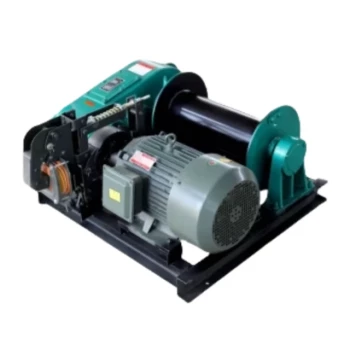
In construction and maintenance, winches are fundamental tools used for a wide range of applications, from hoisting structural beams with A-frames and erecting wind turbine towers to pulling fence posts and performing precise vehicle adjustments. They function as a core component in machinery for lifting, road construction, and mine hoisting, valued for their simple operation and immense power.
A winch is more than just a pulling device; it is a foundational force multiplier. Understanding its core functions—pulling, lifting, and tensioning—allows you to solve a vast array of material handling and positioning challenges safely and efficiently on any job site.
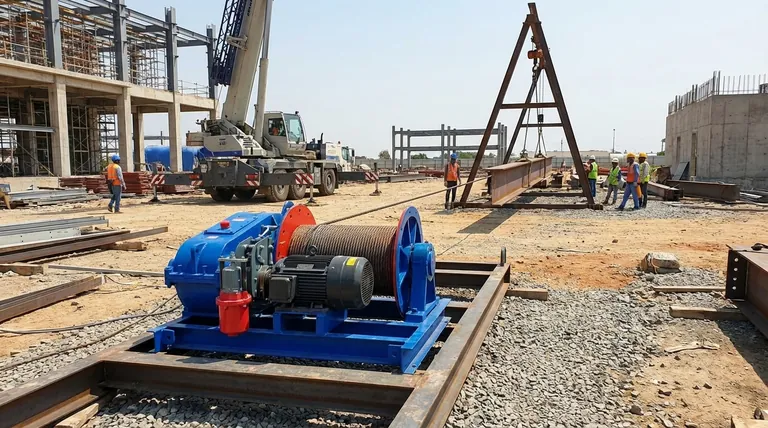
The Core Functions of a Winch on a Job Site
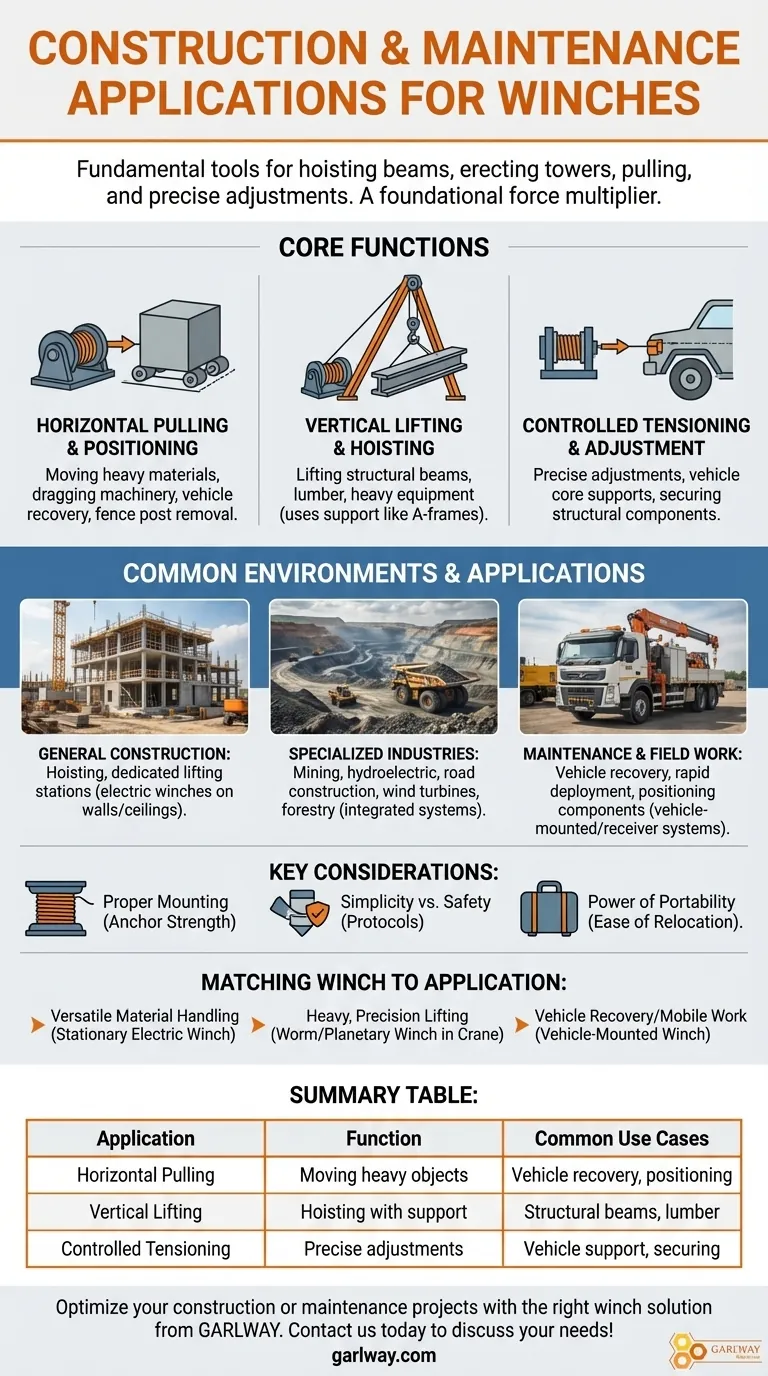
A winch's utility comes from its ability to apply controlled force. On a construction or maintenance site, these applications can be grouped into three primary functions.
Horizontal Pulling and Positioning
This is the most common application, used to move heavy objects across the ground or into a precise location.
Operations include moving heavy construction materials, dragging machinery into place, and pulling vehicles out of mud or snow. This function is also used for tasks like removing fence posts or stumps.
Vertical Lifting and Hoisting
When used with the proper support structures, a winch becomes a powerful and efficient crane or hoist.
This is critical for lifting structural steel beams, hoisting lumber to upper floors, and moving heavy equipment within a structure. Specialized setups like A-frames or gin poles are often used to provide the necessary vertical framework for these lifts.
Controlled Tensioning and Adjustment
Beyond simple movement, winches provide the controlled force needed for precise adjustments and securing loads.
This is essential for tasks like adjusting vehicle core supports during maintenance or ensuring structural components are held firmly in place during assembly.
Common Environments and Applications
The versatility of a winch means it is deployed across nearly every type of heavy industry, from general building sites to highly specialized projects.
General Construction
On any building site, winches are used for hoisting equipment and materials, significantly improving safety and efficiency over manual methods. Electric winches, in particular, are often mounted to walls, floors, or ceilings for dedicated lifting stations.
Specialized Industries
In sectors like mining, hydroelectric installation, and road construction, winches are often integrated directly into larger machinery for hoisting materials or powering equipment. They are indispensable for erecting wind turbine towers and in forestry and dockyard operations.
Maintenance and Field Work
For maintenance crews, vehicle-mounted winches are invaluable. Receiver-mounted systems with quick-connect cables allow for rapid deployment for vehicle recovery or positioning heavy components during repairs in the field.
Understanding the Trade-offs and Key Considerations
While powerful, a winch's effectiveness depends on the right setup and a clear understanding of its operational principles.
The Importance of Proper Mounting
A winch is only as strong as its anchor point. Whether mounted to a vehicle, a ceiling, or a temporary A-frame, the mounting system must be rated to handle the maximum load of the winch to prevent catastrophic failure.
Simplicity vs. Safety
Winches are valued for their simple operation, but this simplicity can mask potential dangers. Always ensure proper safety protocols are followed, such as chocking the wheels of a winching vehicle or clearing the area around a tensioned cable.
The Power of Portability
One of the greatest advantages of many winch systems is their ease of relocation. This allows a single tool to serve multiple purposes across a large job site, from material handling at one end to vehicle recovery at the other.
Matching the Winch to Your Application
Choosing the right winch system depends entirely on the specific demands of your job.
- If your primary focus is versatile material handling: A stationary electric winch offers flexibility, as it can be mounted to walls, ceilings, or floors for dedicated pulling and lifting tasks.
- If your primary focus is heavy, precision lifting: A specialized worm gear or planetary winch integrated into a crane or hoisting system provides the reliable control needed for demanding applications.
- If your primary focus is vehicle recovery or mobile field work: A vehicle-mounted winch, especially a receiver-hitch system, delivers portable power exactly where you need it.
Ultimately, a winch translates electrical or hydraulic power into raw mechanical force, making it one of the most essential and versatile tools in any construction or maintenance arsenal.
Summary Table:
| Application | Function | Common Use Cases |
|---|---|---|
| Horizontal Pulling | Moving heavy objects | Vehicle recovery, material positioning, fence post removal |
| Vertical Lifting | Hoisting with support | Structural steel beams, lumber, equipment lifting |
| Controlled Tensioning | Precise adjustments | Vehicle core support, securing structural components |
Optimize your construction or maintenance projects with the right winch solution from GARLWAY. We specialize in providing durable, high-performance winches, concrete mixers, and batching plants tailored for construction companies and contractors worldwide. Whether you need a stationary electric winch for material handling or a vehicle-mounted system for field work, our expertise ensures you get the right tool for the job. Contact us today to discuss your specific needs and enhance your site's efficiency and safety!
Visual Guide
Related Products
- Hydraulic Winding Engine Harbor Freight Winch
- Small Electric Winch 120V and 240V for Compact Applications
- Electric and Hydraulic Winch for Heavy Duty Applications
- Portable Small Trailer Winch
- Warn Winch Windlass Boat Trailer Winch
People Also Ask
- What role does hydraulic fluid play in hydraulic winches? It's the Lifeblood of Your Heavy-Duty Pulling Power
- What vehicles commonly use hydraulic winches? For Industrial Trucks Needing Unmatched Power
- What are the features of hydraulic winches? Unmatched Power and Continuous Duty for Heavy Loads
- What preventive measures can be taken to avoid oil leakage in hydraulic winches? Ensure Long-Term Reliability
- What does 'power out' mean in a hydraulic winch? Achieve Absolute Control When Lowering Heavy Loads