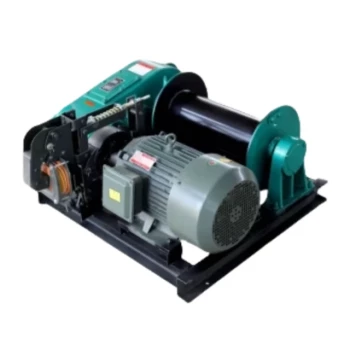
At its core, a heavy-duty winch is a specialized tool for moving massive objects with precision and control. They are indispensable in industries where immense force is a daily requirement, most commonly in construction and infrastructure projects, marine and offshore operations, mining, and large-scale recovery efforts. These applications rely on winches for everything from lifting bridge sections into place to mooring supertankers.
A heavy-duty winch is not merely for pulling; it is a fundamental engine of force for industrial lifting, dragging, and positioning. Understanding the specific demands of the environment—be it on land, at sea, or underground—is the key to selecting the right type of winch for the job.
Core Industrial Applications
A winch's application is defined by the environment it operates in and the task it must perform. The requirements of a construction site are vastly different from those of an offshore oil rig, which dictates the type and scale of the winch used.
Construction and Infrastructure
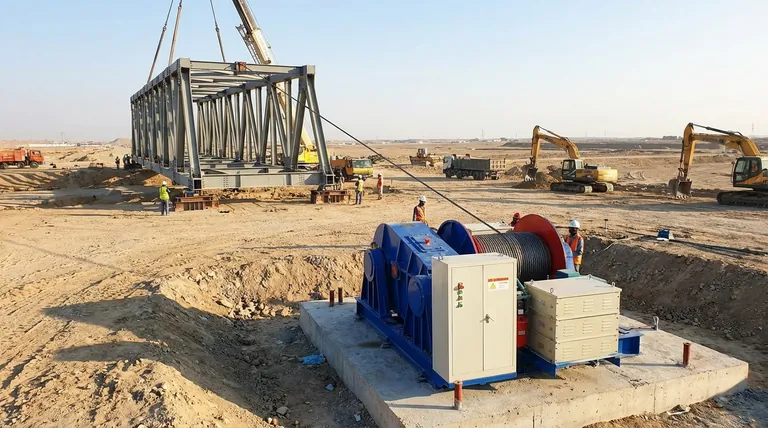
In construction, winches are foundational tools for material handling and structural assembly. They provide the controlled force necessary to manage heavy components safely.
Common tasks include lifting building materials to upper floors, positioning large steel beams, or launching bridge segments across a gap. They are also used in foundation work for operations like punching and piling.
Marine and Offshore Operations
The marine environment is one of the most demanding settings for any machinery. Winches used here must withstand corrosive saltwater and perform reliably under extreme loads.
Hydraulic winches are prevalent in this sector for tasks like ship mooring, anchor handling, and loading and unloading heavy cargo at docks. On offshore oil and gas platforms, they are critical for drilling operations and positioning subsea equipment.
Mining and Resource Extraction
Both surface and underground mining operations rely heavily on winches to move materials and equipment in challenging terrain.
Winches are used to drag ore, pull heavy machinery into position, and support various aspects of drilling and excavation. Their power is essential for overcoming the friction and gravity involved in moving tons of rock and earth.
Recovery and Emergency Services
When heavy vehicles or equipment become stuck or disabled, heavy-duty winches are the primary tool for recovery.
These operations range from pulling a semi-truck out of a ditch to righting overturned construction equipment. The controlled, immense pulling force is crucial for safe and effective recovery without causing further damage.
Understanding the Trade-offs: Hydraulic vs. Electric
The choice between a hydraulic and an electric winch is not about which is "better," but which is better suited for the specific task and environment. This decision hinges on power source availability, duty cycle, and environmental resilience.
The Power and Resilience of Hydraulic Winches
Hydraulic winches generate immense pulling power from a hydraulic system, making them ideal for the most demanding tasks.
They can run for long periods without overheating, a critical feature for continuous operations like those found in mining or on offshore platforms. Their sealed systems also offer superior resistance to water and dust.
The Efficiency and Control of Electric Winches
Electric winches are highly efficient and are often easier to install and operate where a reliable electrical source is available.
They are a common choice for construction sites, manufacturing facilities, and shipping yards. Their precise control makes them excellent for tasks that require careful positioning and lifting rather than just raw, continuous pulling power.
The Physics of the Pull: More Than Just Dragging
While often associated with horizontal pulling, heavy-duty winches are versatile machines designed to apply force across different vectors. The nature of the pull is a key part of their application.
Vertical Lifting
In many construction and factory settings, the winch's primary job is to act as a hoist, lifting materials straight up. This requires specialized braking systems to ensure safety.
Horizontal Dragging
This is the classic winching application, used to drag heavy objects across a surface. It is the fundamental task in most recovery and mining operations.
Inclined Pulling
Moving heavy loads up a ramp or incline, such as on a ship loading ramp or in a quarry, combines elements of both lifting and dragging and is a common industrial requirement.
Making the Right Choice for Your Goal
Selecting the right winch means matching its capabilities to the demands of your specific application and environment.
- If your primary focus is on marine, offshore, or heavy mining operations: A hydraulic winch is almost always the correct choice due to its immense power, long duty cycle, and resilience in harsh environments.
- If your primary focus is on a construction site, factory, or workshop with reliable electricity: An electric winch offers excellent power, efficiency, and precise control for material lifting and positioning.
- If your primary focus is on smaller-scale jobs in remote locations without a power source: A manual winch can provide the necessary force for specific tasks like piling or tensioning.
Ultimately, the right heavy-duty winch is the one that provides the necessary force reliably and safely within the constraints of your operating environment.
Summary Table:
| Application | Primary Use | Common Winch Type |
|---|---|---|
| Construction & Infrastructure | Lifting beams, positioning materials | Electric, Hydraulic |
| Marine & Offshore | Mooring ships, anchor handling | Hydraulic |
| Mining & Resource Extraction | Dragging ore, positioning machinery | Hydraulic |
| Recovery & Emergency Services | Vehicle recovery, righting equipment | Electric, Hydraulic |
Ready to Power Your Projects with the Right Winch?
Choosing the correct heavy-duty winch is critical for the safety and efficiency of your construction, marine, or mining operations. GARLWAY specializes in providing robust and reliable construction machinery, including a range of winches, concrete mixers, and concrete batching plants designed for the demands of construction companies and contractors globally.
Our experts can help you select the perfect winch for your specific application and environment. Contact GARLWAY today for a consultation and let us help you build with confidence and power.
Visual Guide
Related Products
- Electric and Hydraulic Winch for Heavy Duty Applications
- 12000 lb Heavy Duty Electric Boat Winch
- Heavy Duty Electric Boat Winch Windlass Anchor
- Warn Winch Windlass Boat Trailer Winch
- Electric 120V Boat Winch by Badlands
People Also Ask
- What are the differences between electric and hydraulic winches? Choose the Right Winch for Your Job
- What are electro-hydraulic winches and their applications? The Integrated Power Solution for Heavy-Duty Operations
- How do winches assist in bridge launching? Accelerate Bridge Placement with Controlled Pulling Power
- What are the benefits of using heavy-duty winches for large projects? Boost Efficiency & Safety
- What are the key features required for winches in heavy-duty applications? | Ensure Safety & Efficiency