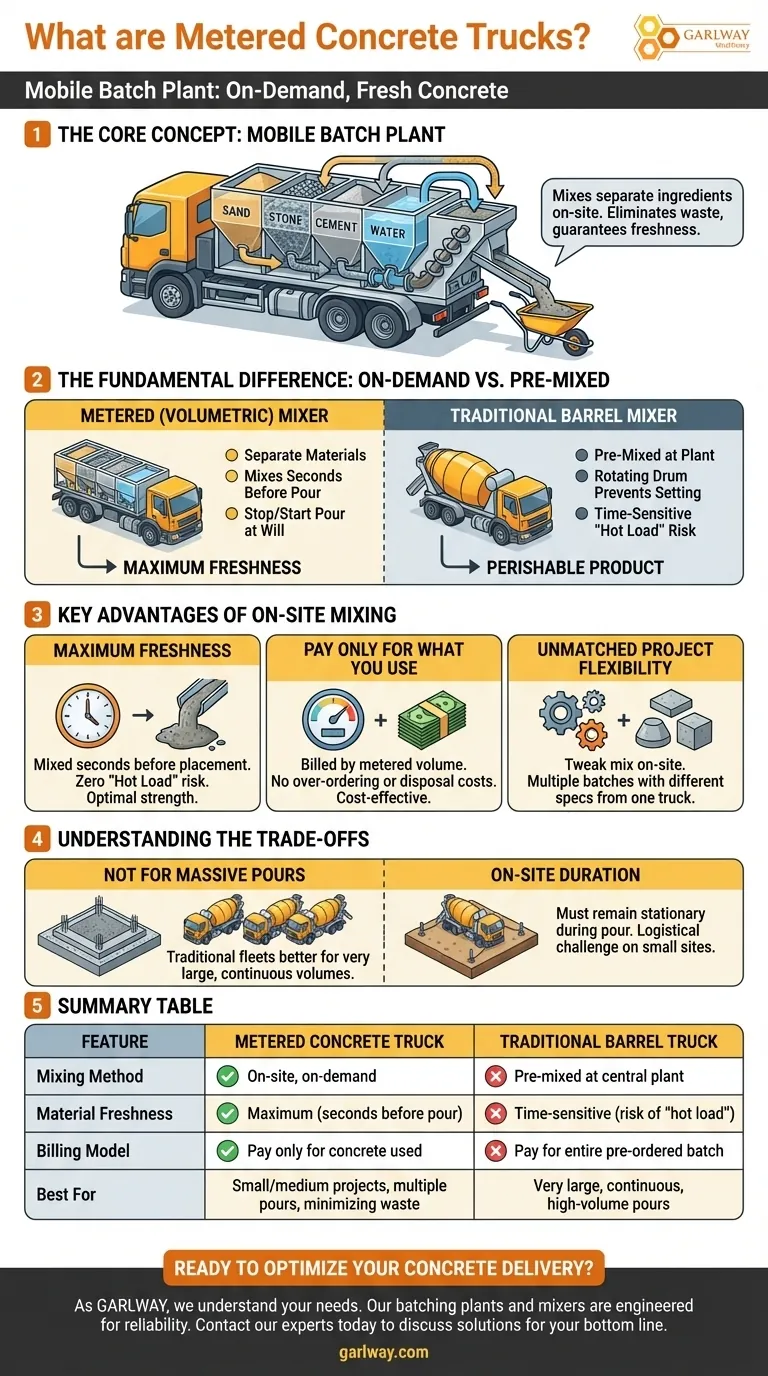
At its core, a metered concrete truck is a mobile batch plant. Unlike a traditional barrel truck that delivers a pre-mixed batch of concrete, a metered truck carries all the raw ingredients—sand, stone, cement, and water—in separate compartments. It then mixes these components on-site, producing the exact amount of fresh concrete you need, precisely when you need it.
The fundamental advantage of a metered concrete truck, also known as a volumetric mixer, is its ability to eliminate waste and guarantee fresh concrete by mixing materials on-demand at the job site. This shifts concrete from a pre-ordered, perishable product to a flexible, just-in-time material.
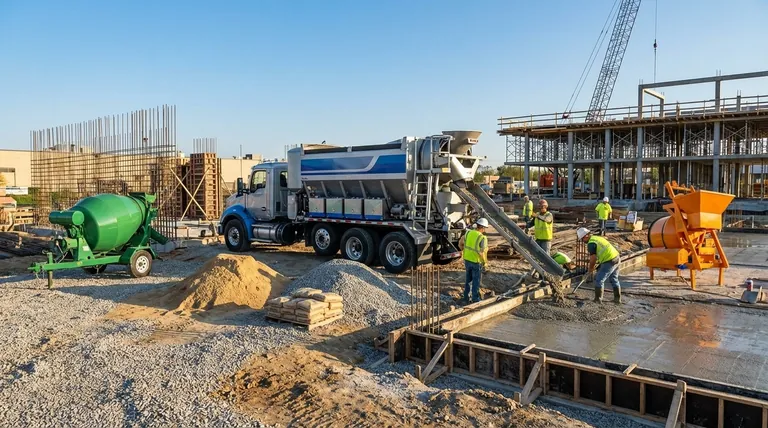
The Fundamental Difference: On-Demand vs. Pre-Mixed
To understand the value of metered concrete, it's essential to compare it directly with the traditional delivery method.
How a Metered (Volumetric) Mixer Works
A metered truck functions as a self-contained concrete factory on wheels. All materials are kept separate until the moment of the pour.
An auger system combines the dry ingredients with water and any necessary admixtures, mixing them to a precise specification as the concrete exits the chute. The operator can start, stop, and restart the pour at will.
The Traditional Barrel Mixer Approach
A traditional barrel truck is filled with a specific quantity of ready-mixed concrete at a central batch plant. The drum rotates during transport to prevent the mixture from hardening.
This creates a time-sensitive delivery. The concrete has a limited window of workability before it begins to set, a problem known as a "hot load."
Key Advantages of On-Site Mixing
The ability to produce concrete on demand provides several distinct operational benefits that directly impact project quality and cost.
Guarantees Maximum Freshness
Because the concrete is mixed seconds before it is placed, it is at its maximum strength and workability. This completely eliminates the risk of receiving a "hot load" that is already beginning to cure.
Pay Only for What You Use
This is the most significant financial benefit. You are billed only for the volume of concrete that comes out of the chute, as measured by the truck's meter.
This model removes the guesswork from ordering. You no longer have to over-order to create a safety buffer or pay for the disposal of unused material.
Unmatched Project Flexibility
The on-demand nature of a metered truck provides superior control. The mix design can be tweaked on-site, or you can produce multiple, smaller batches with different specifications from a single truck.
Understanding the Trade-offs
While highly advantageous, the metered approach is not the universal solution for every scenario.
Not Ideal for Very Large, Continuous Pours
For massive foundation pours where speed and volume are the only priorities, a coordinated fleet of traditional barrel trucks may be able to deliver a larger total volume of concrete more quickly.
On-Site Duration
A metered truck must remain stationary at the job site for the duration of the pour. This can sometimes be a logistical challenge on smaller, more congested sites compared to the quicker drop-and-go nature of a barrel truck.
Making the Right Choice for Your Project
Selecting the right delivery method depends entirely on the priorities and constraints of your specific job.
- If your primary focus is minimizing waste on small to medium jobs: The pay-for-what-you-use model of a metered truck is the most cost-effective solution.
- If your primary focus is quality control and freshness: A metered truck is superior, as it guarantees a perfect mix every time without the risk of a "hot load."
- If your primary focus is project flexibility with multiple small pours: The on-demand capability of a metered truck allows you to complete various tasks without placing multiple, costly orders.
Choosing the right concrete delivery method allows you to treat a critical material not as a fixed liability, but as a flexible asset for your project.
Summary Table:
| Feature | Metered Concrete Truck | Traditional Barrel Truck |
|---|---|---|
| Mixing Method | On-site, on-demand | Pre-mixed at central plant |
| Material Freshness | Maximum (mixed seconds before pour) | Time-sensitive (risk of 'hot load') |
| Billing Model | Pay only for concrete used | Pay for entire pre-ordered batch |
| Best For | Small to medium projects, multiple pours, minimizing waste | Very large, continuous, high-volume pours |
Ready to eliminate concrete waste and guarantee fresh material for your next project? As GARLWAY, a specialist in construction machinery, we understand the precise needs of contractors and construction companies. Our concrete batching plants and mixers are engineered for the reliability and efficiency your projects demand. Contact our experts today to discuss how our solutions can optimize your concrete delivery and boost your bottom line.
Visual Guide
Related Products
- Ready Mixer Machine for Construction Ready Mix Machinery
- Mini Cement Mortar Mixer Truck for Construction
- JW1000 Mobile Cement Mixer Concrete Mixer Truck and Batching Plant
- Harbor Freight JS1500 On Site Concrete Mixing Volumetric Cement Mixer
- Belle Cement Mixer JS2000 Volumetric Concrete Mixer for Harbor Freight
People Also Ask
- What are the purposes of low-speed agitation in truck mixers? Preserve Concrete Quality During Transit
- How is ready-mixed concrete transported from a commercial concrete batching plant? Ensuring Quality & Timely Delivery
- What are the main ingredients mixed in a concrete mixer truck? Master the Formula for Strong Concrete
- In what ways does a mobile concrete mixer improve quality control and consistency? Achieve Superior On-Site Concrete Quality
- What types of construction projects typically use concrete mixer trucks? From Highways to Home Foundations