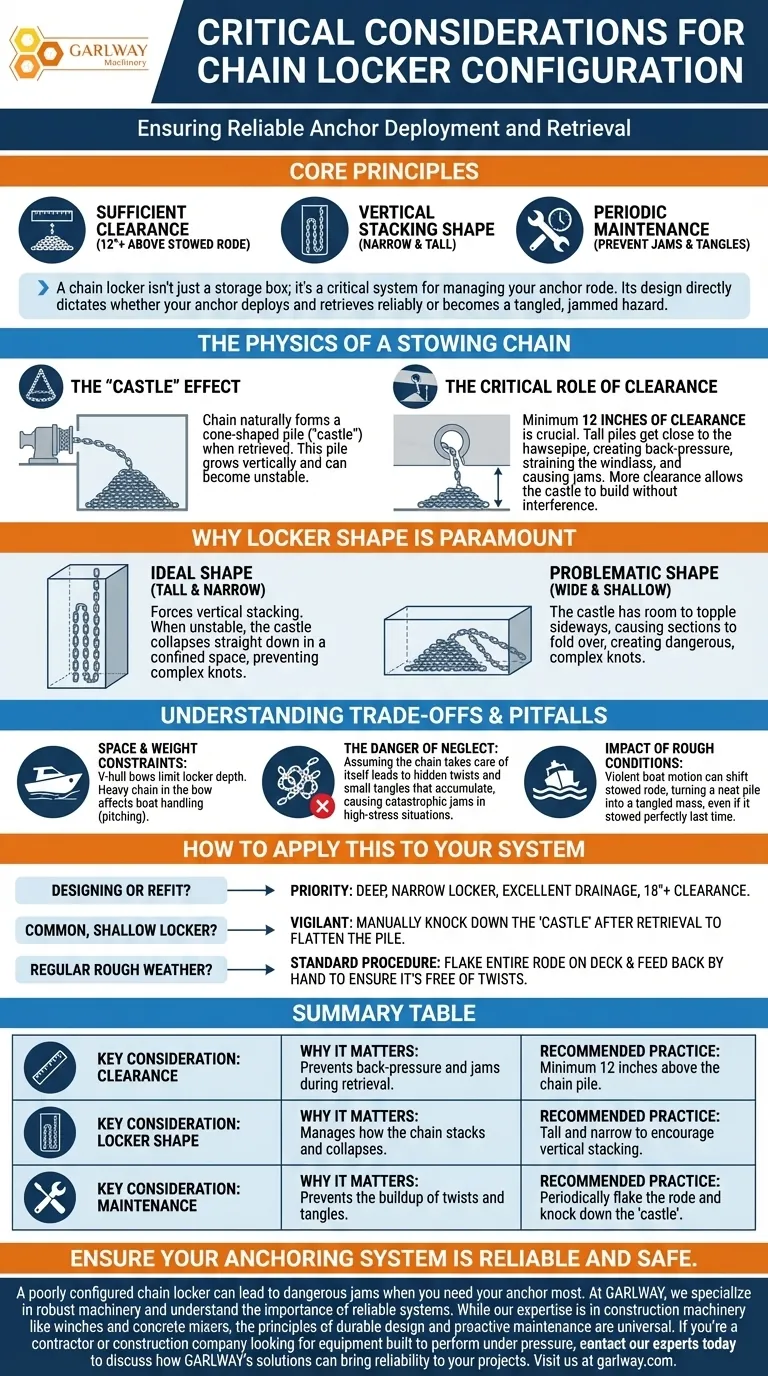
A properly configured chain locker is defined by three core principles: sufficient clearance above the stowed rode, a shape that encourages vertical stacking, and a commitment to periodic maintenance. To prevent dangerous jams, manufacturers recommend a minimum of 12 inches of clearance between the top of the chain pile and the underside of the deck, with a narrow, tall locker being the ideal shape to manage how the chain stows.
A chain locker isn't just a storage box; it's a critical system for managing your anchor rode. Its design directly dictates whether your anchor deploys and retrieves reliably or becomes a tangled, jammed hazard in the moments you need it most.

The Physics of a Stowing Chain
Understanding how anchor chain behaves as it enters the locker is the key to preventing problems. It doesn't pile up randomly; it follows predictable physical patterns.
The "Castle" Effect
As the chain is retrieved by the windlass, it falls into the locker and forms a cone-shaped pile, often called a "castle." The chain doesn't land flat; it stacks on top of itself, growing vertically.
This castle is inherently unstable. In calm waters, it builds fairly predictably. In rough seas, the boat's motion can cause the castle to collapse, creating the foundation for a serious tangle.
The Critical Role of Clearance
The recommendation for at least 12 inches of clearance is directly related to this castle effect. As the pile grows taller, its peak gets closer to the hawsepipe (the hole the chain enters through).
If the peak gets too close, it creates back-pressure and can physically block the incoming chain, causing the windlass to strain and eventually jam. More clearance provides more room for the castle to build without interfering with retrieval.
Why Locker Shape is Paramount
The ideal chain locker is tall and narrow. This shape forces the chain to build its castle vertically in a confined space.
When the castle in a narrow locker becomes too tall and unstable, it tends to collapse on itself in a relatively simple, straight-down manner.
In a wide, shallow locker, the castle has room to topple over sideways. This is far more dangerous, as it can cause entire sections of the rode to fold over on top of each other, creating complex knots that will jam during deployment.
Understanding the Trade-offs and Pitfalls
While the ideal configuration is clear, real-world boat design often involves compromises that can impact anchor system reliability.
The Space and Weight Constraint
The bow of a boat is often a space-constrained area with a V-shaped hull. This makes it structurally difficult to design the deep, boxy locker that is ideal for chain.
Furthermore, a large amount of heavy chain stored in the absolute bow can negatively affect the boat's handling, causing it to pitch and hobby-horse in a seaway. This creates a conflict between ideal locker design and optimal weight distribution.
The Danger of Neglect
The most common pitfall is assuming the chain will take care of itself. Without periodic maintenance, twists and small tangles accumulate with each use.
This gradual buildup of minor issues can culminate in a catastrophic jam. The problem often remains hidden until a high-stress situation, when deploying the anchor quickly is a matter of safety.
The Impact of Rough Conditions
A system that works perfectly at the dock may fail in rough seas. The violent motion of the boat can shift the stowed rode dramatically, turning a neat pile into a tangled mass.
If you anchor in demanding conditions, you cannot rely on the chain to have stowed perfectly during your last retrieval.
How to Apply This to Your System
Your approach should depend on your specific vessel and anchoring needs. Proactive management is the only way to ensure reliability.
- If you are designing a boat or doing a major refit: Prioritize a deep, narrow locker with excellent drainage and at least 18 inches of clearance for true peace of mind.
- If you have a common, shallow locker: You must be vigilant. After retrieving a significant amount of rode, manually knock down the "castle" to create a flatter, more stable pile.
- If you regularly anchor in rough weather: Make it a standard procedure to "flake" your entire rode. This involves pulling all of it out onto the deck and feeding it back into the locker by hand, ensuring it is free of twists and lays neatly.
A well-managed chain locker is the foundation of safe and confident anchoring.
Summary Table:
| Key Consideration | Why It Matters | Recommended Practice |
|---|---|---|
| Clearance | Prevents back-pressure and jams during retrieval. | Minimum 12 inches above the chain pile. |
| Locker Shape | Manages how the chain stacks and collapses. | Tall and narrow to encourage vertical stacking. |
| Maintenance | Prevents the buildup of twists and tangles. | Periodically flake the rode and knock down the 'castle'. |
Ensure your anchoring system is reliable and safe. A poorly configured chain locker can lead to dangerous jams when you need your anchor most. At GARLWAY, we specialize in robust machinery and understand the importance of reliable systems. While our expertise is in construction machinery like winches and concrete mixers, the principles of durable design and proactive maintenance are universal. If you're a contractor or construction company looking for equipment built to perform under pressure, contact our experts today to discuss how GARLWAY's solutions can bring reliability to your projects.
Visual Guide
Related Products
- Auto Concrete Cement Mixer Machine New
- Small Electric Winch 120V and 240V for Compact Applications
- Electric Hoist Winch Boat Anchor Windlass for Marine Applications
- HZS35 Small Cement Concrete Mixing Batch Plant
- HZS25 Best Cement Mixer for Quick Mix Concrete at Bunnings
People Also Ask
- What are the four factors to consider when selecting a concrete mixer? Optimize Your Construction Project
- What are the two main types of concrete mixers and their uses? Choose the Right Mixer for Your Project
- What is a concrete mixer and what does it do? Achieve Consistent, High-Strength Concrete
- What are the benefits of using a concrete mixer on construction sites? Boost Efficiency and Quality
- How should water be added when mixing concrete? A Guide to Achieving Perfect Strength & Workability