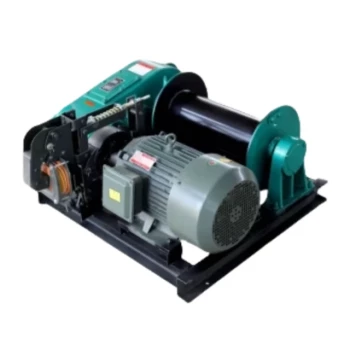
The primary advantage of a winch is its ability to provide a significant mechanical advantage, allowing a single person or a small motor to move an object that is thousands of pounds heavier than the force being applied. It achieves this by using a system of internal gears to convert low-force, high-speed input into a high-force, low-speed pull.
A winch is fundamentally a force multiplier. It uses gear reduction to transform a small, manageable input force into a powerful, controlled pulling tension, making it possible to safely move objects that would otherwise be immovable.
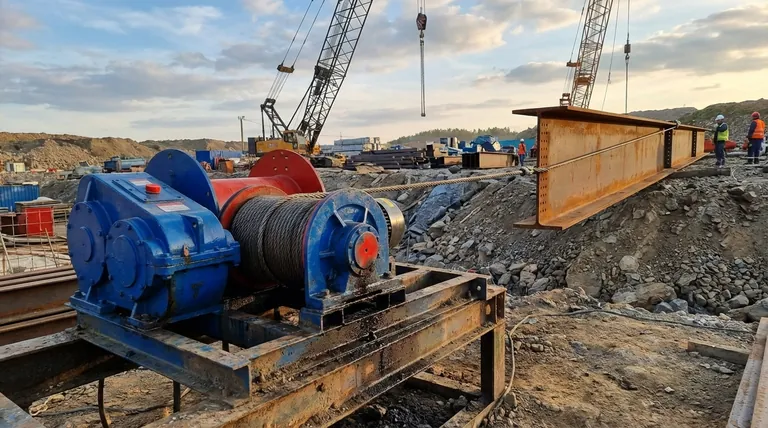
How a Winch Creates Pulling Power
A winch's effectiveness comes from a few core engineering principles working together. Understanding this mechanism is key to appreciating its value.
The Gear Train: Trading Speed for Strength
A winch’s power comes from its gear train, a series of interlocking gears. This system works much like the gears on a bicycle.
When you shift a bike to a low gear to climb a hill, your legs pedal faster, but the wheel turns slowly with immense torque. A winch does the same, using its motor or crank to turn a small gear quickly, which in turn rotates larger gears slowly, dramatically multiplying the pulling force.
The Drum and Cable: Applying Tension
The force generated by the gear train is applied to the winch's drum (or spool).
As the drum rotates, it winds the rope or cable, creating immense tension. This tension is the force that is transferred directly to the object you are moving, allowing for a steady and controlled pull.
Key Operational Advantages
Beyond raw power, the design of a winch offers several practical benefits that make it an indispensable tool in many industries.
Enhanced Safety and Control
By removing the need for intense manual labor or jerky movements, winches make moving heavy loads significantly safer.
The operator can manage the pull from a distance, and the slow, controlled speed of the cable prevents dangerous load shifts or sudden drops.
Efficiency and Versatility
Electric winches, in particular, move heavy goods with remarkable efficiency and often without the need for specialized three-phase electricity.
This makes them ideal for use in remote locations for vehicle recovery or in industries like construction and manufacturing where heavy materials must be lifted with relative ease.
Simplicity and Capacity
Most winches are designed for simple operation, allowing users to focus on the task and safety procedures.
They also feature a large rope capacity, enabling long-distance pulls or lifts from significant depths without compromising the integrity of the operation.
Understanding the Trade-offs and Safety Imperatives
While powerful, a winch is a tool that demands respect and an understanding of its limitations. Its advantages come with inherent trade-offs.
The Speed vs. Power Compromise
The primary trade-off is speed for power. The same gear reduction that provides incredible strength also means the winching process is slow. This is a feature for safety and control, but a limitation for tasks requiring rapid movement.
The Reliance on Safety Systems
A winch's safe operation depends entirely on its built-in protection mechanisms.
Features like an ascending travel limit switch, overload protection, and short-circuit protection are not optional add-ons; they are critical components that must be maintained and verified to be in working order before any operation.
The Importance of a Secure Anchor
The force a winch generates is immense, and it is only as effective as its anchor point. An insecure anchor or improper rigging can lead to catastrophic failure, turning the tool into a significant hazard.
Making the Right Choice for Your Goal
The "best" advantage of a winch depends entirely on the job it needs to do.
- If your primary focus is vehicle recovery: The key advantage is the controlled application of massive pulling power to overcome unpredictable resistance like mud, snow, or steep inclines.
- If your primary focus is industrial lifting: The benefit lies in the system's efficiency, operational safety features, and the reduction of manual labor for repetitive tasks.
- If your primary focus is marine or commercial use: The advantage is its large rope capacity and the ability of certain models to handle a combination of rope and chain reliably.
By understanding its core principles, a winch becomes a predictable and powerful tool for overcoming immense physical challenges.
Summary Table:
| Advantage | Description |
|---|---|
| Mechanical Advantage | Converts low input force into high pulling tension via gear reduction. |
| Enhanced Safety | Allows controlled, distant operation, preventing dangerous load shifts. |
| Operational Efficiency | Enables one person to move thousands of pounds, ideal for remote locations. |
| Versatility & Capacity | Suitable for various tasks (recovery, lifting) with large rope capacity. |
Ready to harness the power of a winch for your projects?
GARLWAY specializes in providing robust and reliable construction machinery, including industrial winches, concrete mixers, and batching plants. Our solutions are designed to enhance safety and efficiency for construction companies and contractors worldwide.
Let us help you move the impossible. Contact our experts today to find the perfect winch for your specific needs!
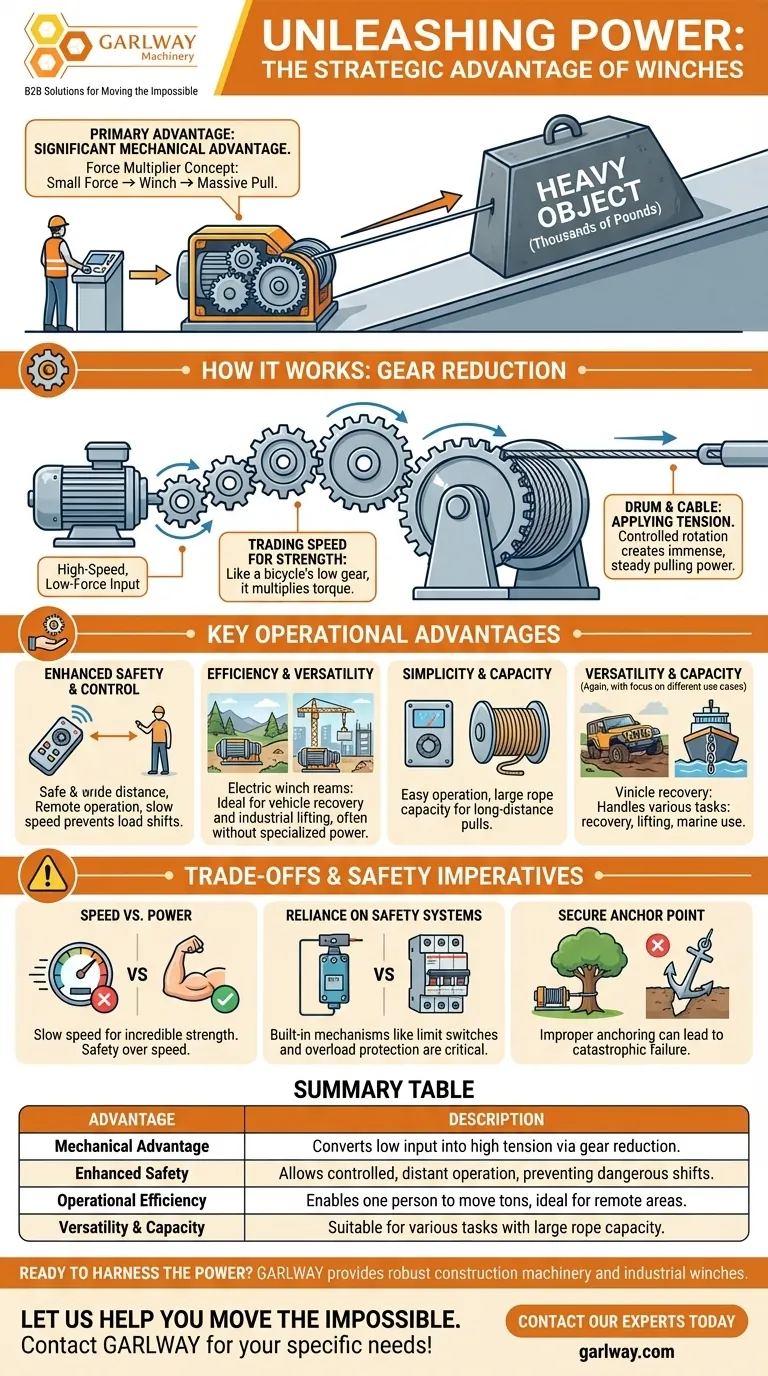
Visual Guide
Related Products
- Warn Winch Windlass Boat Trailer Winch
- Electric and Hydraulic Winch for Heavy Duty Applications
- Small Electric Winch 120V and 240V for Compact Applications
- Quick Windlass Portable Winch for Truck and Boat Best Boat Winch
- Hydraulic Winding Engine Harbor Freight Winch
People Also Ask
- What are the main components of a boat trailer winch? A Guide to Safe & Efficient Boat Loading
- What factors should be considered when choosing a boat trailer winch? Ensure Safe and Effortless Boat Loading
- What is the purpose of boat trailer winches? Safely and Efficiently Load Your Boat
- What are the two main types of boat trailer winches? Manual vs. Electric Explained
- How often should a boat trailer winch be replaced? Your Guide to Safety and Longevity