
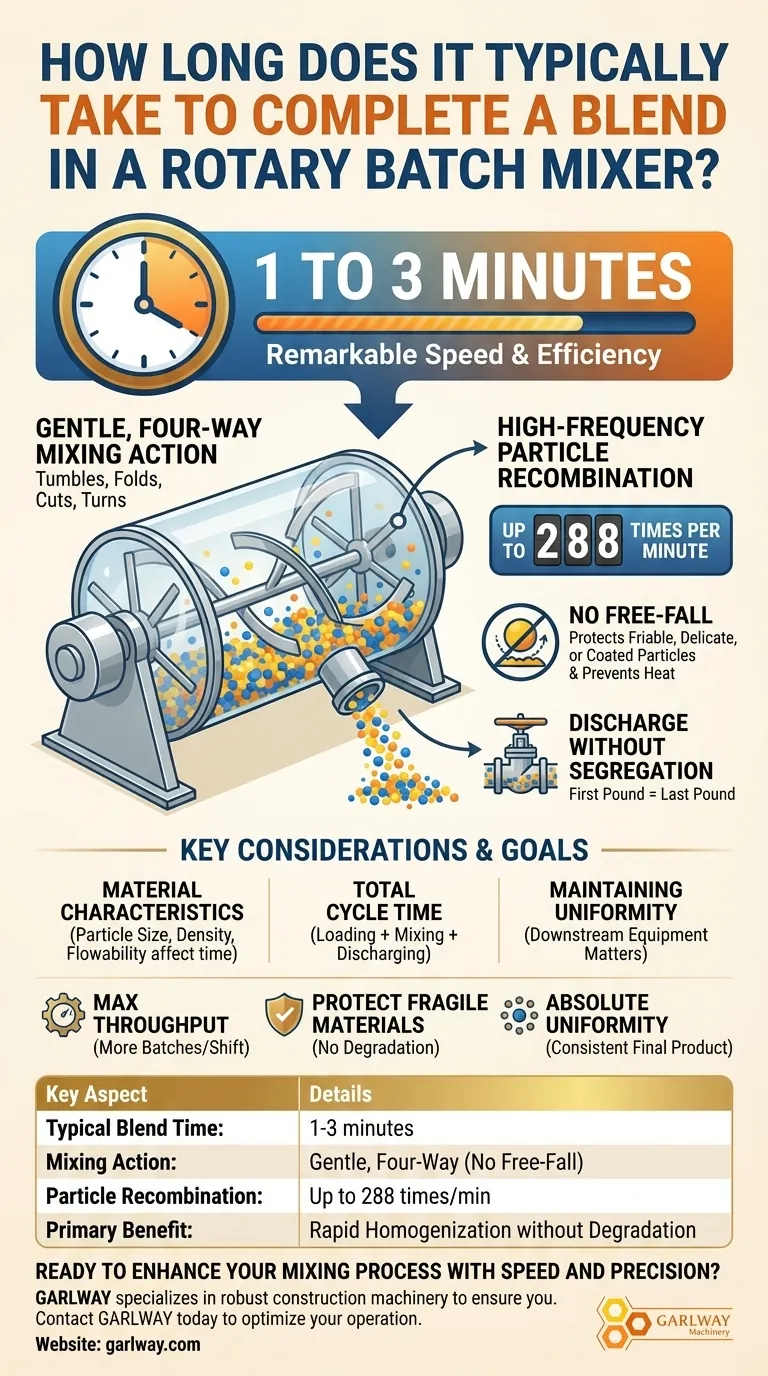
A typical blend cycle in a Rotary Batch Mixer is completed with remarkable speed, generally taking between just 1 to 3 minutes. This efficiency is achieved through a unique mechanical action that prioritizes both speed and the preservation of your materials' integrity.
The core principle of a Rotary Batch Mixer is achieving rapid, homogeneous blends not through aggressive force, but through a gentle, high-frequency particle recombination that protects material integrity from loading through discharge.
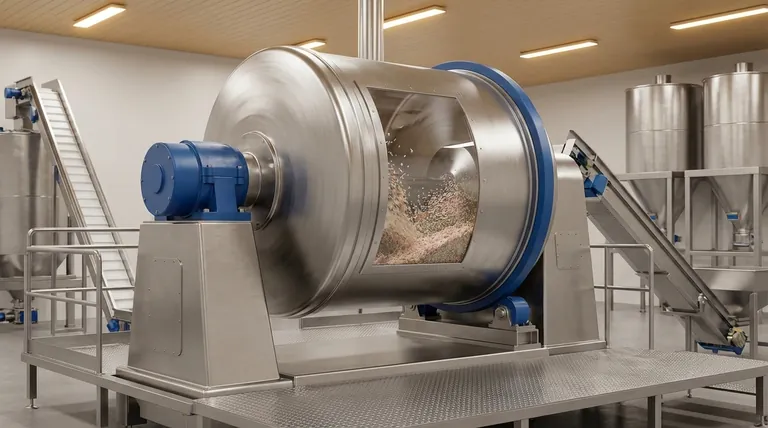
The Mechanism Behind Rapid, Gentle Blending
Understanding why this mixer is so effective requires looking beyond the speed and examining its internal process. The design is engineered to solve two problems simultaneously: achieving a perfect blend quickly and preventing damage to the ingredients.
The Four-Way Mixing Action
The speed of the blend is a direct result of its internal mixing flights. As the drum rotates, these flights create a continuous and gentle four-way mixing action that tumbles, folds, cuts, and turns the material over itself.
This action is incredibly efficient, recombining particles up to 288 times per minute. This high frequency of particle interaction ensures a statistically homogeneous blend is reached in a very short time frame.
Preventing Material Degradation
Crucially, this entire mixing process occurs without any free-fall of the material. Unlike more aggressive mixers that lift and drop ingredients, the Rotary Batch Mixer keeps the material in a constant, gentle tumbling motion.
This lack of impact energy is vital for protecting friable, delicate, or coated particles from damage, degradation, or heat generation.
Preserving the Blend During Discharge
A perfect blend is only useful if it remains homogeneous when it leaves the mixer. The discharge mechanism is designed to prevent segregation or "un-mixing" of the finished product.
When the cycle is complete, the plug gate discharge valve pivots inward. This allows material to flow smoothly out of the spout without stratification, ensuring the first pound discharged is identical to the last.
Understanding the Key Considerations
While the 1-to-3-minute figure is a reliable benchmark, achieving optimal results depends on understanding the complete operational cycle. The blend time itself is just one part of the overall process efficiency.
Material Characteristics Matter
The specific properties of your ingredients—such as particle size, density, and flowability—can influence the ideal blend time within that 1-to-3-minute window. Minor testing and validation will help you lock in the perfect duration for your specific recipe.
The Total Cycle Time
True throughput is determined by the total cycle time, which includes loading, mixing, and discharging. The rapid blend time allows you to focus on creating an efficient loading and unloading process to maximize the number of batches you can run per hour.
Maintaining Blend Uniformity
The anti-segregation discharge system is a key feature. To leverage it fully, ensure your downstream handling equipment (conveyors, hoppers, etc.) is also designed to maintain the blend's uniformity.
Making the Right Choice for Your Goal
The speed of a Rotary Batch Mixer serves different objectives. How you apply it depends on your primary goal.
- If your primary focus is maximum throughput: The 1-3 minute cycle time provides a clear advantage, allowing for more batches per shift than many alternative technologies.
- If your primary focus is protecting fragile materials: The gentle, no free-fall mixing action is the most critical feature, ensuring product quality and preventing waste from damaged ingredients.
- If your primary focus is absolute blend uniformity: The combination of rapid mixing and the anti-stratification discharge gate provides confidence that your final product is perfectly consistent.
Ultimately, the Rotary Batch Mixer's design translates to a process that is not just fast, but fundamentally reliable and protective of your final product quality.
Summary Table:
| Key Aspect | Details |
|---|---|
| Typical Blend Time | 1 to 3 minutes |
| Mixing Action | Gentle, four-way tumbling (no free-fall) |
| Particle Recombination | Up to 288 times per minute |
| Primary Benefit | Rapid homogenization without material degradation |
| Ideal For | Fragile, friable, or coated particles requiring a gentle mix |
Ready to enhance your mixing process with speed and precision?
GARLWAY specializes in robust construction machinery, including concrete mixers and batching plants designed for efficiency and durability. If your projects demand reliable equipment that delivers consistent results batch after batch, our experts are here to help.
Contact GARLWAY today to discuss how our mixing solutions can optimize your operation and protect your material quality.
Visual Guide
Related Products
- Portable Concrete Mixer Machine Equipment for Mixing Concrete
- Commercial Electric Concrete Mixer Machine HZS 50 Small Batch Plant for Sale
- HZS25 Best Cement Mixer for Quick Mix Concrete at Bunnings
- HZS120 Ready Mix Concrete Batching Plant Commercial Mud Cement Mixer
- JW1000 Mobile Cement Mixer Concrete Mixer Truck and Batching Plant
People Also Ask
- Why is it necessary to use a portable concrete mixer? Gain Total Control & Efficiency
- How much concrete can you pour with a portable mixer? Find the Perfect Fit for Your Project
- What types of projects are portable concrete mixers suitable for? Ideal for DIY & Small-Scale Construction
- How much does a portable concrete mixer hold? A Guide to Choosing the Right Capacity
- What types of portable concrete mixers exist? Find the Perfect Mixer for Your Project





