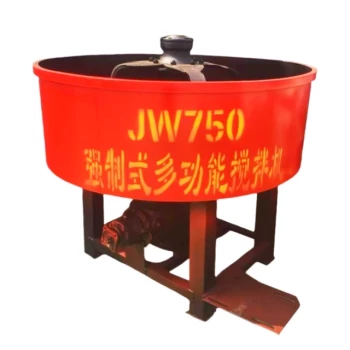
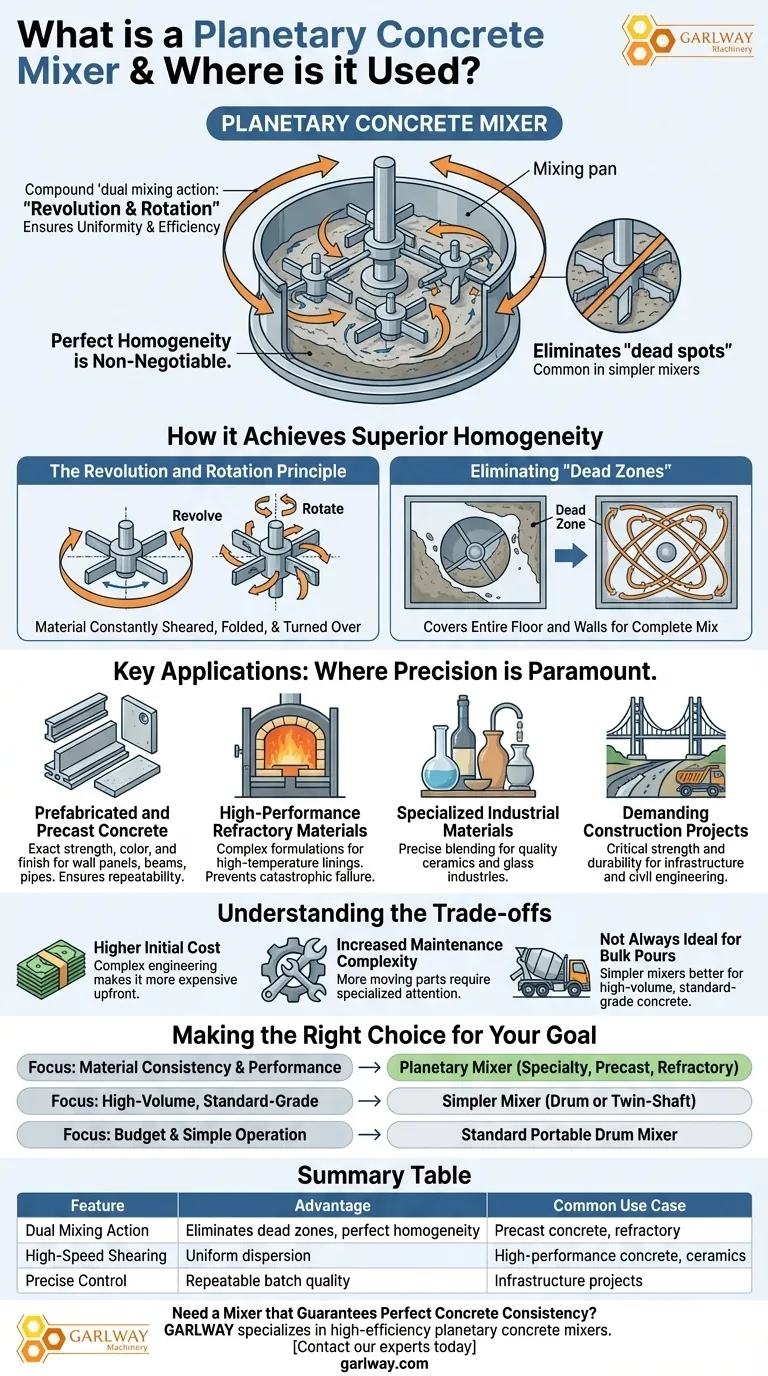
A planetary concrete mixer is a type of vertical shaft mixer defined by a unique, compound mixing action. Its mixing blades not only rotate on their own axes but also revolve around a central point in the mixer, much like planets orbiting the sun. This dual motion ensures an exceptionally uniform, consistent, and efficient mix.
At its core, a planetary mixer is chosen when perfect homogeneity is non-negotiable. Its complex mixing pattern eliminates the dead spots common in simpler mixers, making it essential for high-performance and specialized material applications.
How Planetary Mixing Achieves Superior Homogeneity
The defining advantage of a planetary mixer comes directly from its sophisticated mechanical action. This design is engineered to force interaction between every particle in the batch.
The Revolution and Rotation Principle
The mixer employs one or more mixing stars that revolve around the center of the mixing pan. Simultaneously, the blades or paddles on these stars rotate on their own axes at high speed.
This compound movement creates a powerful and compulsory mixing effect. The material is constantly sheared, folded, and turned over, preventing segregation of aggregates and ensuring additives are dispersed evenly.
Eliminating "Dead Zones"
In simpler drum or pan mixers, material can often get stuck to the walls or sit in "dead zones" that the blades don't effectively reach.
A planetary mixer's sweeping, overlapping paths cover the entire floor and walls of the pan in a short period. This guarantees that no portion of the batch is left unmixed.
Key Applications: Where Precision is Paramount
The intense and uniform mixing action makes planetary mixers the ideal choice for materials where consistency and quality control are critical.
Prefabricated and Precast Concrete
For prefabricated components like wall panels, beams, or pipes, every batch must have the exact same strength, color, and finish. The planetary mixer delivers this required repeatability.
High-Performance Refractory Materials
Refractory materials, used to line high-temperature furnaces and kilns, have complex formulations. Inconsistent mixing can lead to catastrophic failure, making the homogeneity from a planetary mixer essential for safety and performance.
Specialized Industrial Materials
The mixer's versatility extends beyond concrete. It is widely used for producing demanding materials in the ceramics and glass industries, where precise blending of raw ingredients is fundamental to the final product's quality.
Demanding Construction Projects
While used in general construction, planetary mixers are particularly valuable for infrastructure like bridges and high-specification civil engineering works where concrete strength and durability cannot be compromised.
Understanding the Trade-offs
While powerful, a planetary mixer is not the universal solution for every concrete need. Its specialized nature comes with specific considerations.
Higher Initial Cost
The complex gearing and engineering required for the planetary motion make these mixers more expensive upfront compared to simpler drum or pan mixers.
Increased Maintenance Complexity
More moving parts and a more intricate gearbox mean that maintenance can be more demanding. Keeping the machine in optimal condition requires more specialized attention.
Not Always Ideal for Bulk Pours
For massive, continuous pours of standard-grade concrete (like a large foundation slab), a simpler, higher-volume twin-shaft or continuous mixer might be a more economical and practical choice. The planetary mixer excels at quality, not necessarily sheer quantity.
Making the Right Choice for Your Goal
Selecting the right mixer depends entirely on the requirements of your final product.
- If your primary focus is material consistency and performance: The planetary mixer is the definitive choice for specialty concrete, precast, or refractory materials.
- If your primary focus is high-volume, standard-grade concrete: A simpler and more economical drum or twin-shaft mixer is likely a better fit for the job.
- If your primary focus is budget and simple operation for general tasks: A standard portable drum mixer will meet basic needs without the cost and complexity of a planetary system.
Ultimately, choosing a planetary mixer is an investment in guaranteed material quality and consistency.
Summary Table:
| Feature | Advantage | Common Use Case |
|---|---|---|
| Dual Mixing Action | Eliminates dead zones, ensures perfect homogeneity | Precast concrete, refractory materials |
| High-Speed Shearing | Uniform dispersion of additives and aggregates | High-performance concrete, ceramics |
| Precise Control | Repeatable batch quality for critical applications | Infrastructure projects (bridges, etc.) |
Need a Mixer that Guarantees Perfect Concrete Consistency?
If your projects demand the highest quality and uniformity—whether for precast elements, refractory materials, or critical infrastructure—the right equipment is non-negotiable. GARLWAY specializes in robust construction machinery, including high-efficiency planetary concrete mixers designed for contractors and construction companies who cannot compromise on performance.
We can help you select the ideal mixer to meet your specific material requirements and project goals.
Contact our experts today for a consultation and discover how a GARLWAY planetary mixer can enhance your operation's quality and efficiency.
Visual Guide
Related Products
- Portable Concrete Mixer Machine Equipment for Mixing Concrete
- Portable Cement Mixer with Lift Concrete Machine
- Portable Ready Mix Concrete Mixer Equipment
- JS1000 Volumetric Concrete Mortar Mixer for Sale Skid Steer Cement Mixer
- Harbor Freight JS1500 On Site Concrete Mixing Volumetric Cement Mixer
People Also Ask
- Why is it necessary to use a portable concrete mixer? Gain Total Control & Efficiency
- How much concrete can you pour with a portable mixer? Find the Perfect Fit for Your Project
- What types of projects are portable concrete mixers suitable for? Ideal for DIY & Small-Scale Construction
- How much does a portable concrete mixer hold? A Guide to Choosing the Right Capacity
- What types of portable concrete mixers exist? Find the Perfect Mixer for Your Project