
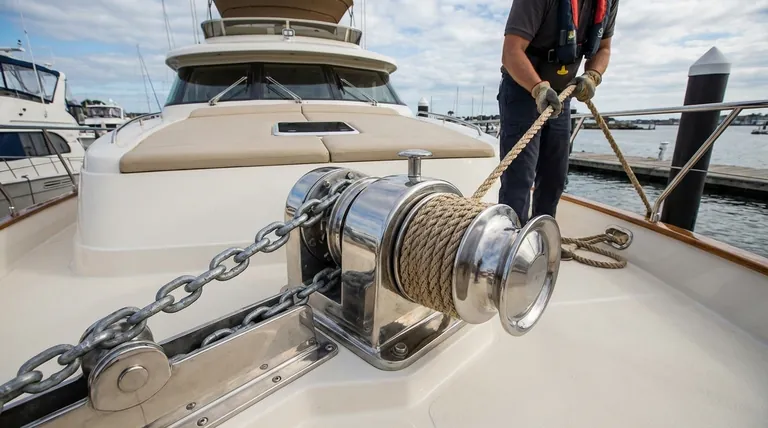
In essence, the drum on a windlass functions as a general-purpose powered winch, entirely separate from the main anchor-retrieval mechanism. While the windlass's primary job is to handle the anchor chain or rope, the drum provides mechanical advantage for a wide range of auxiliary tasks that involve handling a secondary line.
The core purpose of a windlass is to manage the anchor, but modern vessels have countless other line-handling needs. The warping drum brilliantly extends the windlass's function, transforming it from a single-purpose tool into a versatile power source for the foredeck.
The Core Principle: Separating Functions
To understand the drum, you must first distinguish it from the windlass's primary component: the gypsy.
The Gypsy: For the Anchor Rode
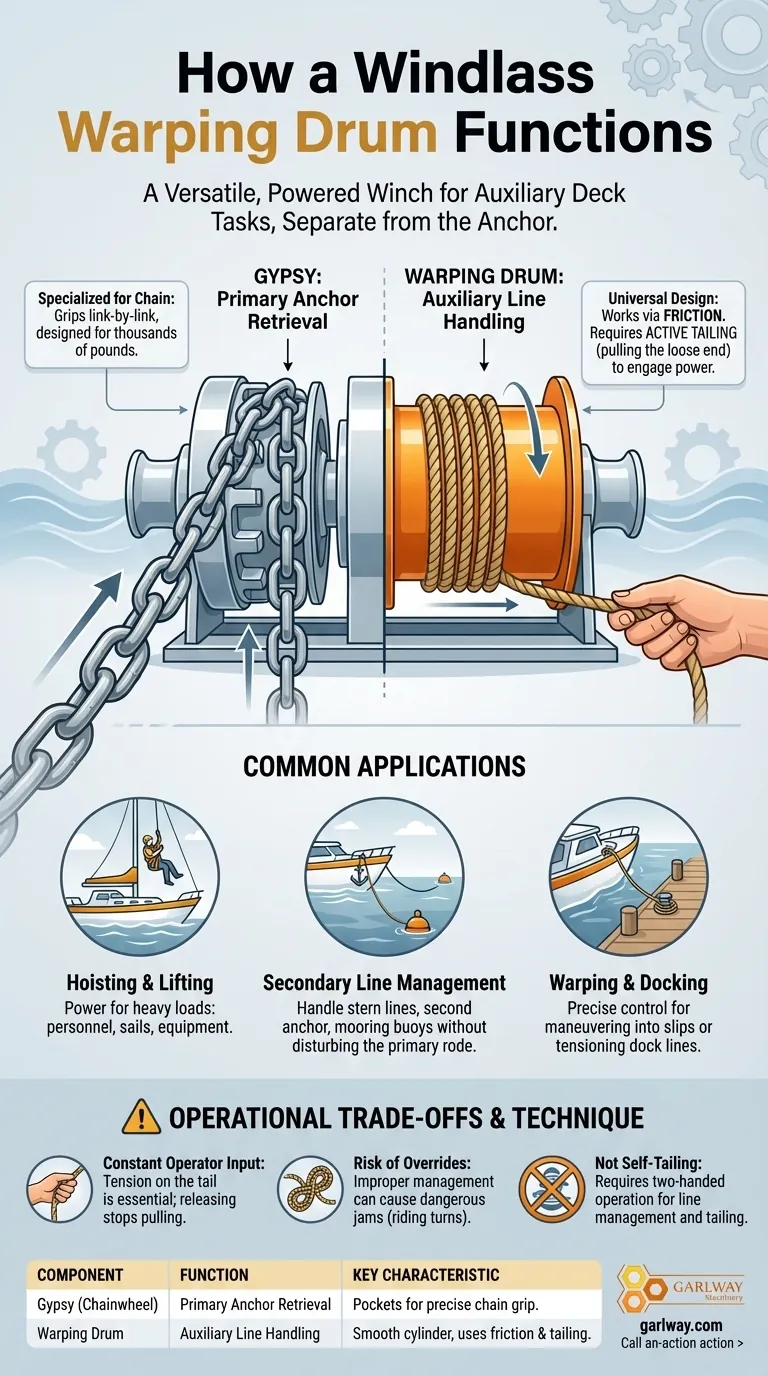
The gypsy (or chainwheel) is the specially molded wheel with pockets designed to precisely fit and grip your anchor chain. It engages the chain link-by-link, providing a secure grip for hauling thousands of pounds.
The Drum: For General-Purpose Lines
The warping drum, in contrast, is a smooth or lightly textured cylinder. It does not have pockets and is not sized for any specific line. This universal design is its greatest strength.
It works on the principle of friction. You wrap a line around the spinning drum several times, and by pulling on the free end (tailing the line), you generate the friction needed to transfer the motor's power to the line.
Common Applications and Why They Matter
The drum's versatility makes it one of the most useful pieces of equipment on the bow.
Hoisting and Lifting
The drum provides the power needed for heavy lifting. This is invaluable for hauling a person up the mast in a bosun's chair for repairs or hoisting heavy sails and equipment from the dock.
Secondary Line Management
It allows you to manage a completely separate line without disturbing your primary anchor. This could be for handling a second anchor, a stern line, or a mooring buoy pickup line.
Warping and Docking
The term "warping drum" comes from its use in warping a vessel. You can run a line to a piling or cleat on the dock and use the drum to carefully pull the boat into its slip or alongside a pier, giving you precise control.
Understanding the Operational Trade-offs
While powerful, the drum is not an automated tool and requires proper technique to use safely and effectively.
Constant Operator Input is Required
Unlike the gypsy which holds the chain securely, the drum requires a user to actively "tail" the line—that is, pull on the loose end. Releasing tension on the tail immediately disengages the drum's pulling power, as the line will simply slip.
The Risk of Overrides
If the line is not managed correctly as it's pulled in, it can wrap over itself and jam tightly on the drum. This is known as an override or a "riding turn," and it can be difficult and dangerous to clear.
It Is Not a Self-Tailing Winch
Most windlass drums are not self-tailing. A self-tailing winch has a mechanism on top that grips and strips the line for you, freeing up a hand. A windlass drum requires you to manage the incoming line with one hand while tailing with the other.
How to Apply This to Your Vessel
Your use of the drum will depend entirely on your immediate operational goal.
- If your primary focus is anchoring: View the drum as your backup and secondary system for managing mooring lines or a second anchor without disturbing your main rode.
- If your primary focus is general deck work: Treat the drum as your primary foredeck power source for hoisting sails, equipment, or personnel (with extreme caution and proper safety gear).
- If your primary focus is docking: Use the drum's power to precisely warp the boat into tight slips and tension dock or spring lines far tighter than you could by hand.
Ultimately, the warping drum multiplies your physical strength, turning a specialized anchor tool into a versatile workhorse for the entire vessel.
Summary Table:
| Function | Component | Key Characteristic |
|---|---|---|
| Primary Anchor Retrieval | Gypsy (Chainwheel) | Pockets designed to grip anchor chain link-by-link. |
| Auxiliary Line Handling | Warping Drum | Smooth cylinder that uses friction to handle various lines. |
Ready to harness the power of a versatile windlass on your vessel?
GARLWAY specializes in robust construction and marine machinery, offering powerful winches and reliable equipment trusted by marine operators and contractors globally. Our solutions provide the mechanical advantage you need for heavy lifting, precise docking, and efficient deck work.
Contact GARLWAY today to find the perfect winch solution for your operational needs and enhance your vessel's capabilities!
Visual Guide
Related Products
- Electric Hoist Winch Boat Anchor Windlass for Marine Applications
- Warn Winch Windlass Boat Trailer Winch
- Heavy Duty Electric Boat Winch Windlass Anchor
- Quick Windlass Portable Winch for Truck and Boat Best Boat Winch
- 12000 lb Electric Boat Trailer Winch with Windlass Anchor Warn
People Also Ask
- How does an electric anchor winch work? Power, Safety, and Reliable Operation Explained
- What are the advantages of installing an electric anchor winch on a boat? Boost Safety & Ease for Boaters
- What are the operational differences between electric hoists and winches? A Guide to Safe Lifting vs. Pulling
- What are the main benefits of a boat anchor winch? Boost Safety & Efficiency for Your Vessel
- How does a boat anchor winch work? A Guide to Reliable Anchor Handling


