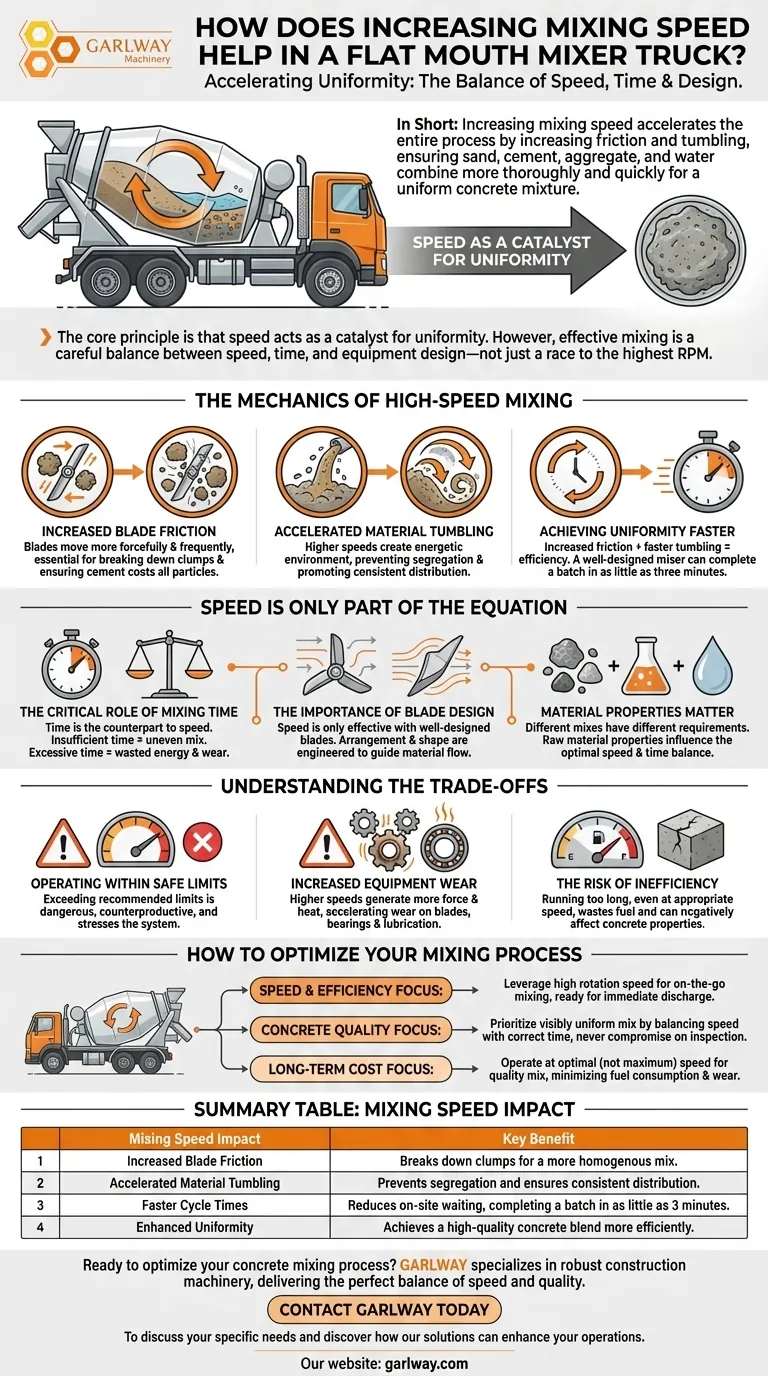
In short, increasing the mixing speed in a flat mouth mixer truck accelerates the entire process by increasing the friction and tumbling action of the materials inside. This rapid movement ensures that sand, cement, aggregate, and water are combined more thoroughly and quickly, leading to a more uniform concrete mixture.
The core principle is that speed acts as a catalyst for uniformity. However, effective mixing is a careful balance between speed, time, and equipment design—not just a race to the highest RPM.
The Mechanics of High-Speed Mixing
Achieving a homogenous concrete mix is the primary goal of any mixer. In a flat mouth mixer, speed is a critical lever for influencing the physical interactions between the raw materials.
Increased Blade Friction
As the mixer's speed increases, the blades move through the materials more forcefully and frequently. This heightened friction is essential for breaking down clumps and ensuring that cement particles coat every piece of sand and aggregate.
Accelerated Material Tumbling
Higher rotational speeds create a more energetic environment inside the mixer. This causes the materials to lift, fold, and roll over each other more rapidly, preventing segregation and promoting a consistent distribution throughout the batch.
Achieving Uniformity Faster
The combination of increased friction and faster tumbling directly translates to efficiency. A well-designed flat mouth mixer can complete a batch in as little as three minutes, a significant advantage over slower methods that reduces on-site waiting time.
Speed Is Only Part of the Equation
While speed is a powerful tool, it does not work in isolation. Relying on speed alone without considering other factors can lead to poor results and equipment damage.
The Critical Role of Mixing Time
Time is the counterpart to speed. Insufficient mixing time, even at high speed, will result in an uneven mix and compromise concrete quality. Conversely, excessive time wastes energy and causes unnecessary wear on the machinery.
The Importance of Blade Design
Speed is only effective when channeled by well-designed blades. The arrangement and shape of the blades are engineered to guide material flow, and a high-quality mixer maximizes the impact of its rotational speed.
Material Properties Matter
Different mixes have different requirements. The properties of the raw materials—such as aggregate size or the addition of admixtures—influence the optimal combination of speed and time needed to achieve a uniform blend.
Understanding the Trade-offs
Operating a mixer is about finding the optimal balance, not just pushing for maximum output. Understanding the limitations and potential downsides is key to professional operation.
Operating Within Safe Limits
Every piece of equipment has an engineered operational limit. Exceeding the recommended mixing speed can be dangerous and is counterproductive, putting unnecessary stress on the entire system.
Increased Equipment Wear
Higher speeds generate more force and heat, accelerating wear on critical components like blades, bearings, and the lubrication system. Aggressive operation leads to more frequent and costly maintenance.
The Risk of Inefficiency
Running the mixer for too long, even at an appropriate speed, is a common mistake. This not only consumes more fuel but can, in some cases, negatively affect the properties of the concrete mix.
How to Optimize Your Mixing Process
Your operational strategy should align with your project's primary goal.
- If your primary focus is speed and efficiency: Leverage the high rotation speed to mix on-the-go, ensuring concrete is ready for immediate discharge upon arrival at the construction site.
- If your primary focus is concrete quality: Prioritize achieving a visibly uniform mix by balancing speed with the correct mixing time, and never compromise on regular equipment inspection.
- If your primary focus is long-term operational cost: Operate at the optimal—not maximum—speed to achieve a quality mix while minimizing fuel consumption and mechanical wear.
Mastering your equipment means understanding how to balance these variables for consistent, high-quality results on every job.
Summary Table:
| Mixing Speed Impact | Key Benefit |
|---|---|
| Increased Blade Friction | Breaks down clumps for a more homogenous mix. |
| Accelerated Material Tumbling | Prevents segregation and ensures consistent distribution. |
| Faster Cycle Times | Reduces on-site waiting, completing a batch in as little as 3 minutes. |
| Enhanced Uniformity | Achieves a high-quality concrete blend more efficiently. |
Ready to optimize your concrete mixing process?
GARLWAY specializes in providing robust construction machinery, including high-performance concrete mixers and batching plants designed for contractors and construction companies worldwide. Our equipment is engineered to deliver the perfect balance of speed and quality, maximizing your on-site efficiency and project outcomes.
Contact GARLWAY today to discuss your specific needs and discover how our solutions can enhance your operations.
Visual Guide
Related Products
- Mini Cement Mortar Mixer Truck for Construction
- Ready Mixer Machine for Construction Ready Mix Machinery
- JW1000 Mobile Cement Mixer Concrete Mixer Truck and Batching Plant
- Portable Concrete Mixer Machine Equipment for Mixing Concrete
- HZS25 Best Cement Mixer for Quick Mix Concrete at Bunnings
People Also Ask
- Why might mixing mortar in a cement truck be problematic? Avoid Costly Mixing Mistakes
- What are the main types of construction cement mixers available? Choose the Right Mixer for Your Project
- What are the two primary methods for filling a cement mixer truck? Central vs. Transit Mix Explained
- What are the common uses of cement mixer trucks? Boosting Construction Efficiency and Quality
- What are the primary methods to fill a cement mixer truck? Central Mix vs. Transit Mix Explained