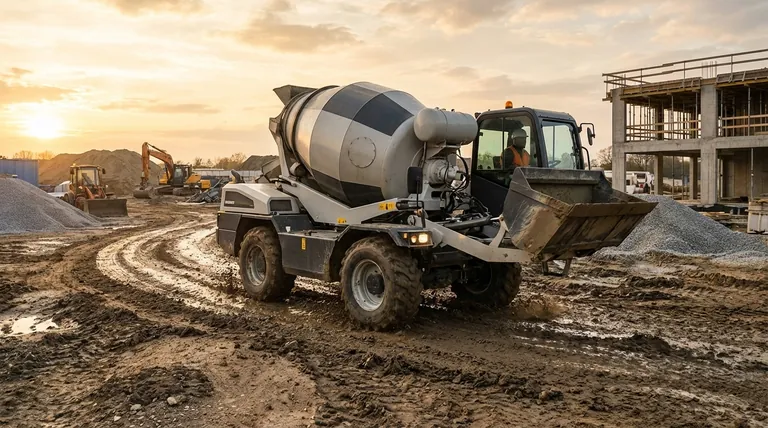
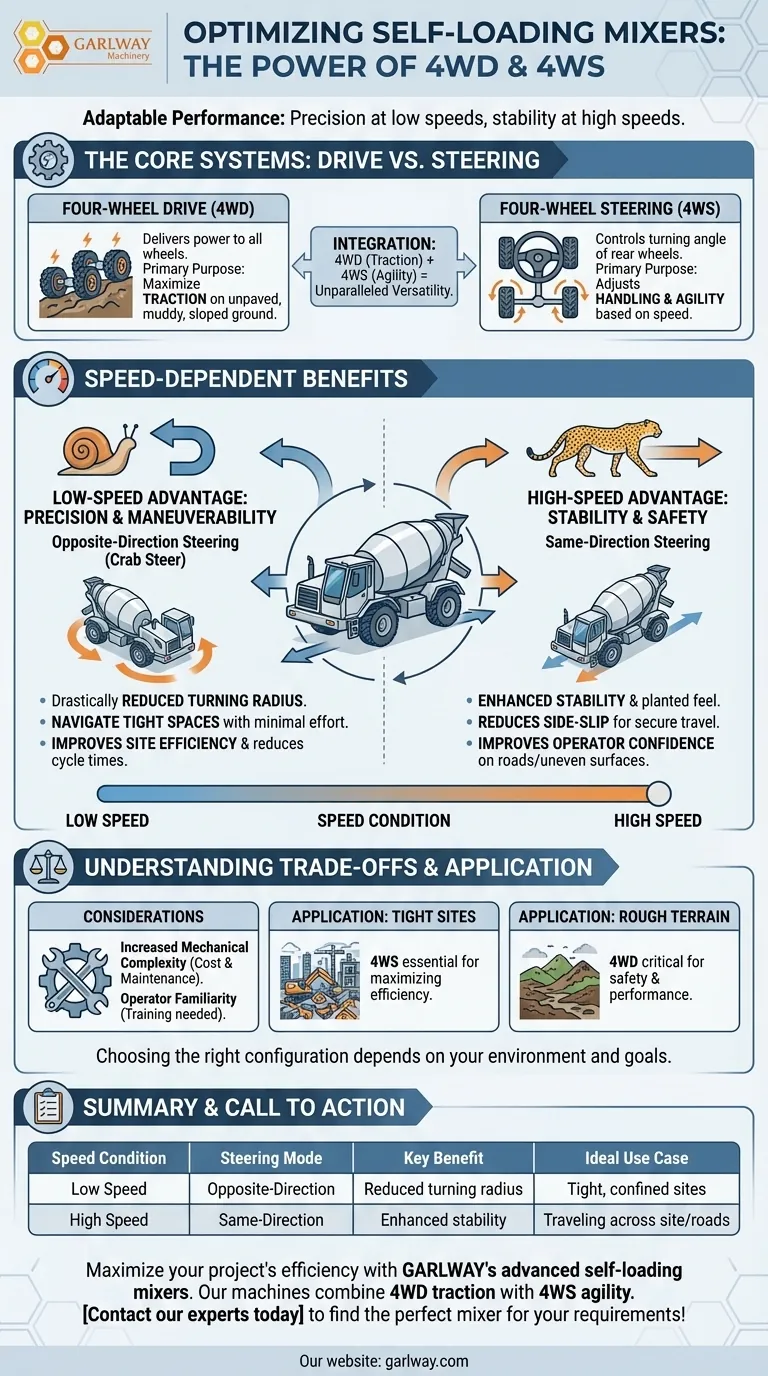
For a self-loading mixer, the benefits of its drive and steering systems are speed-dependent, designed to maximize either maneuverability or stability. At low speeds, the four-wheel system enables opposite-direction wheel turning, drastically reducing the turning radius for navigating tight job sites. At higher speeds, it transitions to same-direction turning, which improves stability and reduces side-slip for safer travel.
The true advantage lies in the integration of four-wheel drive for traction with four-wheel steering for agility. This combination creates an adaptable machine that is both precise in confined spaces and stable when moving quickly across a work site.
The Core Systems: Drive vs. Steering
Before examining the benefits, it's crucial to distinguish between two related but distinct systems that work together on these machines.
Understanding Four-Wheel Drive (4WD)
Four-wheel drive delivers engine power to all four wheels simultaneously. Its primary purpose is to maximize traction. This is essential on the unpaved, muddy, or sloped terrain common to construction sites, preventing wheel spin and ensuring the machine can move reliably under load.
Understanding Four-Wheel Steering (4WS)
Four-wheel steering controls the turning angle of the rear wheels in relation to the front wheels. This system is what directly changes the machine's handling characteristics at different speeds, offering distinct modes for different operational needs.
The Low-Speed Advantage: Precision and Maneuverability
At low speeds, the machine's primary need is agility. The system prioritizes the ability to navigate tight spaces with minimal effort.
Opposite-Direction Steering
To achieve this, the rear wheels turn in the opposite direction of the front wheels. This is sometimes called "crab steer" mode.
A Radically Reduced Turning Radius
This counter-steering action significantly shortens the machine's turning radius. It allows the mixer to make sharp turns and pivot in areas that would require a multi-point turn from a conventional two-wheel steer vehicle.
The Impact on Site Efficiency
This enhanced maneuverability is not just a convenience; it directly impacts project timelines. The operator can position the mixer for loading materials or discharging concrete more quickly and precisely, reducing cycle times and eliminating the need for extra equipment to reposition materials.
The High-Speed Advantage: Stability and Safety
When the mixer needs to travel longer distances across a site or on a road, the priority shifts from agility to stability.
Same-Direction Steering
At higher speeds, the system automatically adjusts so the rear wheels turn in the same direction as the front wheels, though at a much smaller angle.
Enhancing Stability and Reducing Side-Slip
This coordinated movement makes the machine feel more planted and secure. It counteracts the natural tendency of a heavy, high-center-of-gravity vehicle to sway or "drift" during lane changes or on uneven surfaces, improving operator confidence and safety.
Understanding the Trade-offs
While highly effective, these advanced systems come with considerations that are important for any operational assessment.
Increased Mechanical Complexity
A 4WD/4WS system has more components than a standard two-wheel drive setup, including additional driveshafts, steering linkages, and hydraulic controls. This can lead to higher initial purchasing costs and more complex maintenance requirements over the machine's life.
Operator Familiarity
To leverage the full potential of different steering modes, operators need proper training. While the systems are often automated based on speed, understanding how to manually engage modes like "crab steer" for specific tasks is key to maximizing efficiency.
Necessity vs. Application
For projects on large, open, and perfectly flat paved surfaces, the extreme maneuverability offered by 4WS might be underutilized. However, for the vast majority of construction environments, its benefits in overcoming terrain and space constraints are invaluable.
How to Apply This to Your Project
Choosing the right machine configuration depends entirely on your operational environment and project goals.
- If your primary focus is operating on tight, congested, or complex job sites: The superior maneuverability from a four-wheel steering system is essential for maximizing efficiency.
- If your primary focus is working on unpaved, muddy, or sloped terrain: The superior traction from four-wheel drive is a critical safety and performance feature you cannot compromise on.
- If your primary focus is minimizing initial cost for simple, open sites: A two-wheel drive/steer model may suffice, but you will sacrifice significant operational flexibility for future projects.
Ultimately, selecting a self-loading mixer with both four-wheel drive and four-wheel steering is an investment in unparalleled versatility and operational speed.
Summary Table:
| Speed Condition | Steering Mode | Key Benefit | Ideal Use Case |
|---|---|---|---|
| Low Speed | Opposite-Direction (Crab Steer) | Drastically reduced turning radius | Tight, confined job sites |
| High Speed | Same-Direction | Enhanced stability, reduced side-slip | Traveling across site or on roads |
Maximize your project's efficiency with GARLWAY's advanced self-loading mixers. Our machines combine four-wheel drive for superior traction on rough terrain with four-wheel steering for unmatched agility in tight spaces. Whether you're a construction company or contractor working on complex sites, GARLWAY's mixers deliver the precision and stability you need to accelerate your timeline. Contact our experts today to find the perfect mixer for your specific job site requirements!
Visual Guide
Related Products
- Skid Steer Self Loading Concrete Mixers for Construction
- Belle Mixer Drum Self Loading Mortar Mixers JS3000
- Portable Cement Mixer with Lift Concrete Machine
- JW1000 Mobile Cement Mixer Concrete Mixer Truck and Batching Plant
- Portable Concrete Mixer Machine Equipment for Mixing Concrete
People Also Ask
- How does the control system improve production efficiency in a self loading concrete mixer? Automate Mixing for Speed & Quality
- What is the purpose of keeping the drum rotating during transportation in a self loading concrete mixer? Ensure Quality & Consistency
- How does the weighing process work in a self loading concrete mixer? Achieve Precise, On-Site Concrete Batching
- What components are involved in the loading process of a self loading concrete mixer? A Guide to the Key Systems
- How should materials be loaded into a self-loading concrete mixer? Master the Step-by-Step Process