
In the automotive industry, an electric winch is a foundational tool for power and control. Its primary roles are to recover stuck vehicles, assist in complex rescue operations, and manage demanding towing tasks by applying substantial, controlled force where it's needed most.
An electric winch transforms a vehicle from a simple mode of transport into a powerful recovery tool. Its value lies not just in raw pulling power, but in the precise, remote-controlled, and safe application of force that is difficult to achieve by other means.
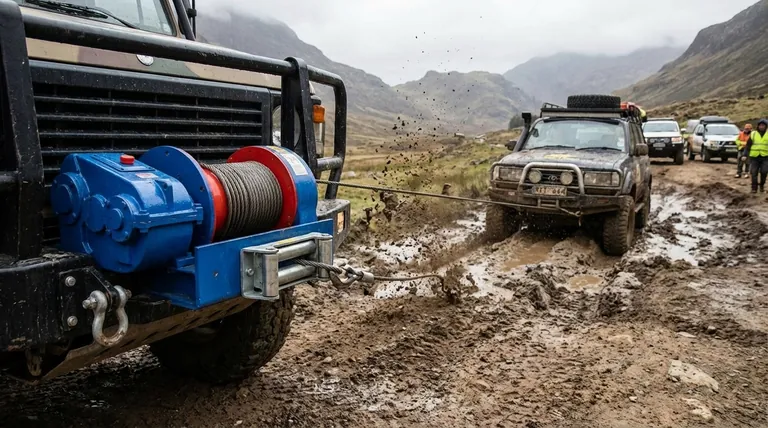
The Core Function: From Immobility to Recovery
An electric winch is fundamentally a tool for converting a vehicle's electrical power into immense pulling force, providing a mechanical advantage to move heavy objects and overcome resistance.
The Mechanics of Force
An electric winch consists of a powerful electric motor that turns a drum. This drum is wound with a strong wire rope or synthetic cable, allowing it to pull heavy loads like a car or machinery with controlled force.
Key Automotive Applications
The most common application is in off-roading, where winches are essential for self-recovery or assisting other vehicles stuck in mud, sand, or on difficult terrain. They are also used for loading immobile vehicles onto trailers and in professional rescue scenarios.
Why Electric Winches Are a Standard Tool
Electric winches have become standard equipment in many automotive contexts because they offer a superior combination of control, safety, and operational efficiency compared to manual or even hydraulic alternatives.
Unmatched Control and Precision
Advanced models offer precise control over the load. Features like variable speed control and a "power-out" option, which uses the motor in reverse, allow an operator to manage speed and direction accurately for both pulling and controlled lowering.
Superior Safety by Design
Safety is a paramount advantage. Remote controls allow the operator to stand at a safe distance, away from the tensioned cable and the load, providing a better vantage point and minimizing risk.
Clean and Efficient Operation
Compared to hydraulic systems, electric winches have lower installation costs and operate cleanly without the risk of hydraulic fluid leaks. They run quietly and can be programmed for specific speeds or stop positions, automating difficult work.
Understanding Key Features and Trade-offs
The effectiveness of an electric winch is defined by its core features. Understanding them is crucial for safe and efficient operation.
The Automatic Load-Holding Brake
This is a critical safety feature. The moment the motor stops, an automatic brake engages on the drum. This prevents the load from slipping backward, which is essential when holding a vehicle on an incline.
Remote Operation
Operating the winch from a distance is non-negotiable for safety. It keeps personnel out of the "danger zone" should the cable fail under extreme tension and provides the operator with a wider, safer field of view.
Free Spooling
This feature allows the drum to rotate freely, enabling the operator to pull out the cable by hand quickly. This saves significant time and battery power compared to using the motor to unspool the entire length of the cable.
Making the Right Choice for Your Goal
Selecting the right winch depends entirely on its intended application.
- If your primary focus is recreational off-road recovery: Prioritize a winch with a durable remote control, a reliable automatic brake, and a pulling capacity rated for at least 1.5 times your vehicle's weight.
- If your primary focus is vehicle transport or trailer loading: Look for a winch with a smooth power-out function for controlled unloading and precise speed controls to prevent damage.
- If your primary focus is professional rescue or commercial work: Choose a heavy-duty model with advanced features like overload protection and programmable controls for maximum safety and repeatable performance.
Ultimately, an electric winch provides the controlled power necessary to safely overcome challenging automotive situations.
Summary Table:
| Key Feature | Benefit |
|---|---|
| Electric Motor & Drum | Converts electrical power into immense, controlled pulling force |
| Remote Control | Enables safe operation from a distance, away from the load |
| Automatic Load-Holding Brake | Prevents load slippage when motor stops, crucial for inclines |
| Free Spooling | Allows quick manual cable deployment, saving time and battery |
| Variable Speed Control | Provides precise management of pulling and lowering speed |
Need a reliable electric winch for your fleet or project? GARLWAY specializes in high-performance construction machinery, including durable electric winches designed for the demanding needs of construction companies and contractors. Our winches deliver the power, control, and safety features essential for efficient vehicle recovery and material handling. Contact us today to find the perfect winch solution for your specific requirements and enhance your operational safety and efficiency. Get in touch with our experts now!
Visual Guide

Related Products
- Electric 120V Boat Winch by Badlands
- Electric and Hydraulic Winch for Heavy Duty Applications
- Small Electric Winch 120V and 240V for Compact Applications
- 12000 lb Electric Boat Trailer Winch with Windlass Anchor Warn
- Electric Hoist Winch Boat Anchor Windlass for Marine Applications
People Also Ask
- How do electric boat winches work? Unlock Effortless Launching & Retrieval
- How much current does an electric boat winch draw? Plan Your Electrical System for Peak Performance
- Can I run a winch straight from a battery? Essential Power Setup for Safe Operation
- What are the types of electric winches available? Choose the Right Winch for Your Job
- What are the uses of electric winches in mining and tunneling? Enhance Safety and Efficiency Underground





