Ultimately, a cement mixer saves time and effort by automating the physically demanding process of manual mixing. This allows a single worker to produce a consistent, high-quality concrete mix while freeing up the rest of the crew to focus on other critical construction tasks, dramatically increasing overall project productivity.
The core value of a cement mixer is not just in mixing faster; it's in transforming labor allocation. By turning a multi-person, high-effort task into a simple, one-person operation, it unlocks significant gains in project efficiency and reduces labor costs.

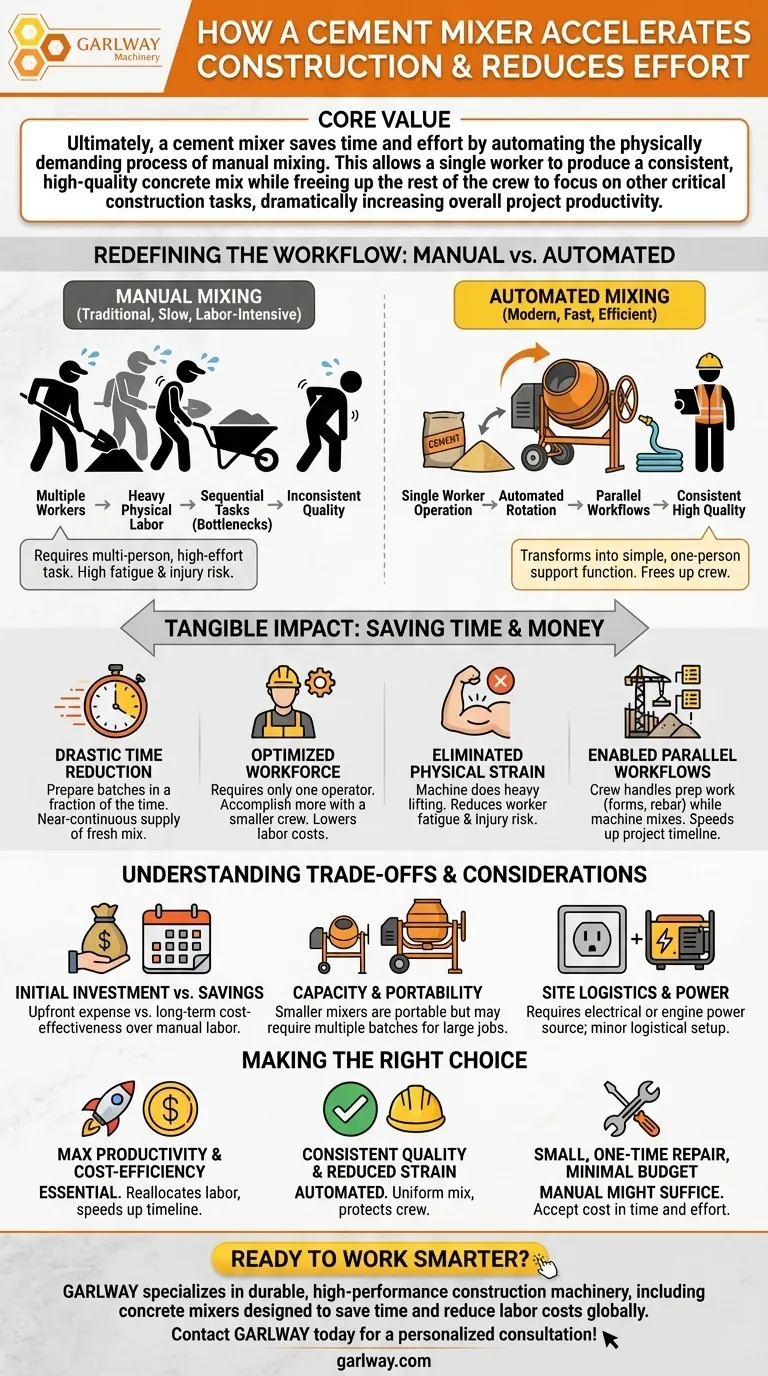
How a Cement Mixer Redefines the Workflow
The introduction of a cement mixer to a job site fundamentally changes how concrete is produced and how labor is managed. It shifts the process from a bottleneck to a streamlined support function.
The Automated Mixing Process
A mixer uses a rotating drum powered by a motor or engine. Workers simply load cement, aggregates like sand or gravel, and water into the drum.
The constant rotation tumbles and folds the materials together, ensuring every particle is coated and hydrated. This mechanical action produces a completely homogenous mixture with a consistent quality that is difficult to achieve by hand.
Liberating Human Effort
Manual mixing is one of the most physically strenuous tasks in construction. It requires constant, heavy labor with shovels in a wheelbarrow or on a mixing board.
A cement mixer completely eliminates this strain. The machine does all the heavy lifting, reducing worker fatigue and the risk of injury.
Enabling Parallel Workflows
While the machine handles the mixing, the crew can proceed with other preparatory tasks. They can be setting up forms, laying rebar, or preparing the site for the pour.
This ability to perform tasks in parallel, rather than sequentially, is a key driver of on-site productivity.
The Tangible Impact on Time and Labor
Automating the mixing process translates directly into measurable savings in both time and money. The efficiency gains are immediate and compound over the course of a project.
Drastic Reduction in Mixing Time
A mixer can prepare a batch of concrete in a fraction of the time it would take to mix the same amount manually. The loading and unloading process is efficient, allowing for a near-continuous supply of fresh mix.
Optimizing Your Workforce
Manual mixing on any significant scale often requires multiple workers dedicated solely to that task. A small cement mixer, however, typically requires only one operator.
This reduction in dedicated labor allows you to accomplish more with a smaller crew, directly lowering labor costs.
Understanding the Trade-offs
While highly efficient, using a cement mixer involves practical considerations that differ from manual methods.
Initial Investment vs. Long-Term Savings
Purchasing a mixer is an upfront capital expense. However, when compared to the recurring high cost of labor for manual mixing or the fees for renting, ownership often becomes the more cost-effective choice for frequent use.
Capacity and Portability
Smaller mixers offer excellent portability and are easy to load and unload. Their primary limitation is the smaller bowl size, which may require mixing multiple batches for larger jobs.
Site Logistics and Power
Unlike a wheelbarrow and shovel, a mixer requires a power source, whether it's an electrical outlet or a gasoline engine. This adds a minor logistical step to ensure the machine can be operated where it's needed on the site.
Making the Right Choice for Your Goal
The decision to use a cement mixer should be aligned with your project's primary objectives.
- If your primary focus is maximum productivity and cost-efficiency: A cement mixer is essential for reallocating labor and speeding up the entire construction timeline.
- If your primary focus is consistent quality and reduced physical strain: The mixer's automated process provides a uniform mix every time while protecting your crew from fatigue and injury.
- If your primary focus is a very small, one-time repair with minimal budget: Manual mixing might suffice, but you must accept the significant cost in time and physical effort.
By automating a core task, a cement mixer empowers your team to work smarter, not just harder.
Summary Table:
| Benefit | Impact |
|---|---|
| Automates Mixing | Eliminates strenuous manual labor, reducing fatigue and injury risk. |
| Saves Time | Produces consistent, high-quality batches in a fraction of the time. |
| Optimizes Labor | Frees up crew for other tasks, allowing a smaller team to achieve more. |
| Increases Productivity | Enables parallel workflows, dramatically speeding up project timelines. |
Ready to work smarter and boost your project's efficiency?
GARLWAY specializes in durable, high-performance construction machinery, including concrete mixers designed to save time and reduce labor costs for construction companies and contractors globally. Let us help you find the perfect mixer to transform your workflow.
Contact GARLWAY today for a personalized consultation and discover the right solution for your job site!
Visual Guide
Related Products
- HZS25 Best Cement Mixer for Quick Mix Concrete at Bunnings
- JDC350 Small Cement Concrete Mortar Mixer
- JW1000 Mobile Cement Mixer Concrete Mixer Truck and Batching Plant
- Concrete Cement Mixer Machine Drum Mixer for Construction
- JZC400 Mobile Small Concrete Mixer Cement Mixer Machine
People Also Ask
- How do cement mixers enhance safety on construction sites? Reduce Strain, Hazards, and Accidents
- What are the main components of a cement mixer? A Guide to Core Parts & Functions
- What are some tips for using a cement mixer effectively? Maximize Your Mixer's Performance & Concrete Quality
- How does cleaning a cement mixer after use benefit its performance? Maximize Lifespan and Mix Quality
- Why is it important to clean the cement mixer after use? Prevent Costly Damage and Ensure Quality Concrete