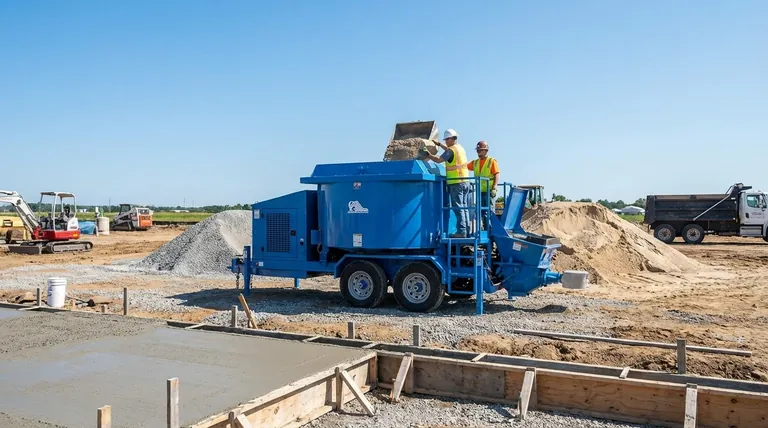
Fundamentally, a concrete mixer saves time and money by automating a labor-intensive process and relocating production to the job site. Instead of relying on manual mixing or coordinating expensive ready-mix deliveries, a mixer allows a small crew to produce large volumes of high-quality concrete precisely when and where it is needed, directly accelerating project timelines and cutting operational costs.
The core value of a concrete mixer is not just its speed, but the operational control it gives a project manager. By bringing production on-site, you eliminate dependency on external suppliers, minimize material waste, and ensure a consistent, reliable product for every single pour.
The Core Financial Benefits of On-Site Mixing
Drastic Reduction in Labor Costs
A concrete mixer is a force multiplier. It allows one or two workers to produce a volume of concrete that would otherwise require a much larger team to mix by hand over a significantly longer period.
This automation directly translates to fewer labor hours spent on mixing and more time dedicated to placement and finishing, reducing overall payroll expenses.
Elimination of Ready-Mix Delivery Costs
For many small to medium-sized projects, the cost and logistical hassle of ordering ready-mix concrete are substantial.
An on-site mixer eliminates delivery fees, "short load" charges for small batches, and the risk of paying for concrete that goes unused due to project delays.
Minimized Material Waste
With on-site mixing, you produce the exact amount of concrete required for the task at hand. This precision prevents the costly problem of over-ordering and having to dispose of leftover ready-mix concrete.
This practice is not only more economical but also more environmentally friendly by reducing material waste.
Boosting Operational Efficiency and Project Timelines
Unmatched Mixing Speed and Volume
The primary time-saving feature is raw output. A mechanical mixer can produce a perfectly consistent batch of concrete in a matter of minutes.
This rapid production allows crews to work continuously, dramatically increasing the pace of foundation, slab, or footing work and potentially boosting overall productivity by up to 40% compared to traditional methods.
On-Demand Concrete Production
Perhaps the most significant efficiency gain is the elimination of waiting. Crews are no longer idle while waiting for a scheduled delivery truck that may be delayed by traffic or plant issues.
With an on-site mixer, fresh concrete is available the moment the forms are ready, turning a common project bottleneck into a smooth, streamlined process.
Guaranteed Mixture Consistency and Quality
Manual mixing is prone to human error, often resulting in batches that are too wet, too dry, or improperly blended. This inconsistency can compromise structural integrity and lead to costly rework.
A concrete mixer ensures that the specified ratios of cement, water, and aggregate are used for every batch, guaranteeing a reliable, high-quality product that meets project standards.
Understanding the Trade-offs
Initial Capital or Rental Cost
The most obvious consideration is the upfront cost of purchasing the machine or the ongoing expense of renting it. This investment must be carefully weighed against the projected savings in labor, materials, and eliminated delivery fees for your specific project volume.
Scale and Application
An on-site mixer is the ideal solution for small to medium-sized jobs, remote locations, or projects requiring multiple, spaced-out pours.
However, for massive-scale pours, such as a large building foundation, the continuous flow from a dedicated ready-mix plant remains more efficient. The key is to match the tool to the scale of the job.
Operational Requirements
A mixer requires a competent operator and routine maintenance, primarily cleaning, to function reliably. While these costs are typically minimal, they are a necessary part of integrating the equipment into your workflow.
Making the Right Choice for Your Project
The decision to use a concrete mixer hinges on your project's specific goals and constraints.
- If your primary focus is cost control on small-to-medium jobs: An on-site mixer is an invaluable asset, as the savings on labor and eliminated delivery fees will quickly justify the machine's cost.
- If your primary focus is timeline certainty and flexibility: The ability to produce concrete on-demand is the single greatest advantage, protecting your schedule from third-party delays and keeping your crew productive.
- If your primary focus is ensuring consistent quality: A mixer provides a level of control and batch-to-batch consistency that is difficult to achieve manually, significantly reducing the risk of defects and rework.
Ultimately, investing in on-site mixing capabilities transforms concrete from a logistical dependency into a controlled, on-demand asset for your project.
Summary Table:
| Benefit | How It Saves Time & Money |
|---|---|
| Reduced Labor Costs | Automates mixing, allowing a small crew to do the work of a larger team. |
| No Delivery Fees | Eliminates costly ready-mix concrete delivery charges and short-load fees. |
| On-Demand Production | Prevents crew idle time by providing concrete exactly when needed. |
| Minimized Waste | Produces exact batch sizes, avoiding the cost of unused ready-mix concrete. |
Ready to take control of your concrete costs and project schedule?
GARLWAY specializes in providing durable and efficient construction machinery, including concrete mixers and batching plants, for contractors and construction companies globally. Our equipment is designed to deliver the on-site mixing advantages detailed above, helping you save money and complete projects faster.
Contact our experts today to find the perfect concrete mixing solution for your next project!
Visual Guide

Related Products
- Portable Concrete Mixer Machine Equipment for Mixing Concrete
- Construction Products Concrete Plant Machine Mixing Concrete Mixer
- Portable Electric Concrete Mixer Machine for Cement Mixing
- Concrete Cement Mixer Machine Drum Mixer for Construction
- HZS90 Large Multiquip Concrete Mixers for Construction
People Also Ask
- Why is it necessary to use a portable concrete mixer? Gain Total Control & Efficiency
- How much concrete can you pour with a portable mixer? Find the Perfect Fit for Your Project
- What types of projects are portable concrete mixers suitable for? Ideal for DIY & Small-Scale Construction
- How much does a portable concrete mixer hold? A Guide to Choosing the Right Capacity
- What types of portable concrete mixers exist? Find the Perfect Mixer for Your Project