
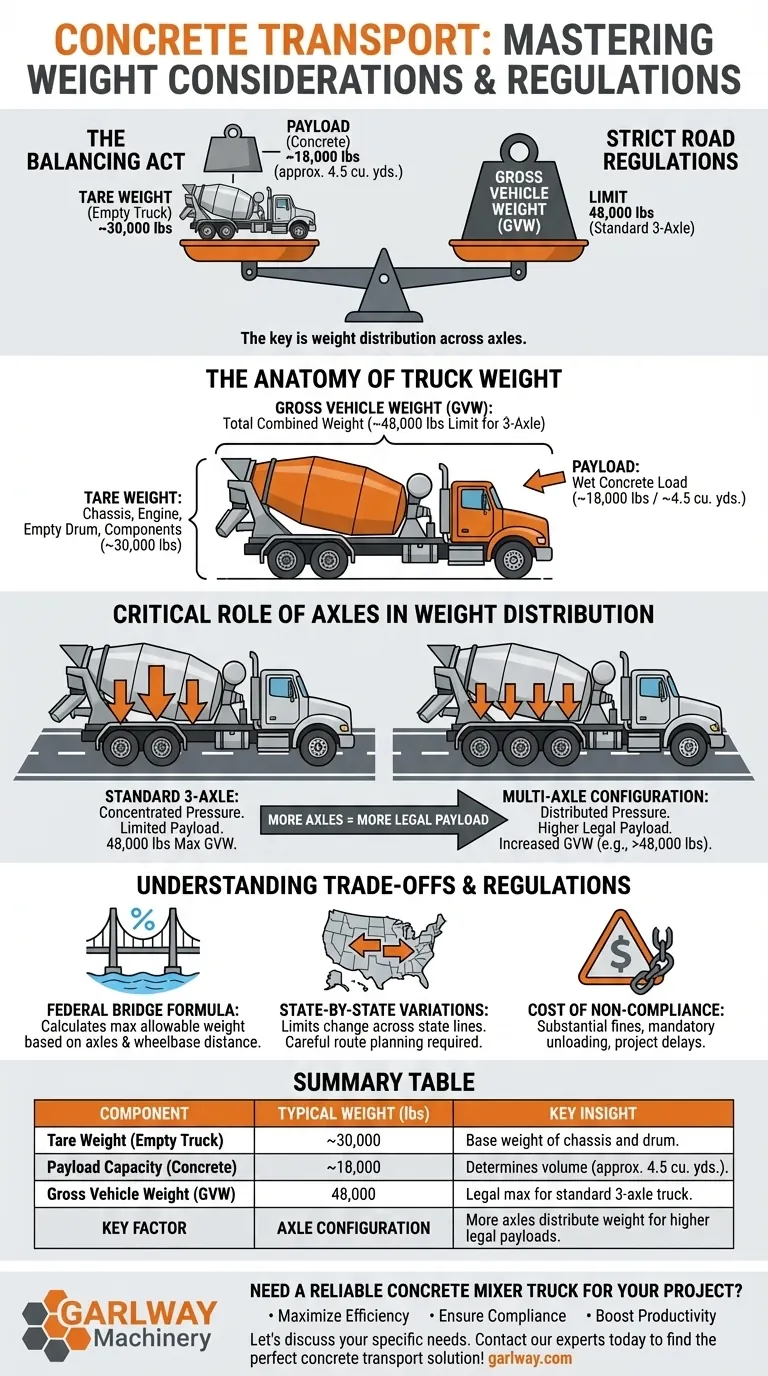
At its core, the weight of a concrete transport truck is a balancing act between maximizing payload and complying with strict road regulations. For a standard three-axle truck in the U.S., the total weight is typically capped at 48,000 pounds. With the truck itself weighing around 30,000 pounds, this leaves a functional payload of about 18,000 pounds for the concrete.
The key to understanding concrete truck weight isn't just the total limit, but how that weight is distributed across its axles. Adding more axles is the primary strategy for legally increasing payload capacity and meeting federal and state bridge laws designed to protect infrastructure.
The Anatomy of Truck Weight: Tare, Payload, and Gross
To manage concrete logistics effectively, you must first understand the three core components of its weight. These figures dictate everything from legal compliance to project efficiency.
Defining Tare Weight
Tare weight is the empty weight of the truck. This includes the chassis, engine, mixing drum, and all other components before any concrete is loaded. For a typical three-axle mixer, this is around 30,000 pounds.
Understanding Payload Capacity
Payload is the actual weight of the product being transported—in this case, wet concrete. Given the tare weight and total limit, a three-axle truck has a payload capacity of approximately 18,000 pounds.
Since concrete weighs about 4,000 pounds per cubic yard, this translates to a load of roughly 4.5 cubic yards.
The Gross Vehicle Weight (GVW) Limit
The Gross Vehicle Weight (GVW) is the total combined weight of the truck and its payload. This is the number that matters most for regulation. For a three-axle truck, the GVW limit is 48,000 pounds.
The Critical Role of Axles in Weight Distribution
The total GVW limit is only part of the story. The true constraint is how that weight is spread across the truck's axles to prevent damage to roads and bridges.
Why Axles are the Key
Road regulations are designed to limit the pounds-per-square-inch pressure exerted on pavement and bridge structures. The law doesn't just limit total weight; it heavily restricts the weight allowed per axle.
The Standard Three-Axle Configuration
The 48,000-pound limit is specific to the common three-axle design. This configuration is a baseline standard but offers limited payload, making it suitable for smaller jobs.
Increasing Capacity with More Axles
To legally carry more concrete, manufacturers add more axles. You will often see trucks with four, five, or even six axles. These additional axles, sometimes called "lift axles" or "pusher axles," help distribute the load over a larger area, allowing for a higher GVW while keeping the per-axle weight within legal limits.
Understanding the Trade-offs and Regulations
Navigating weight laws is complex because they are not uniform. What is legal in one state may be prohibited in another, creating significant logistical challenges.
The Federal Bridge Formula
The underlying principle for these regulations is the Federal Bridge Gross Weight Formula. This formula calculates the maximum allowable weight based on the number of axles and the distance (wheelbase) between them. A longer truck with more axles can legally carry a much heavier load.
State-by-State Variations
While the federal formula provides a guideline, states have the authority to set their own specific limits. This means a truck's maximum legal payload can change simply by crossing a state line, requiring careful route planning for any long-distance transport.
The Cost of Non-Compliance
Operating an overweight truck is a serious violation. The consequences include substantial fines, mandatory unloading of excess material at the roadside, and significant project delays. Consistent compliance is a non-negotiable aspect of fleet management.
Making the Right Choice for Your Project
Choosing the right approach depends entirely on the scale and logistics of your concrete pour.
- If your primary focus is small-scale residential projects: A standard three-axle truck with a 4-5 cubic yard capacity is often sufficient and cost-effective.
- If your primary focus is large commercial or infrastructure projects: You must plan for multi-axle trucks to maximize payload per trip, reduce the number of vehicles required, and stay compliant with bridge laws.
- If your primary focus is logistical planning: Always verify local and state axle weight regulations for your specific route, as these can override general federal guidelines and impact your delivery schedule.
Ultimately, mastering concrete logistics means understanding that weight compliance is as foundational as the concrete itself.
Summary Table:
| Component | Typical Weight (lbs) | Key Insight |
|---|---|---|
| Tare Weight (Empty Truck) | ~30,000 | The base weight of the chassis and drum before loading. |
| Payload Capacity (Concrete) | ~18,000 | Determines the volume of concrete (approx. 4.5 cubic yards). |
| Gross Vehicle Weight (GVW) Limit | 48,000 | The legal maximum total weight for a standard 3-axle truck. |
| Key Factor | Axle Configuration | More axles distribute weight, allowing for higher legal payloads. |
Need a Reliable Concrete Mixer Truck for Your Project?
Choosing the right equipment is critical for maximizing payload and ensuring on-time, compliant deliveries. GARLWAY specializes in high-performance construction machinery, including durable concrete transport trucks and mixers designed for construction companies and contractors.
We help you:
- Maximize Efficiency: Select the optimal truck and axle configuration for your project scale and local regulations.
- Ensure Compliance: Get equipment built to meet stringent weight and safety standards.
- Boost Productivity: Reduce delays and costs with reliable machinery built for heavy-duty use.
Let's discuss your specific needs. Contact our experts today to find the perfect concrete transport solution!
Visual Guide
Related Products
- Ready Mixer Machine for Construction Ready Mix Machinery
- Mini Cement Mortar Mixer Truck for Construction
- JW1000 Mobile Cement Mixer Concrete Mixer Truck and Batching Plant
- Harbor Freight JS1500 On Site Concrete Mixing Volumetric Cement Mixer
- Belle Cement Mixer JS2000 Volumetric Concrete Mixer for Harbor Freight
People Also Ask
- What are the purposes of low-speed agitation in truck mixers? Preserve Concrete Quality During Transit
- How is ready-mixed concrete transported from a commercial concrete batching plant? Ensuring Quality & Timely Delivery
- What are the main ingredients mixed in a concrete mixer truck? Master the Formula for Strong Concrete
- In what ways does a mobile concrete mixer improve quality control and consistency? Achieve Superior On-Site Concrete Quality
- What types of construction projects typically use concrete mixer trucks? From Highways to Home Foundations


