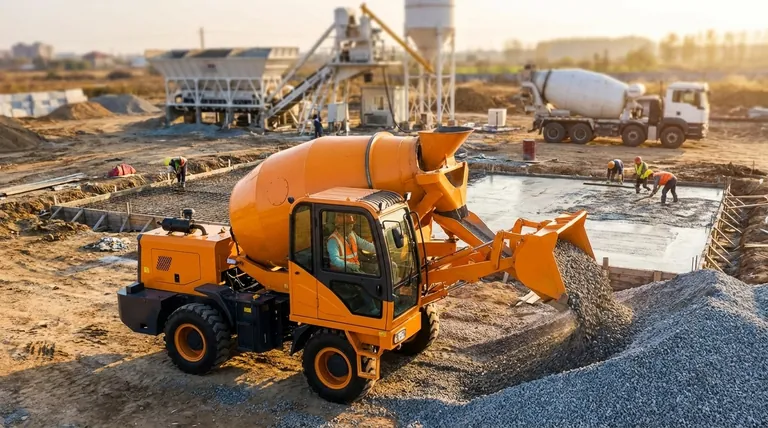
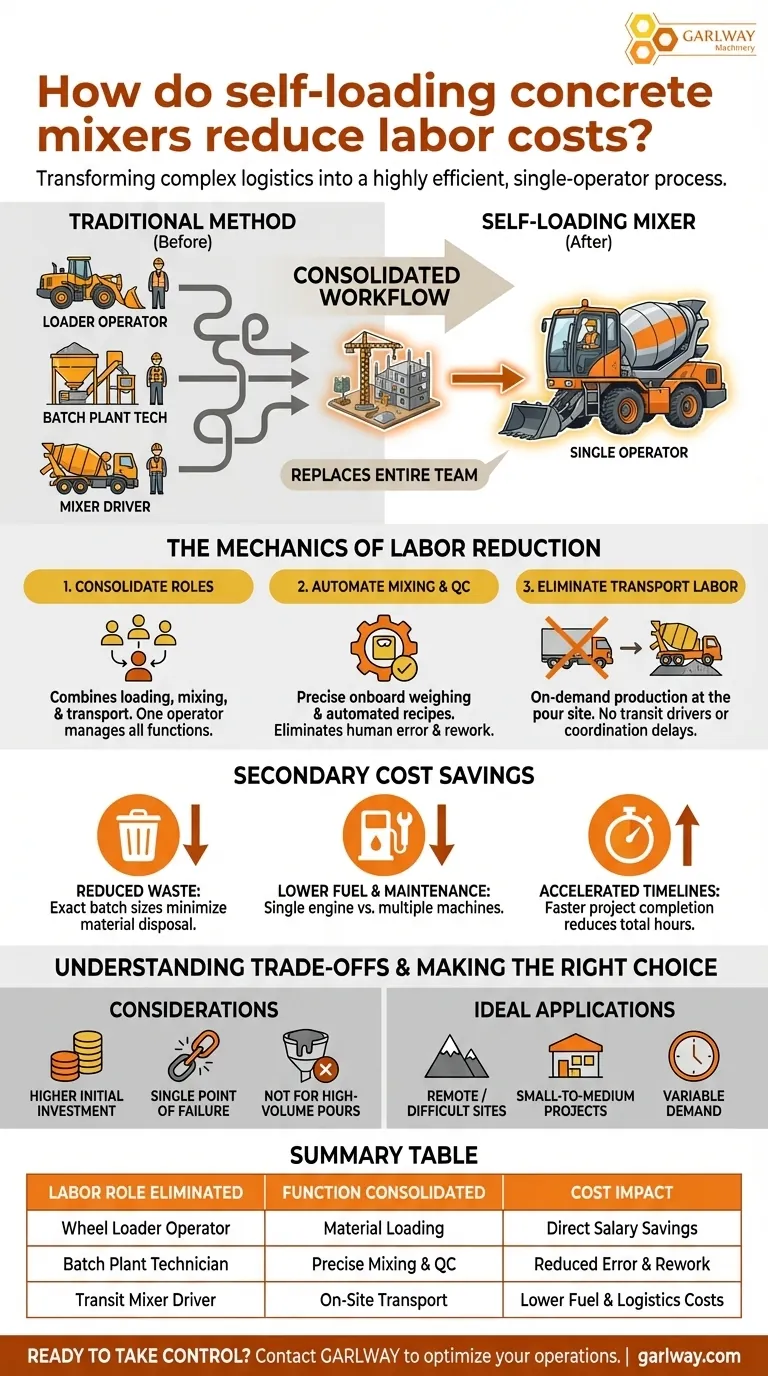
At its core, a self-loading concrete mixer reduces labor costs by consolidating the work of an entire concrete production team into a single machine operated by one person. This single operator manages material loading, precise mixing, and direct transport to the pour site. This integrated process effectively eliminates the need for a dedicated wheel loader operator, a batch plant technician, and a transit mixer driver.
The primary cost saving isn't just about cutting salaries; it's the strategic advantage of transforming a complex, multi-machine logistical chain into a highly efficient, single-operator process that happens directly at the point of construction.
The Mechanics of Labor Reduction: From Team to Operator
A self-loading mixer is an all-in-one mobile batching plant. Its design fundamentally restructures the traditional concrete workflow, which is where the most significant labor savings are realized.
Consolidating Multiple Roles into One
The most direct impact on labor is the reduction in headcount. A conventional concrete operation requires a team: one person to operate a wheel loader to load aggregates, another to manage the batching plant, and a driver for each transit mixer.
A self-loading mixer combines these functions. The same operator who drives the machine to the material pile also operates the articulated bucket to load it, uses the onboard system to mix it, and then drives the completed batch to the formwork.
Automating the Mixing and Quality Control
Modern self-loading mixers feature automated and precise weighing systems. The operator sets the required mix recipe, and the machine automatically adds the correct proportions of aggregate, cement, and water.
This automation removes the need for a skilled batch plant operator whose job is to ensure mix consistency. It reduces the chance of human error, which can lead to costly rework and wasted materials.
Eliminating Transportation and Coordination Labor
With on-site production, you eliminate the entire logistical chain of transporting wet concrete from a central plant. This removes the need for transit truck drivers and the associated dispatch and coordination labor.
There is no more idle time for crews waiting on a late concrete truck stuck in traffic. Concrete is produced on-demand, exactly when and where it is needed.
Beyond Salaries: The Secondary Cost Savings
While direct labor reduction is the most obvious benefit, the operational efficiencies introduced by a self-loading mixer create a cascade of secondary cost savings that impact the entire project budget.
Reduced Material Waste
The ability to produce exact batch sizes on-site dramatically minimizes waste. There is no need to over-order from a central plant to ensure you have enough, which often results in costly disposal of unused concrete.
Lower Fuel and Maintenance Costs
Instead of running a wheel loader, a batching plant, and multiple transit trucks, you are fueling and maintaining a single engine. Optimized hydraulics and engine management in modern units further reduce fuel consumption per cubic meter of concrete produced.
Accelerated Project Timelines
On-demand concrete production eliminates delays, allowing crews to work more efficiently. Faster project completion reduces total labor hours, equipment rental days, and site overhead costs, leading to significant savings over the life of the project.
Understanding the Trade-offs
No solution is perfect for every scenario. To make an informed decision, it's critical to understand the limitations of this technology.
Higher Initial Investment
The upfront capital cost of a self-loading concrete mixer is significant compared to individual pieces of traditional equipment. The return on investment is calculated through long-term operational savings.
A Single Point of Failure
Because one machine handles the entire process, any mechanical failure can bring all concrete production to a halt. This contrasts with a traditional setup where a backup truck or loader might be available.
Not Ideal for High-Volume Pours
These mixers are engineered for flexibility and on-site control, not sheer volume. For massive, continuous pours like high-rise foundations or highway paving, a dedicated large-scale batch plant and a fleet of transit mixers remain the more effective solution.
Making the Right Choice for Your Operation
The decision to invest in a self-loading mixer depends entirely on the nature of your projects and your core business goals.
- If your primary focus is remote or difficult-to-access sites: The self-loader's mobility and self-sufficiency provide unparalleled value, eliminating complex logistical challenges.
- If your primary focus is small-to-medium construction with variable demand: This machine's ability to produce exact batches on-demand minimizes material waste and optimizes operational costs.
- If your primary focus is large-scale, continuous concrete supply: A traditional batching plant and transit mixer fleet remains the more efficient solution for high-volume requirements.
Ultimately, integrating a self-loading mixer is a strategic decision to take direct control of your concrete supply chain, converting logistical complexity into on-site efficiency.
Summary Table:
| Labor Role Eliminated | Function Consolidated | Cost Impact |
|---|---|---|
| Wheel Loader Operator | Material Loading | Direct Salary Savings |
| Batch Plant Technician | Precise Mixing & Quality Control | Reduced Error & Rework |
| Transit Mixer Driver | On-Site Transport | Lower Fuel & Logistics Costs |
Ready to reduce your labor costs and take control of your concrete supply chain? GARLWAY specializes in construction machinery, offering robust self-loading concrete mixers designed for construction companies and contractors globally. Our machines help you eliminate multi-crew dependencies, cut material waste, and accelerate project timelines—all operated by a single person. Contact GARLWAY today to discuss how our solutions can optimize your operations and boost your profitability!
Visual Guide
Related Products
- Skid Steer Self Loading Concrete Mixers for Construction
- Belle Mixer Drum Self Loading Mortar Mixers JS3000
- Portable Cement Mixer with Lift Concrete Machine
- Portable Concrete Mixer Machine Equipment for Mixing Concrete
- Portable Ready Mix Concrete Mixer Equipment
People Also Ask
- How does the control system improve production efficiency in a self loading concrete mixer? Automate Mixing for Speed & Quality
- What is the purpose of keeping the drum rotating during transportation in a self loading concrete mixer? Ensure Quality & Consistency
- How does the weighing process work in a self loading concrete mixer? Achieve Precise, On-Site Concrete Batching
- What components are involved in the loading process of a self loading concrete mixer? A Guide to the Key Systems
- How should materials be loaded into a self-loading concrete mixer? Master the Step-by-Step Process