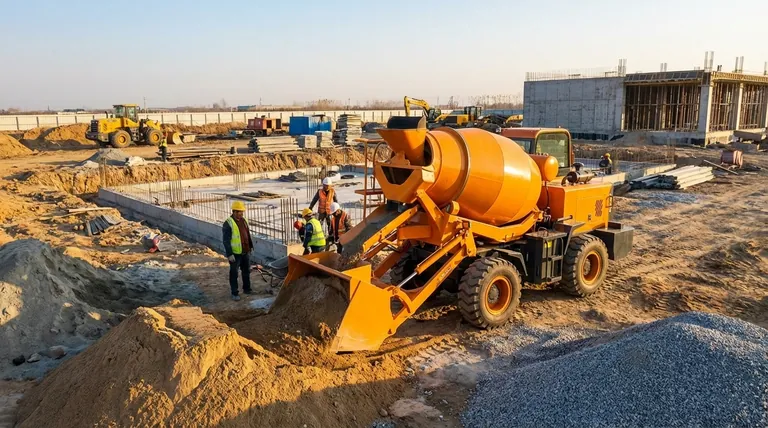
At its core, a self-loading concrete mixer improves construction efficiency by consolidating the entire concrete production workflow into a single, mobile machine. It handles the loading of raw materials, precise mixing, transportation across the site, and direct placement, eliminating the need for separate loaders, batching plants, and transit trucks. This integration fundamentally streamlines operations and removes critical points of delay.
The true efficiency of a self-loading mixer is not just in its mechanical function, but in its ability to transform concrete supply from a complex logistical dependency into a predictable, on-demand resource controlled directly at the job site.
The Core Principle: Consolidating the Production Chain
The most significant efficiency gain comes from integrating what are traditionally separate, resource-intensive processes. This creates a self-sufficient system that decouples your project from external schedules and constraints.
From Multiple Machines to One
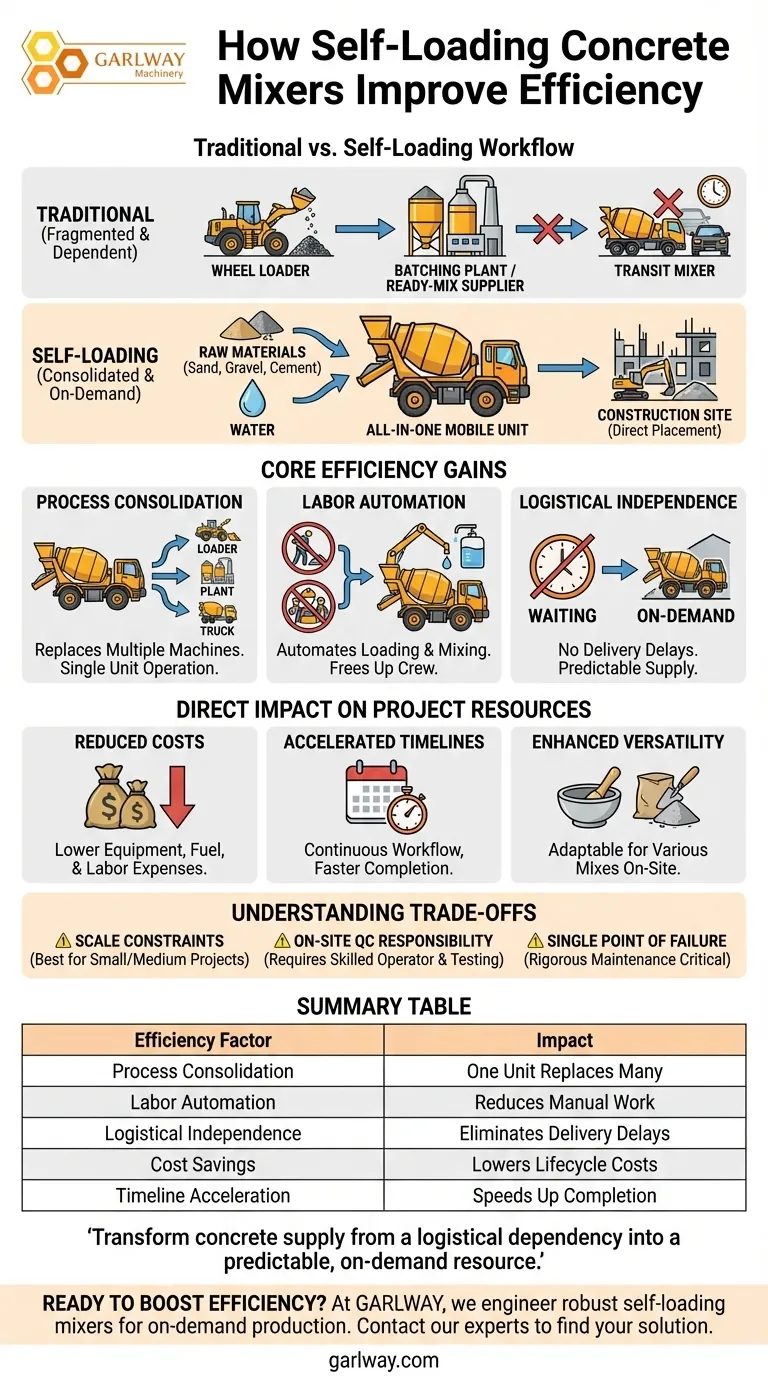
A conventional concrete operation often requires a wheel loader to handle aggregates, a stationary batching plant or a delivery from a ready-mix supplier, and a transit mixer or dumper for transport. A self-loading mixer replaces all of these. This immediately reduces the number of machines you need to purchase, rent, fuel, and maintain.
Automating Labor-Intensive Steps
The "self-loading" feature automates the most physically demanding part of the process—getting sand, gravel, and cement into the drum. Combined with automated water dispensing and controlled discharge, it drastically reduces the manual labor required for concrete production, freeing up crew members for other critical tasks.
Eliminating Logistical Delays
One of the most common sources of project downtime is waiting for a ready-mix concrete delivery. Traffic, plant scheduling, and communication issues can cause significant delays. A self-loading mixer provides concrete exactly when and where you need it, ensuring a continuous workflow and eliminating costly standby time for your crew and equipment.
Direct Impact on Project Resources
By simplifying the concrete production process, these machines have a direct and measurable impact on your project's budget, timeline, and material management.
Reduced Labor and Equipment Costs
Consolidating functions into a single unit directly lowers overhead. You have fewer operators to pay, less fuel to purchase, and lower maintenance costs associated with a smaller fleet. This leads to substantial and predictable cost savings over the project lifecycle.
Accelerated Project Timelines
The ability to produce and place concrete on demand allows for faster completion of each phase of work. By removing the dependency on external suppliers, you can maintain project momentum and compress timelines without compromising the quality of the work.
Enhanced Material Versatility
Modern self-loading mixers are not limited to a single type of concrete mix. They can be used to prepare mortar, plaster, and other materials on-site, making them highly adaptable tools for different project stages and reducing the need for additional specialized mixing equipment.
Understanding the Trade-offs
While highly efficient, self-loading mixers are not the universal solution for every scenario. Understanding their limitations is key to making an informed decision.
Scale and Volume Constraints
For massive, continuous pours like large building foundations or highway paving, the sheer output volume of a dedicated batching plant and a fleet of transit mixers is often superior. Self-loading mixers excel in small to medium-volume projects, remote locations, or jobs requiring frequent relocation.
On-Site Quality Control Responsibility
Using a self-loading mixer shifts the full responsibility for mix design and quality control from the ready-mix supplier to your on-site team. While modern machines have features like precise water tanks to aid consistency, it requires skilled operators who understand the materials and ratios to ensure high-quality results.
A Single Point of Failure
The all-in-one nature of the machine is its greatest strength but also a potential weakness. If the mixer breaks down, your entire concrete production capacity is halted. This makes rigorous daily maintenance and the availability of a skilled operator absolutely critical to prevent project delays.
Making the Right Choice for Your Project
Choosing the right concrete production method depends entirely on your project's specific goals and constraints.
- If your primary focus is cost savings on small to medium projects: A self-loader is ideal, as it significantly reduces both equipment and labor overhead compared to traditional methods.
- If your primary focus is timeline acceleration and flexibility: The on-demand nature of a self-loader eliminates waiting for deliveries, making it perfect for projects with tight schedules or unpredictable pacing.
- If your primary focus is working in remote or constrained sites: Its mobility and self-sufficiency are unparalleled for locations where setting up a batching plant or getting delivery trucks is difficult or impossible.
- If your primary focus is massive, continuous high-volume pours: A dedicated batching plant with a fleet of ready-mix trucks often remains the more efficient solution for meeting large-scale demand.
Ultimately, a self-loading mixer empowers you to take direct control over your concrete supply chain, turning a major project variable into a predictable asset.
Summary Table:
| Efficiency Factor | Impact of Self-Loading Mixer |
|---|---|
| Process Consolidation | Replaces multiple machines (loader, batch plant, transit mixer) with one unit. |
| Labor Automation | Automates material loading and mixing, reducing manual work and crew size. |
| Logistical Independence | Eliminates delays from ready-mix truck schedules, enabling on-site, on-demand production. |
| Cost Savings | Lowers equipment rental, fuel, and labor costs over the project lifecycle. |
| Timeline Acceleration | Provides continuous workflow by removing dependencies, speeding up project completion. |
Ready to take control of your concrete supply and boost your project's efficiency?
At GARLWAY, we specialize in providing robust and reliable construction machinery for contractors and construction companies worldwide. Our range of self-loading concrete mixers is engineered to deliver the on-demand production and operational flexibility detailed in this article, helping you save on costs, accelerate timelines, and work efficiently in remote or constrained sites.
Let us help you find the perfect solution for your specific project needs. Contact our experts today to discuss how a GARLWAY self-loading mixer can transform your concrete operations.
Visual Guide
Related Products
- Skid Steer Self Loading Concrete Mixers for Construction
- Belle Mixer Drum Self Loading Mortar Mixers JS3000
- Portable Cement Mixer with Lift Concrete Machine
- Portable Concrete Mixer Machine Equipment for Mixing Concrete
- JW1000 Mobile Cement Mixer Concrete Mixer Truck and Batching Plant
People Also Ask
- How does the control system improve production efficiency in a self loading concrete mixer? Automate Mixing for Speed & Quality
- What is the purpose of keeping the drum rotating during transportation in a self loading concrete mixer? Ensure Quality & Consistency
- How does the weighing process work in a self loading concrete mixer? Achieve Precise, On-Site Concrete Batching
- What components are involved in the loading process of a self loading concrete mixer? A Guide to the Key Systems
- How should materials be loaded into a self-loading concrete mixer? Master the Step-by-Step Process