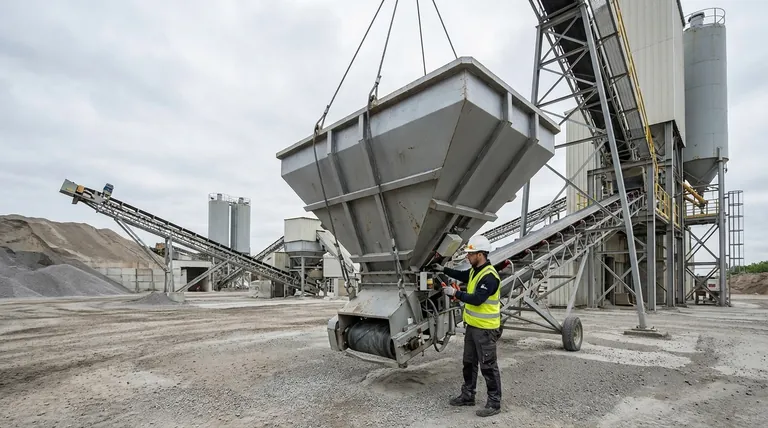
To resolve a deviating or stuck aggregate hopper, you must systematically correct its alignment by adjusting three key components: the lifting wire ropes, the lower limit position sensor, and the anti-deviation device. These adjustments ensure the hopper travels smoothly and evenly along its designated path without tilting or binding.
The core issue is almost always mechanical misalignment. The solution is not a single fix, but a process of re-calibrating the hopper's lifting and guidance systems to restore balanced, symmetrical operation.
Diagnosing the Root Cause of Hopper Deviation
A hopper that deviates or jams is a symptom of an underlying imbalance in its lifting or guidance mechanism. Each component plays a specific role in keeping the hopper on track.
The Role of Wire Rope Length
The lifting wire ropes are responsible for pulling the hopper vertically.
If the ropes are of unequal length, even by a small amount, one side of the hopper will be lifted or lowered before the other.
This creates a tilting force, causing the hopper's guide wheels or frame to press against the track, leading to friction, scraping, and eventually, jamming.
The resolution is to ensure all lifting ropes are adjusted to be perfectly consistent in length and tension, so the hopper remains level throughout its travel.
The Impact of the Lower Limit Position
The lower limit switch or sensor tells the hoist motor when the hopper has reached the bottom.
If this switch's sensitivity is incorrect or its position is misaligned, it can cause operational errors.
An insensitive switch might allow the hopper to hit the bottom too hard, while an overly sensitive one might stop it short. Both scenarios can lead to misalignment on the subsequent lift cycle, contributing to deviation.
Adjusting the limit position ensures the hopper stops precisely where it should, setting it up for a clean, straight lift every time.
The Function of the Anti-Deviation Device
This mechanism, often a set of guide rollers or wheels, physically keeps the hopper centered within its track.
If the anti-deviation device is loose, worn, or misaligned, it cannot effectively prevent the side-to-side or twisting movements that lead to deviation.
In some cases, a poorly adjusted guide can itself become the obstruction that causes the hopper to get stuck.
Proper adjustment involves inspecting these guides for wear and ensuring they are correctly positioned to maintain consistent clearance with the track.
Common Pitfalls During Adjustment
While the adjustments are straightforward, incorrect application can lead to other problems. It is crucial to approach this as a careful calibration, not just a quick fix.
Over-Tensioning Ropes
When equalizing the wire ropes, avoid the mistake of over-tightening them.
Excessive tension puts unnecessary strain on the hoist motor, gearbox, and bearings, leading to premature wear and potential failure. The goal is equal tension, not maximum tension.
Ignoring Component Wear
These adjustments may solve the immediate problem, but they can also mask a deeper issue.
Always inspect the components you are adjusting. A frayed wire rope, a worn-out guide roller, or a faulty limit switch needs to be replaced, not just adjusted.
Neglecting Safety Protocols
Adjusting mechanical and electrical systems carries inherent risks.
Always follow proper lockout/tagout procedures to ensure the machine is de-energized before working on electrical components like limit switches. Ensure the hopper is securely blocked or supported before working underneath it.
How to Apply This to Your Situation
Your troubleshooting sequence should be dictated by the specific symptoms you observe.
- If the hopper visibly tilts during ascent or descent: Your first action should be to inspect and adjust the lifting wire ropes for equal length and tension.
- If the hopper consistently jams at the very bottom or top of its travel: The sensitivity and physical position of the lower or upper limit switches are the most likely cause.
- If you hear scraping sounds or see side-to-side movement: The anti-deviation device is not performing its function and requires immediate inspection and realignment.
By systematically addressing these mechanical alignments, you can restore safe and efficient hopper operation.
Summary Table:
| Component | Role in Deviation | Key Adjustment |
|---|---|---|
| Lifting Wire Ropes | Unequal length causes tilting and jamming. | Ensure equal length and tension for a level lift. |
| Lower Limit Sensor | Incorrect position leads to misalignment on lift cycles. | Adjust sensitivity for precise stopping. |
| Anti-Deviation Device | Worn or loose guides fail to center the hopper. | Inspect and realign guides for consistent clearance. |
Is your concrete batching plant's aggregate hopper causing costly downtime? GARLWAY specializes in providing robust construction machinery solutions, including reliable batching plants designed for minimal maintenance. Our expert team can help you optimize your equipment's performance and avoid common issues like hopper jamming. Contact our specialists today to ensure your project runs smoothly and efficiently!
Visual Guide

Related Products
- HZS120 Ready Mix Concrete Batching Plant Commercial Mud Cement Mixer
- HZS35 Small Cement Concrete Mixing Batch Plant
- HZS75 Concrete Batching Plant Cement Mixer Price Concrete Mixer Bunnings Mixing Plant
- HZS180 Ready Mix Concrete Plant for Foundations with Sand and Cement
- Commercial Electric Concrete Mixer Machine HZS 50 Small Batch Plant for Sale
People Also Ask
- What is a ready mix concrete batching plant? The Engine of Modern Construction
- What is the name of the machine used in ready mix? Unpacking the Complete Concrete System
- What is the core component of a concrete batching plant? The Mixer Unit Defines Your Concrete Quality
- What are the types of concrete mixers used in batching plants? Choose the Right Mixer for Your Project
- What are the advantages and disadvantages of concrete batching plants? Maximize Quality & Efficiency